A loan payment receipt confirms a payment toward a loan — personal, auto, student, or business — and it carries a detail most receipts don’t: how the payment splits between interest and principal. That split is the heart of how a loan works, and it’s why keeping these receipts matters for tracking your balance, disputing a misapplied payment, and proving a payoff. This page explains what a loan payment receipt shows and why each part matters.
Loan Payment Receipt
Add custom logo
Edit line items
Choose payment method
Add/remove elements
Customize business information
Choose font
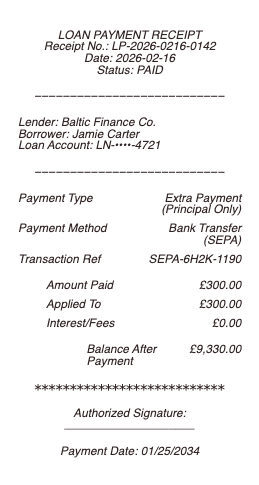
What’s on a Loan Payment Receipt
The lender and loan/account number, and the borrower
The payment amount and date, with a confirmation number
The principal portion — how much reduced the balance
The interest portion — the cost of borrowing for the period
Any fees — a late fee, if applicable
The remaining balance after the payment
The next due date, and whether autopay is set
Principal vs Interest — How a Payment Splits
The key thing a loan payment receipt reveals is that your payment splits into principal and interest. On an amortizing loan (most installment loans), each fixed monthly payment covers the interest accrued for the period first, and the remainder reduces the principal — the balance you owe. Early in the loan’s life, a larger share goes to interest and less to principal; as the balance falls over time, that flips, and more of each payment chips away at principal. This is why two identical payments a few years apart reduce your balance by very different amounts. The receipt showing the split lets you see exactly how much of what you paid actually lowered your debt versus covered interest. Understanding it also explains why paying extra early in a loan is so powerful — as the next section covers, extra money applied to principal saves interest across the whole remaining term.
Extra Payments, Amortization, and Payoff
Because of how the split works, extra payments applied to principal are valuable: reducing the principal ahead of schedule lowers the base that future interest is calculated on, saving interest and shortening the term — but only if the lender applies the extra to principal rather than to future interest or the next payment, which is why the receipt confirming an extra-principal payment matters. The amortization schedule is the full map of every payment’s split over the loan’s life, and your receipts are the record of actually following (or beating) it. At the end comes the payoff: the final amount can include interest accrued to the exact payoff date (a per-diem amount), so a payoff quote differs from the plain balance. Keeping the payoff confirmation is essential — for a secured loan (auto, for instance), it’s what triggers the lien release and clear title, and it’s your proof the debt is fully settled.
Disputes, Credit, and Keeping Records
Loan payment receipts protect you in several ways. Misapplied payments happen — a payment posted late, applied to the wrong loan, or an extra-principal payment mishandled — and the dated receipt with its confirmation number is your evidence to correct the lender’s records. For credit, your payment history is a major factor in credit scores, so proof of on-time payments matters if a lender ever misreports one. For records and taxes, certain loan interest is deductible (student loan interest, mortgage interest, business loan interest), and the receipts or year-end statements substantiate it. Lenders keep payment history in your online account, so copies are downloadable, but keeping your own record of key payments — especially extra-principal payments and the final payoff — guards against errors that can be hard to unwind later. The receipt is the atomic proof behind your loan’s history.
Related rent and housing receipts: see also our Mortgage Payment receipt guide and our Storage Unit receipt guide.
Create a Loan Payment Receipt
Our generator produces a clean loan payment receipt — lender and loan number, payment amount and date, principal and interest split, and remaining balance — as a PDF when you need a legible copy for your records, a payoff file, or a payment dispute.
Use it responsibly: recreate only real payments you actually made, with their true amounts and dates. Fabricating a loan payment receipt to fake a payment, misrepresent a balance or payoff, or mislead a lender or credit report is fraud — the lender’s own payment records are authoritative and verifiable. This tool is for legitimate record-keeping only.
Frequently asked questions
Everything you need to know about the product and billing.
What does a loan payment receipt show?
The lender and loan/account number, the borrower, the payment amount and date with a confirmation number, the principal portion (how much reduced the balance), the interest portion, any late fee, the remaining balance after the payment, and the next due date.
How does a loan payment split between principal and interest?
On an amortizing loan, each payment covers the period’s accrued interest first, and the rest reduces principal. Early in the loan more goes to interest; as the balance falls, more goes to principal. The receipt’s split shows how much of your payment actually lowered the debt.
Why should I pay extra toward principal?
Extra money applied to principal lowers the base that future interest is calculated on, saving interest and shortening the term — but only if the lender applies it to principal rather than future payments. The receipt confirming an extra-principal payment is what proves it was applied correctly.
What is a loan payoff amount?
The total to fully settle the loan, which can include interest accrued to the exact payoff date (a per-diem amount), so it differs from the plain balance. Keep the payoff confirmation — for a secured loan it triggers the lien release and clear title, and it proves the debt is settled.
What if a loan payment is applied incorrectly?
Misapplied payments — posted late, to the wrong loan, or an extra-principal payment mishandled — do happen. The dated receipt with its confirmation number is your evidence to correct the lender’s records, and it protects your payment history, which is a major factor in your credit.
Is loan interest tax-deductible?
Certain loan interest is — student loan interest, mortgage interest, and business loan interest, under their rules. The loan payment receipts or year-end statements, which show the interest portion, are the substantiation. Personal loan interest generally isn’t deductible.