A storage unit receipt records a monthly self-storage payment — and it earns its keep in two ways most renters do not think about until they need it: as a business or moving tax deduction, and as evidence the account is current when a missed payment can put the unit’s contents up for lien auction. This page covers what the receipt shows, why the payment trail matters legally, and how to get copies.
Storage Unit Receipt
Add custom logo
Edit line items
Choose payment method
Add/remove elements
Customize business information
Choose font
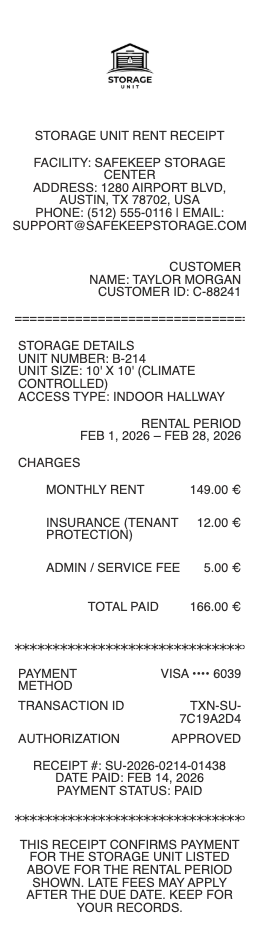
What’s on a Storage Unit Receipt
The facility name and address
Unit number and size — 5×5, 10×10, 10×20, climate-controlled or standard
Tenant name and account number
Billing period the payment covers
Monthly rent, plus any insurance/protection plan, late fee, or admin charge
Amount paid, date, and method — often autopay
Balance after payment
Why the Payment Trail Matters: Storage Liens
Self-storage runs on a legal mechanism most renters never read about: the facility lien. Miss enough monthly payments and, under your state’s self-storage act, the facility can eventually auction the unit’s contents to recover the debt. That is precisely why the receipt trail is worth keeping — a clean record of on-time payments is your evidence the account was current if a billing dispute, an erroneous late fee, or a wrongful-auction question ever arises. Renters who autopay should still confirm each month posted; the receipt or paid statement is the proof, and “I paid it” without documentation is a weak position against a lien notice.
Receipts also document rate increases over time: month-to-month storage rents commonly rise, and a dated payment history is what lets a tenant confirm a new charge matches the notice they were given rather than an unannounced jump.
Storage Receipts as a Tax Deduction
Storage is deductible more often than renters realize, and the receipt is the substantiation. A business storing inventory, equipment, or records deducts the unit as an ordinary business expense. Storage tied to a qualifying job-related move can factor into moving costs where those rules apply. Even estate and household transitions sometimes make storage a documentable cost. In every case the itemized receipt — facility, unit, period, amount — is what a return or an accountant needs, which is why a year of receipts (or the facility’s annual payment history) beats a pile of card-statement lines that only show a company name.
Getting Copies and the Move-Out Receipt
Most storage operators run an online account portal where monthly invoices and payment history download on demand — the fastest fix for a lost receipt. National operators tie everything to your account login; independent facilities can usually reprint from the office. Two moments deserve their own document: the move-out, where a final receipt or zero-balance statement proves you vacated and owe nothing (important, because storage billing does not always stop automatically), and any prepay, where a receipt for several months paid up front protects you if the facility’s records later disagree. For cash payments at the counter, the printed slip is the only record — keep it.
Related rent and housing receipts: see also our Loan Payment receipt guide and our Landlord Rent receipt guide.
Create a Storage Unit Receipt
Our generator rebuilds a self-storage receipt — facility and unit block, tenant and account, billing period, rent with any add-on lines, and the payment record — as a clean PDF for a tax file or your own records.
Use it responsibly: recreate only payments that genuinely happened, with real amounts. For anything the facility must honor — a lien dispute, a billing correction — the authoritative record is their invoice or account statement, reissued from your portal or office. Recreate receipts only to make real payments legible for your files.
Frequently asked questions
Everything you need to know about the product and billing.
What should a storage unit receipt include?
The facility name and address, the unit number and size, the tenant and account, the billing period, the monthly rent with any insurance or late fees, and the amount paid with date and method.
Why keep storage payment receipts?
Two reasons: they substantiate a tax deduction when the storage is deductible, and they prove the account was current — important because missed payments can lead to a lien auction of the unit’s contents.
Is a storage unit tax-deductible?
Often, with documentation. Businesses deduct storage of inventory, equipment, or records as an expense; some qualifying moves and transitions also make it deductible. The itemized receipt is the substantiation your return needs.
How do I get a copy of a storage receipt?
Most facilities offer an online account portal where invoices and payment history download on demand. National operators tie it to your login; independent facilities can reprint from the office.
What is a storage lien?
Under state self-storage law, a facility can auction a unit’s contents to recover unpaid rent after a series of missed payments and required notices. A clean receipt trail is your evidence the account was current in any dispute.
Do I need a receipt when I move out of storage?
Yes — get a final receipt or zero-balance statement confirming you vacated and owe nothing. Storage billing does not always stop automatically, so the move-out document protects you from continued charges.