A mortgage payment receipt confirms a payment on a home loan — and a mortgage payment is unlike any other loan payment because it usually bundles four things into one: principal, interest, and, held in escrow, your property taxes and homeowners insurance. That bundle, called PITI, is why your payment can change even on a fixed-rate loan. This page explains what a mortgage payment receipt shows, how escrow works, and why the breakdown matters.
Mortgage Payment Receipt
Add custom logo
Edit line items
Choose payment method
Add/remove elements
Customize business information
Choose font
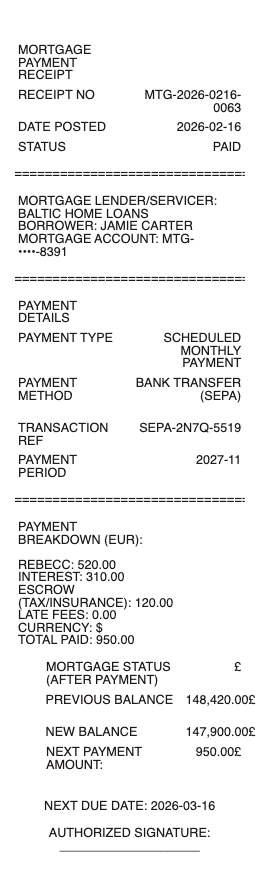
What’s on a Mortgage Payment Receipt
The lender/servicer and loan number, and the borrower
The payment amount and date, with a confirmation
The principal and interest split for the period
The escrow portion — toward property taxes and homeowners insurance
Any PMI (private mortgage insurance), if applicable
The remaining principal balance and escrow balance
Any extra payment and how it was applied
PITI and the Escrow Account — What Makes a Mortgage Different
A standard mortgage payment is PITI: Principal, Interest, Taxes, and Insurance. The principal and interest are your actual loan payment; the taxes and insurance are collected into an escrow account the servicer holds. Each month you pay roughly one-twelfth of your annual property tax and homeowners insurance into escrow, and the servicer pays those bills for you when they come due — so you don’t face a huge tax or insurance bill once or twice a year. This is the defining difference from an ordinary loan payment: a car or personal loan is just principal and interest, while a mortgage bundles two big household bills into the monthly amount. The receipt showing the escrow portion separately is how you see that your payment isn’t all going to the loan — a meaningful share is prepaying taxes and insurance the servicer disburses on your behalf.
Escrow Analysis, Shortages, and Why the Payment Changes
Because escrow covers taxes and insurance that change over time, your mortgage payment can change even on a fixed-rate loan. Once a year the servicer runs an escrow analysis: if property taxes or insurance premiums rose, there may be an escrow shortage, and your monthly payment increases to cover it (and often to repay the shortfall); if they fell, you may get a surplus refund and a lower payment. This surprises many homeowners — “my rate is fixed, why did my payment go up?” — and the answer is escrow, visible in the payment breakdown. Separately, if you put down less than 20%, you likely pay PMI (private mortgage insurance), which can eventually be removed as you build equity. Reading the escrow line and watching the annual analysis is how you understand and anticipate payment changes, rather than being caught off guard by them.
Extra Principal, the 1098, and Records
Mortgage receipts do a few more jobs. Extra principal payments are powerful on a long (15- or 30-year) loan, where early payments are mostly interest — paying extra directly to principal shortens the term and saves substantial interest, but only if the servicer applies it to principal (not escrow or the next payment), which is why the receipt confirming an extra-principal payment matters. For taxes, mortgage interest is often deductible, and your servicer issues a year-end Form 1098 reporting the interest (and sometimes property tax) paid — your monthly receipts reconcile to it. For records, keeping payment confirmations helps resolve a misapplied payment, prove your payment history (a major credit factor), and document the escrow disbursements. And the eventual payoff statement, plus the recorded satisfaction of mortgage, is what proves the loan is cleared and the lender’s lien released. Keeping mortgage receipts is genuinely worthwhile given the sums and timeframes involved.
Related rent and housing receipts: see also our Security Deposit receipt guide and our Loan Payment receipt guide.
Create a Mortgage Payment Receipt
Our generator produces a clean mortgage payment receipt — servicer and loan number, payment amount and date, principal/interest/escrow breakdown, and balances — as a PDF when you need a legible copy for your records, a tax file, or a payment dispute.
Use it responsibly: recreate only real payments you actually made, with their true amounts and dates. Fabricating a mortgage payment receipt to fake a payment, misrepresent a balance or escrow, or mislead a lender, insurer, or credit report is fraud — the servicer’s own records and your Form 1098 are authoritative and verifiable. This tool is for legitimate record-keeping only.
Frequently asked questions
Everything you need to know about the product and billing.
What does a mortgage payment receipt show?
The lender/servicer and loan number, the borrower, the payment amount and date with a confirmation, the principal and interest split, the escrow portion toward property taxes and homeowners insurance, any PMI, the remaining principal and escrow balances, and any extra payment and how it was applied.
What is PITI?
The four parts of a typical mortgage payment: Principal, Interest, Taxes, and Insurance. Principal and interest are the loan payment; taxes and insurance are collected into an escrow account the servicer uses to pay your property tax and homeowners insurance bills when they’re due.
What is a mortgage escrow account?
An account your servicer holds where you pay roughly one-twelfth of your annual property tax and homeowners insurance each month, and the servicer pays those bills for you when due — so you avoid large lump-sum tax and insurance bills. The escrow portion is shown separately on the receipt.
Why did my mortgage payment go up if my rate is fixed?
Almost always escrow. Property taxes and insurance premiums change, so the servicer’s annual escrow analysis can find a shortage and raise your monthly payment to cover it — even on a fixed-rate loan. If taxes or insurance fell, you may get a surplus refund and a lower payment.
How do extra principal payments help on a mortgage?
On a 15- or 30-year loan, early payments are mostly interest, so paying extra directly to principal shortens the term and saves substantial interest. It only works if the servicer applies the extra to principal, not escrow or the next payment — so keep the receipt confirming it.
What is the Form 1098 for a mortgage?
A year-end statement your servicer issues reporting the mortgage interest (and sometimes property tax) you paid, which is often tax-deductible. Your monthly payment receipts reconcile to it, so keeping them helps substantiate the deduction and resolve any discrepancy.