A maintenance receipt documents upkeep work on an asset — a property, a building system, a piece of equipment — and it does quieter, longer-term work than most receipts: it feeds a tax distinction that decides how the cost is deducted, keeps warranties valid, and builds the service history that protects an asset’s value. This page explains what a maintenance receipt shows and the three jobs that make it worth filing rather than tossing.
Maintenance Receipt
Add custom logo
Edit line items
Choose payment method
Add/remove elements
Customize business information
Choose font
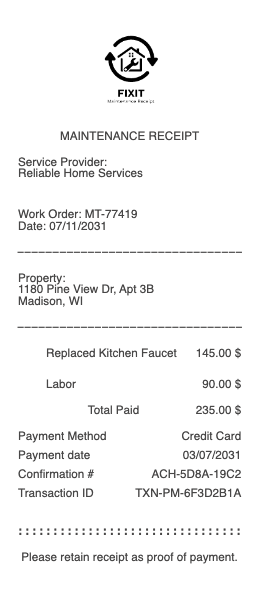
What’s on a Maintenance Receipt
The provider — company or technician — and the date
The asset or property serviced, ideally with address or unit/serial
The work performed, described specifically
Parts and materials, itemized, plus labor
Whether it was scheduled/preventive or a repair call
The total, tax, and payment method
Any next-service recommendation or interval
Repair vs Improvement — the Tax Line the Wording Decides
For rental and business property, maintenance receipts feed one of the most consequential distinctions in tax: repair versus improvement. A repair keeps the asset in its ordinary working condition — fixing a leak, patching a roof section, servicing a furnace — and is generally deductible in the current year. An improvement makes the asset better, adapts it, or restores it beyond its original state — replacing the whole roof, upgrading a system — and must be capitalized and depreciated over years instead. The receipt’s wording matters here: “repaired leaking section of roof” and “replaced roof” describe different tax treatments, so a specific description of the actual work is worth insisting on. Landlords and businesses sort every maintenance receipt into one of these buckets at tax time, and the itemized receipt — what was done, on what, for how much — is the substantiation either way.
Maintenance Records Keep Warranties Alive
The second job is warranty compliance. Many manufacturers condition their warranties on documented regular maintenance — an HVAC system’s annual service, a generator’s scheduled checks, commercial equipment’s service intervals — and when a claim is made, they can ask for the service records. No documentation, weakened claim: the maintenance receipts are the proof the required upkeep actually happened, with dates and provider details. The same logic applies at resale: a property or machine with a documented service history is worth more and sells easier than the identical one without, because the folder of receipts answers the buyer’s biggest question — was this thing looked after? Keeping every maintenance receipt filed by asset, even the small ones, quietly builds that history. It’s the difference between asserting an asset was maintained and being able to show it.
Landlords, Property Files, and Preventive vs Reactive
For landlords and property managers, maintenance receipts are the operating record of each unit: they substantiate deductible operating expenses, they document that reported problems were actually fixed (useful in a security-deposit dispute or a habitability complaint, where proof and dates matter), and they build the per-property cost history that informs rent and budgeting. A useful habit is filing receipts per unit and marking each as preventive (scheduled servicing that prevents failures) or reactive (a repair call after something broke) — the ratio tells you how an asset is really doing. To get a copy of a lost receipt, providers keep job records by address or customer and can reprint. However it’s organized, the principle is the same: maintenance receipts are an asset’s medical file, and the folder is worth more than any single slip in it.
Related home service receipts: see also our Appliance Repair receipt guide and our Electrician receipt guide.
Create a Maintenance Receipt
Our generator produces a clean maintenance receipt — provider, asset or property, the specific work performed, parts and labor, and total — as a PDF for a property file, a warranty record, or a landlord’s expense documentation.
Use it responsibly: recreate only work that was actually performed, with true details and amounts. Fabricating maintenance receipts to invent deductible expenses, fake a warranty-required service history, or manufacture proof of repairs in a deposit or habitability dispute is fraud — providers’ job records, and the physical state of the asset itself, are checkable against any claimed receipt. This tool is for legitimate record-keeping only.
Frequently asked questions
Everything you need to know about the product and billing.
What does a maintenance receipt show?
The provider and date, the asset or property serviced (with address, unit, or serial), a specific description of the work performed, itemized parts and labor, whether it was scheduled/preventive or a repair call, the total and payment method, and any next-service recommendation.
What’s the difference between a repair and an improvement for taxes?
A repair keeps an asset in ordinary working condition — fix a leak, service a furnace — and is generally deductible in the current year. An improvement betters or restores the asset beyond its original state — replace the roof — and must be capitalized and depreciated. The receipt’s wording helps decide which.
Why does the wording on a maintenance receipt matter?
“Repaired leaking section of roof” and “replaced roof” describe different tax treatments — current deduction versus capitalization. A specific description of the actual work is the substantiation a landlord or business needs to classify the cost correctly.
Do maintenance receipts affect my warranty?
Often, yes. Many manufacturers condition warranties on documented regular maintenance — HVAC annual service, generator checks, equipment intervals — and can ask for service records with a claim. The receipts are the proof the required upkeep happened.
Why should landlords keep maintenance receipts per unit?
They substantiate deductible operating expenses, prove reported problems were fixed with dates (useful in deposit or habitability disputes), and build each property’s cost history. Marking receipts preventive or reactive also shows how the asset is really doing.
Does a maintenance history help at resale?
Yes — a property or machine with a documented service history sells easier and for more than an identical one without, because the folder of dated receipts shows the asset was actually looked after rather than just asserted to be.