A marketing services receipt records payment to an agency or freelancer for marketing work — and its single most important feature is a distinction clients constantly miss: the difference between the agency’s fee and the ad spend passed through it. A $5,000 payment might be $1,000 of work and $4,000 of Google and Meta ad budget. This page explains how a marketing receipt should separate those, and what else it captures.
Marketing Services Receipt
Add custom logo
Edit line items
Choose payment method
Add/remove elements
Customize business information
Choose font
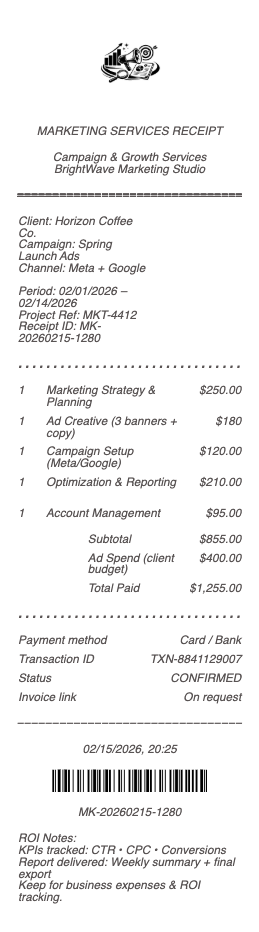
What’s on a Marketing Services Receipt
Agency/provider and client, with the billing period
The management fee — retainer or percentage of ad spend
Ad spend / media budget passed through, listed separately by platform
The services covered — SEO, paid ads, social, content, email
Deliverables or reporting tied to the period
Whether it’s a monthly retainer or a one-off project
Amount paid, tax where applicable, and method
Management Fee vs Ad Spend Pass-Through — the Key Split
This is the distinction that defines a marketing receipt. When an agency runs paid advertising, the money splits in two: the management fee (what the agency charges to do the work — a flat retainer or a percentage of ad spend) and the ad spend itself (the budget that goes to Google, Meta, TikTok, or LinkedIn). A clean receipt lists these separately, because they’re fundamentally different: the fee is the agency’s revenue; the pass-through spend is money the agency forwards to the ad platforms on the client’s behalf. Blurring them into one number causes real confusion — a client can’t tell what they paid for service versus media, and it distorts both sides’ bookkeeping. If ad platforms bill the client directly, the receipt shows only the fee; if the agency fronts the spend, it should appear as a distinct pass-through line. Reading that split is how you know the true cost of the service.
Retainers, Projects, and What the Fee Covers
Marketing work is billed as an ongoing monthly retainer or a one-off project, and the receipt shows which. A retainer covers a defined scope each month — managing campaigns, producing content, reporting — and recurs, so keeping each month’s receipt builds the record of an ongoing engagement. A project (a website launch campaign, a brand push, a one-time audit) is a fixed deliverable billed once, often with a deposit. The receipt should tie the fee to what was delivered in the period — the reports, campaigns, or assets — so the charge is legible rather than a bare “marketing services” line. For results-based arrangements, some agencies add performance bonuses, which appear as their own line. Knowing whether you’re paying a recurring retainer or a project fee tells you what to expect next month, and the deliverable reference proves what the fee bought.
Contractor Payments, 1099s, and Records
Marketing is often freelance or agency income with no tax withheld, so these receipts matter on both sides of the tax ledger. For the provider, issued receipts total reportable income, and a client who pays a US contractor $600 or more in a year files a 1099-NEC — so the provider reconciles issued receipts against 1099s received. For the client, marketing fees are a deductible business expense, and separating the management fee from pass-through ad spend keeps that deduction clean (the ad spend is also deductible, but tracking it apart matters for measuring cost-per-result). Agencies that subcontract — a freelance designer, a copywriter — issue their own receipts down the chain. Keeping period-by-period receipts paired with the scope agreement documents what was paid, for what work, over what term — the record an accountant or the IRS expects if the spend is ever questioned.
Related creative service receipts: see also our Web Design receipt guide and our Software Services receipt guide.
Create a Marketing Services Receipt
Our generator produces a clean marketing services receipt — agency and client, the management fee, any pass-through ad spend by platform, the services and period, and the total — as a PDF you can send a client or keep for your income records and bookkeeping.
Use it responsibly: recreate only real work and payments, with their true amounts. Fabricating marketing receipts to misstate income, inflate a business deduction, or invent ad spend that didn’t occur is fraud — the figures should match your return, the ad platforms’ billing, and what clients report on 1099-NECs, which the IRS cross-checks. This tool is for legitimate record-keeping only.
Frequently asked questions
Everything you need to know about the product and billing.
What does a marketing services receipt show?
The agency or provider and client with the billing period, the management fee (retainer or percentage of ad spend), any ad spend passed through by platform, the services covered (SEO, paid ads, social, content), deliverables or reporting for the period, and the amount paid.
What’s the difference between a management fee and ad spend?
The management fee is what the agency charges to do the work — a retainer or a percentage of spend. Ad spend is the budget forwarded to platforms like Google and Meta. A clean receipt lists them separately because one is agency revenue and the other is money passed through on your behalf.
Why should ad spend be a separate line on the receipt?
Because blurring the fee and the media budget into one number hides what you paid for service versus advertising, and distorts bookkeeping on both sides. Separating them shows the true cost of the service and keeps cost-per-result measurable — the pass-through spend isn’t the agency’s revenue.
Is a marketing retainer different from a project fee?
Yes. A retainer covers a defined scope each month and recurs — managing campaigns, content, reporting. A project is a one-off fixed deliverable billed once, often with a deposit. The receipt shows which, and ties the fee to what was delivered in the period.
Do I get a 1099 for marketing services?
If a US client pays a contractor or agency $600 or more in a year, they file a 1099-NEC. Providers reconcile the receipts they issued against 1099s received, and report all income regardless. For clients, marketing fees are a deductible business expense.
Are marketing services tax-deductible for my business?
Yes — marketing fees and ad spend are both deductible business expenses. Separating the management fee from pass-through ad spend on the receipt keeps the deduction clean and lets you track cost-per-result, which a single lumped “marketing services” figure would obscure.