A web design receipt records payment for building or maintaining a website — and it’s trickier than most service receipts because a web project mixes one-time design work with recurring costs the client keeps paying, like hosting and domains. It’s usually billed in stages, too. This page explains what the receipt should separate out, so both designer and client can tell a one-off fee from an ongoing charge.
Web Design Receipt
Add custom logo
Edit line items
Choose payment method
Add/remove elements
Customize business information
Choose font
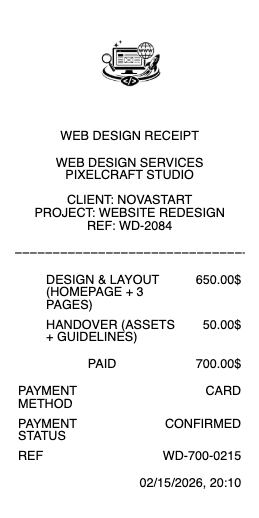
What’s on a Web Design Receipt
Designer/agency and client, with the project or invoice reference
The design fee — one-time build cost, often split into stages
The project phase paid — deposit, milestone, or final launch balance
Pass-through costs — hosting, domain, premium themes or plugins, stock
Recurring items — a maintenance retainer or hosting billed monthly/annually
Scope reference — pages, revisions included, and what’s extra
Amount paid, balance, and payment method
Milestone Billing — Deposit, Build, Launch
Web projects are rarely paid all at once, and the receipt reflects the stage. The common structure is a deposit to start (often 50%, or a third), one or more milestone payments as design and development progress, and a final balance due at launch — sometimes held until the site goes live. Each payment should get its own receipt naming the phase it covered, so the client can see the project’s money against its progress and the designer has a clear record of what’s been collected. This staged approach protects both sides: the designer isn’t building for free, and the client pays as work is delivered. When a receipt just says “web design $X,” it hides which phase was paid — naming the milestone (“deposit,” “final on launch”) is what makes the record useful for tracking a live project.
One-Time Design vs Recurring Hosting and Domains
The distinction that trips up web-design billing is one-time versus recurring. The design and build is a one-off fee. But a website also needs hosting and a domain, which renew (monthly or annually) for as long as the site exists — and premium themes, plugins, or stock assets may carry their own renewing licenses. Designers handle these two ways: bill them as pass-through costs (the client reimburses the actual charge) or have the client pay the host and registrar directly. Either way, the receipt should keep them separate from the design fee, because a client who thinks a one-time payment covers hosting forever is in for a surprise at renewal. Clearly labeling recurring items — and noting the renewal cycle — is what prevents that misunderstanding and shows the true ongoing cost of the site.
Maintenance Retainers, Scope, and Records
After launch, many designers offer a maintenance retainer — a recurring fee for updates, backups, security, and small changes — which is a separate, ongoing receipt from the build. Defining scope on the receipt or invoice (number of pages, rounds of revisions included, what counts as extra) heads off the classic “scope creep” dispute, since work beyond the agreed scope is billed as an add-on with its own line. For the designer, these receipts are freelance or agency income records with no tax withheld, so keeping them organized — build payments, pass-through reimbursements, and retainer income separated — is what makes bookkeeping and tax filing clean. Pairing each receipt with the project agreement gives a defensible record of what was quoted, delivered, and paid.
Related creative service receipts: see also our Graphic Design receipt guide and our Marketing Services receipt guide.
Create a Web Design Receipt
Our generator produces a clean web design receipt — designer and client, the design fee and phase paid, any pass-through hosting or domain costs, a maintenance retainer, and the total — as a PDF you can send a client or keep for your income records.
Use it responsibly: recreate only real work and payments, with their true amounts. Fabricating web design receipts to misstate income, invent expenses, or bill for work not delivered is fraud — the figures should match your return and your project agreement. This tool is for legitimate record-keeping only.
Frequently asked questions
Everything you need to know about the product and billing.
What does a web design receipt show?
The designer and client with a project reference, the one-time design fee and which phase was paid (deposit, milestone, or final), any pass-through costs like hosting and domains, recurring items such as a maintenance retainer, a scope reference, and the amount paid with method.
How is web design usually billed?
In stages: a deposit to start (often 50% or a third), milestone payments as work progresses, and a final balance at launch. Each payment should get its own receipt naming the phase, so the money can be tracked against the project’s progress.
Why are hosting and domains separate from the design fee?
The design and build is a one-time cost, but hosting and domains renew for as long as the site exists, and premium themes or plugins may carry renewing licenses. Keeping them separate on the receipt prevents a client from thinking one payment covers hosting forever.
What is a website maintenance retainer?
A recurring fee for post-launch updates, backups, security, and small changes — billed separately from the one-time build and generating its own ongoing receipts. It’s how designers cover continued work after a site goes live.
How does scope affect a web design receipt?
Defining scope — pages, included revision rounds, and what counts as extra — on the receipt or invoice heads off “scope creep” disputes. Work beyond the agreed scope is billed as an add-on with its own line rather than absorbed into the original fee.
Are pass-through costs the same as the design fee?
No. Pass-through costs are actual third-party charges (hosting, domain, stock, plugins) the client reimburses, kept separate from your design fee. Labeling them distinctly — with the renewal cycle for recurring ones — shows the true one-time versus ongoing cost.