A MetaMask receipt is a record of activity in a self-custody wallet — a send, a swap, or a dapp interaction — where you, not a company, hold the keys. That changes what the record means: MetaMask is software over your own on-chain wallet, so its activity list reflects blockchain transactions you alone control. This page explains what a MetaMask transaction shows, how self-custody and swaps work, and the security that keeping records supports.
MetaMask Wallet Receipt
Add custom logo
Edit line items
Choose payment method
Add/remove elements
Customize business information
Choose font
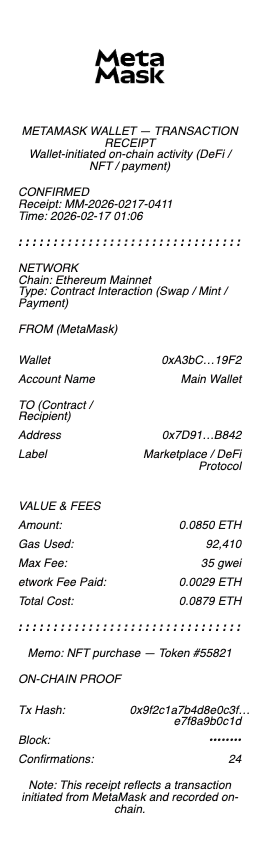
What’s on a MetaMask Transaction Record
The action — send, receive, swap, or a contract interaction
The asset and amount, and the counterparty address
The network — Ethereum or another EVM chain (Polygon, Arbitrum, BNB)
The gas fee paid, which MetaMask lets you adjust
The transaction hash, viewable on the chain’s explorer
For swaps, the rate and MetaMask’s service fee
Date, status, and your wallet address
Self-Custody and the Secret Recovery Phrase
The defining feature of MetaMask is self-custody: unlike an exchange that holds your crypto, MetaMask puts you in sole control through a 12-word Secret Recovery Phrase (seed phrase) generated when you set up the wallet. That phrase is the wallet — anyone who has it controls the funds, and if you lose it, no one, including MetaMask, can recover your assets. This is the “not your keys, not your coins” principle in practice: total control, total responsibility. It means your MetaMask activity record is a record of transactions only you authorized, and it also means the phrase must be stored offline and never entered into a website or shared — the single most important security rule in crypto. Because there’s no company backstop, your own records and your safeguarding of that phrase are the entirety of your account security. The wallet address is public; the recovery phrase is everything.
Connecting to Dapps and In-Wallet Swaps
MetaMask’s main job is connecting to decentralized apps — DeFi protocols, NFT marketplaces, games — by signing transactions from your wallet. Each connection and each action is a transaction you approve, paying gas, and appears in your activity. MetaMask also has a built-in Swap feature that aggregates decentralized exchanges to find a rate and charges a service fee (a small percentage of the swap) on top of gas — so a swap receipt shows the rate, the gas, and that fee. A crucial security point lives here: connecting to a dapp often requires granting a token approval, and a malicious or unlimited approval can let a contract drain that token later. Reviewing what you approve — and periodically revoking stale approvals — is part of safe self-custody. The activity record helps you see what your wallet has interacted with, which is the starting point for spotting anything wrong.
Records, Verification, and Taxes
Because MetaMask is a window onto the blockchain, every transaction it shows is verifiable on-chain by its hash — the record is as strong as any in crypto. But self-custody also means no exchange is tracking your cost basis for you: the responsibility to keep tax records falls entirely on you. Each swap or sale is a taxable disposal with a gain or loss, each token received may be income, and MetaMask itself doesn’t issue a tax form. The practical approach is to export or import your wallet’s transaction history into crypto tax software, which reads the on-chain activity and applies USD values by date. Keeping your own record of significant transactions — the asset, amount, USD value, date, and hash — is what makes that reconciliation accurate. In self-custody, the blockchain is your statement, and your discipline in recording it is your accounting department.
Related crypto receipts: see also our Ledger wallet receipt guide and our Ethereum receipt guide.
Create a MetaMask-Style Receipt
Our generator produces a clean self-custody wallet receipt in the MetaMask style — action, asset and amount, network, gas fee, any swap rate and fee, and transaction hash — as a readable PDF for your records or a crypto tax file when you want a legible copy of wallet activity.
Use it responsibly: recreate only real transactions that actually occurred, with their true amounts and hashes. Fabricating a wallet receipt to fake a transfer, invent proof of funds, or misstate crypto gains is fraud — the transaction is on a public blockchain and verifiable by its hash. And never share or enter your Secret Recovery Phrase anywhere. MetaMask is a trademark of its owner; this tool is not affiliated with it and is for legitimate record-keeping only.
Frequently asked questions
Everything you need to know about the product and billing.
What does a MetaMask transaction record show?
The action (send, receive, swap, or contract interaction), the asset and amount, the counterparty address, the network (Ethereum or another EVM chain), the gas fee, the transaction hash, any swap rate and MetaMask service fee, and the date, status, and your wallet address.
What is the MetaMask Secret Recovery Phrase?
A 12-word phrase generated at setup that is the wallet — anyone with it controls your funds, and if you lose it, no one, including MetaMask, can recover your assets. It must be stored offline and never entered into a website, the single most important rule in self-custody.
What does self-custody mean in MetaMask?
That you, not a company, hold the keys to your crypto through your recovery phrase. It’s total control and total responsibility — “not your keys, not your coins” — so your activity record reflects only transactions you authorized, with no company backstop if you lose access.
Does MetaMask charge a fee for swaps?
Yes. The built-in Swap aggregates decentralized exchanges to find a rate and charges a service fee — a small percentage of the swap — on top of the network gas fee. A swap receipt shows the rate, the gas, and that service fee.
What is a token approval and why does it matter?
Connecting to a dapp often requires granting a token approval so a contract can move that token. A malicious or unlimited approval can let it drain the token later, so review what you approve and periodically revoke stale approvals as part of safe self-custody.
How do I handle MetaMask transactions for taxes?
Since no exchange tracks your basis, it’s on you. Each swap or sale is a taxable disposal, and MetaMask issues no tax form. Import your wallet history into crypto tax software, which reads on-chain activity and applies USD values — keep your own record of asset, amount, value, date, and hash.