An NFT marketplace receipt records a sale or purchase on a platform like OpenSea, Blur, or Magic Eden — and the seller side is where the interesting details live: what the marketplace took, what royalty went to the creator, and what you actually netted. Listing is usually free, but fees come out at the sale. This page explains what a marketplace transaction shows, how fees and royalties work, and the quirks of listing and offers.
NFT Marketplace Receipt
Add custom logo
Edit line items
Choose payment method
Add/remove elements
Customize business information
Choose font
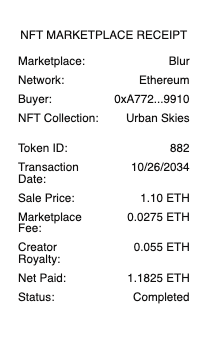
What’s on an NFT Marketplace Receipt
The marketplace — OpenSea, Blur, Magic Eden, and others
The NFT — collection, and the contract address plus token ID
Sale price in ETH (or the chain’s coin) and USD value
The marketplace fee deducted
The creator royalty paid, if any
Net proceeds to the seller (or total cost to the buyer)
The transaction hash, gas, and date
Listing, Offers, and Gas Quirks
Marketplaces have billing quirks worth knowing. Listing an NFT for sale is usually gasless — you sign an off-chain message rather than paying a fee, so putting something up for sale costs nothing up front; you pay gas only when it actually sells or transfers. The first time you sell from a new collection, a one-time approval transaction (which does cost gas) may be needed to let the marketplace move your tokens. Offers and bids are typically made in Wrapped ETH (WETH) rather than plain ETH, because the marketplace needs an ERC-20 token it can escrow for a standing bid — so buyers wrap ETH into WETH to make offers. Auctions add timed bidding on top. Understanding that listing is free but selling incurs gas, and that offers use WETH, explains transactions that otherwise look confusing on your record — and tells you where the costs actually land.
Marketplace Fees, Royalties, and the Royalty War
Two cuts come out of a sale, and the receipt should show both. The marketplace fee is the platform’s commission — it varies significantly, and competition has driven it down (Blur launched with zero marketplace fees to win pro traders, pressuring others). The creator royalty is a percentage meant for the original creator on every resale, and it became the industry’s biggest fight: the “royalty war” erupted when marketplaces made royalties optional to lower costs for traders, cutting into creator earnings, which pushed platforms toward enforcement tools and on-chain blocklists. What this means practically is that the royalty on your sale depends on the marketplace and the collection’s settings — it may be full, reduced, or zero. For a seller, the receipt’s fee and royalty lines are what turn a headline sale price into your real net proceeds; for a creator, the royalty line is your income.
Net Proceeds, Verification, and Taxes
The number that matters most to a seller isn’t the sale price — it’s the net after the marketplace fee, the royalty, and gas. A clean marketplace receipt makes that math explicit, which you need both to know what you earned and to file taxes. Selling an NFT is a taxable disposal with a capital gain or loss measured against your cost basis (what you paid to acquire it, plus fees), and some NFTs may be treated as collectibles with a different rate. For a creator, royalty income is ordinary income. Every sale settles on-chain, so the transaction hash lets anyone verify the price and parties on a block explorer — stronger proof than a PDF. Keeping the record — NFT, price, marketplace fee, royalty, gas, net, and date — is what lets you calculate the gain or loss correctly. On public marketplaces, the blockchain is the receipt of record; your notes make it legible.
Related crypto receipts: see also our NFT purchase receipt guide and our Coinbase receipt guide.
Create an NFT Marketplace Receipt
Our generator produces a clean NFT marketplace receipt — platform, NFT identity, sale price and USD value, marketplace fee, creator royalty, net proceeds, and transaction hash — as a readable PDF for your records or a crypto tax file.
Use it responsibly: recreate only real sales or purchases that actually occurred, with their true amounts. Fabricating a marketplace receipt to fake a sale, invent proceeds, or misstate crypto gains is fraud — every marketplace sale is recorded on a public blockchain and verifiable by its hash. The on-chain record is the authoritative source; this tool is for legitimate record-keeping only.
Frequently asked questions
Everything you need to know about the product and billing.
What does an NFT marketplace receipt show?
The marketplace (OpenSea, Blur, Magic Eden), the NFT’s collection with contract address and token ID, the sale price in crypto and USD, the marketplace fee, any creator royalty, the net proceeds to the seller or cost to the buyer, and the transaction hash, gas, and date.
Does it cost gas to list an NFT for sale?
Usually not — listing is gasless, done by signing an off-chain message, so putting an NFT up for sale costs nothing up front. You pay gas when it sells or transfers, and a one-time approval (which costs gas) may be needed the first time you sell from a collection.
Why are NFT offers made in WETH instead of ETH?
Because a standing bid needs an ERC-20 token the marketplace can escrow, and plain ETH isn’t one. Buyers wrap ETH into Wrapped ETH (WETH) to make offers, which is why bids and offers on your record show WETH rather than ETH.
How much does an NFT marketplace charge in fees?
It varies by platform and has fallen with competition — Blur launched with zero marketplace fees to attract traders, pressuring others. The fee is the platform’s commission, deducted from the sale, and it’s separate from any creator royalty.
What is the NFT royalty war?
The industry fight over creator royalties. Marketplaces began making royalties optional to lower costs for traders, cutting creator earnings, which pushed platforms toward enforcement tools and blocklists. So the royalty on a sale now depends on the marketplace and the collection’s settings.
How are NFT marketplace sales taxed?
Selling an NFT is a taxable disposal with a capital gain or loss against your cost basis (purchase price plus fees), and some NFTs may be treated as collectibles with a different rate. For creators, royalty income is ordinary income. Keep the price, fees, royalty, gas, and net for each sale.