An NFT purchase receipt records buying a non-fungible token — and what it documents is unusual: not a product shipped to you, but a token transferred to your wallet that points to a specific item on a blockchain. The receipt’s key details are the contract address and token ID that identify exactly what you bought, plus the price, gas, and any royalty. This page explains what an NFT purchase record shows and what you actually own.
NFT Purchase Receipt
Add custom logo
Edit line items
Choose payment method
Add/remove elements
Customize business information
Choose font
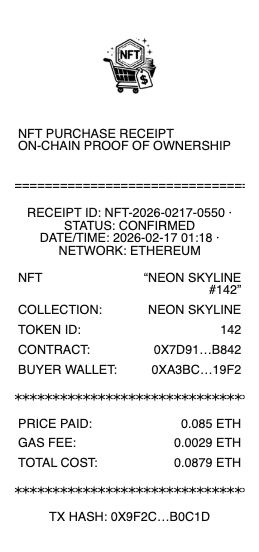
What’s on an NFT Purchase Receipt
The transaction hash — verifiable on a block explorer
The contract address and token ID — the unique identifier of the NFT
The collection name and marketplace used
The price paid — in ETH (or the chain’s coin) and its USD value
The gas fee for the transaction
Marketplace fee and creator royalty, if itemized
Buyer and seller wallet addresses, and the date
Contract Address + Token ID — What Identifies Your NFT
Every NFT is pinned down by two things on the receipt: the contract address (the collection’s address on the blockchain) and the token ID (the specific number within that collection). Together they name your exact item — “token #4521 of this contract” — the way a serial number identifies one unit. This pairing is what makes the purchase verifiable and what you’d reference to prove ownership or list it for resale. The token itself lives on-chain, while the image or media it represents is usually stored elsewhere and pointed to by the token’s metadata. That distinction surprises buyers: you own the token (provably), and the token references the art, but the media file typically isn’t on the blockchain itself. The contract-and-token-ID line is the heart of the receipt, because it’s the permanent, checkable identity of what changed hands.
Price, Gas, Marketplace Fees, and Royalties
An NFT purchase can carry several costs, and a good receipt separates them. There’s the price (in ETH or the chain’s native coin, with a USD value at the time), the gas fee to execute the transaction, a marketplace fee taken by the platform (OpenSea, Blur, Magic Eden, and others charge differently), and often a creator royalty — a percentage routed to the original creator on secondary sales. So the total you spend is more than the sticker price, and the breakdown matters for records and for calculating your true cost. Royalties in particular vary by marketplace and collection, and some platforms have made them optional, which affects the final number. Reading the fee and royalty lines tells you where your money actually went beyond the seller — and establishes the full cost basis you’ll need if you ever sell.
Ownership Proof, Verification, and Taxes
The strongest proof of an NFT purchase is the transaction on the blockchain: the hash shows the token moving from seller to your wallet, permanently and publicly, and the token now sitting in your wallet is itself the proof of ownership — stronger than any PDF. For taxes, NFTs are treated as property/crypto in the US: buying with ETH is itself a disposal of that ETH (a taxable event on the ETH), and later selling the NFT is a separate gain or loss against the cost basis — the price plus fees on this receipt. Some NFTs may be treated as collectibles, which can carry a different capital-gains rate. Keeping the purchase record with the price, gas, fees, and date is what establishes that basis. Because everything is on-chain, each figure can be independently verified, so accurate records aren’t optional if you trade NFTs.
Related crypto receipts: see also our NFT marketplace receipt guide and our Ethereum receipt guide.
Create an NFT Purchase Receipt
Our generator produces a clean NFT purchase receipt — collection, contract address and token ID, price and USD value, gas, marketplace fee, and royalty — as a readable PDF for your records or a crypto tax file when you want a legible copy of an on-chain purchase.
Use it responsibly: recreate only real purchases that actually occurred, with their true amounts and token details. Fabricating an NFT receipt to fake ownership, invent a purchase price, or misstate crypto gains is fraud — the blockchain is public, so the contract, token ID, and transaction can all be verified in seconds. The on-chain record is the authoritative source; this tool is for legitimate record-keeping only.
Frequently asked questions
Everything you need to know about the product and billing.
What does an NFT purchase receipt show?
The transaction hash, the contract address and token ID identifying the exact NFT, the collection and marketplace, the price in crypto and USD, the gas fee, any marketplace fee and creator royalty, the buyer and seller wallet addresses, and the date.
What identifies the specific NFT I bought?
The contract address (the collection’s blockchain address) and the token ID (the specific number within it). Together they name your exact item, like a serial number, and are what you reference to prove ownership or list it for resale.
Do I own the actual image when I buy an NFT?
You own the token, provably, on the blockchain — and the token references the art through its metadata. But the media file itself usually isn’t stored on-chain, so what you hold is the verifiable token pointing to the item, not the image file sitting on the blockchain.
What is a creator royalty on an NFT purchase?
A percentage of a secondary sale routed to the original creator. It’s one of several costs — alongside price, gas, and marketplace fee — that make your total more than the sticker price. Royalties vary by marketplace and collection, and some platforms have made them optional.
How do I prove I own an NFT?
The token sitting in your wallet is itself the proof, and the purchase transaction hash on a block explorer permanently shows it moving to you. That on-chain record is stronger evidence than any PDF receipt, since anyone can verify it publicly.
Are NFT purchases taxable?
In the US, buying an NFT with ETH is a disposal of that ETH — a taxable event — and later selling the NFT is a separate gain or loss against your cost basis (price plus fees). Some NFTs may be treated as collectibles with a different rate, so keep the full purchase record.