A physiotherapy receipt records a physical-therapy session and, done right, doubles as a superbill — the itemized document you submit to an insurer for reimbursement. Because PT is billed in coded, often time-based units and usually has visit limits, its receipt carries details a plain payment slip never would: the CPT codes, the diagnosis, and the provider’s NPI. This page explains what it shows and how to use it for a claim.
Physiotherapy Receipt
Add custom logo
Edit line items
Choose payment method
Add/remove elements
Customize business information
Choose font
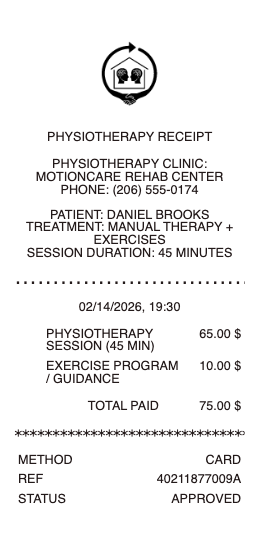
What’s on a Physiotherapy Receipt
Clinic and treating therapist, with the therapist’s and clinic’s NPI number
Patient name and date of service
CPT procedure codes for each treatment performed, with units
An ICD-10 diagnosis code — the reason for treatment
Per-code charges, the total, and what you paid (copay or full fee)
Whether it’s in- or out-of-network, and any referral on file
The provider’s signature or credentials for claim validity
CPT Codes and the 8-Minute Rule
Physical therapy is billed by procedure, not by a flat visit fee, and the receipt lists the CPT codes to prove it. Common ones are 97110 (therapeutic exercise), 97140 (manual therapy), 97112 (neuromuscular re-education), and 97530 (therapeutic activities), plus an evaluation code (97161–97163) on the first visit. Many of these are time-based, billed in 15-minute units, which is where Medicare’s “8-minute rule” comes in: a therapist must provide at least 8 minutes of a timed service to bill one unit of it. That’s why two sessions of the same length can show different units — the receipt reflects exactly which timed and untimed services were delivered. For a claim, those codes and units are what the insurer prices against your benefits.
Visit Limits, Referrals, and Medicare Thresholds
PT coverage comes with rules the receipt helps you track. Most plans cap visits per year (commonly 20–30, but it varies), and some require a physician referral or prescription and prior authorization before they’ll pay — without them, a claim is denied regardless of the receipt. Medicare no longer has a hard dollar cap but sets a therapy threshold above which the provider must attach a KX modifier attesting the care is still medically necessary; you may see that modifier on the receipt. Keeping every session’s receipt lets you count visits against your annual limit and prove medical necessity if a payer questions ongoing treatment. When you’re near a visit cap, the running record of dated, coded sessions is exactly what supports an authorization for more.
Superbills, HSA/FSA, and Out-of-Network Claims
If your physiotherapist is out-of-network, you pay up front and claim reimbursement yourself — and the document that makes that possible is a superbill: an itemized receipt carrying the CPT codes, the ICD-10 diagnosis, the provider’s NPI, and the fee. Submit it to your insurer and they reimburse at your out-of-network rate. The same itemized receipt is what you keep for HSA or FSA reimbursement, since PT is a qualified medical expense — the coded receipt substantiates it if the account administrator asks. A plain “paid $X” slip won’t do either job; it’s the codes, diagnosis, and NPI that turn a receipt into a claimable document. Ask your clinic specifically for a superbill if reimbursement is your goal.
Related medical receipts: see also our Massage receipt guide and our Therapy receipt guide.
Create a Physiotherapy Receipt
Our generator builds an itemized physiotherapy receipt or superbill layout — clinic and therapist with NPI, CPT codes and units, diagnosis, per-line charges, and total — as a clean PDF when you need a legible copy for an insurance claim, an HSA/FSA reimbursement, or your records.
Use it responsibly: recreate only real sessions that took place, with the actual services, codes, and amounts. Fabricating a physiotherapy superbill to claim reimbursement for care you didn’t receive is insurance fraud — payers verify CPT codes and units against the provider’s records and NPI. Your clinic’s own itemized receipt is the authoritative document; this tool is for legitimate record-keeping only.
Frequently asked questions
Everything you need to know about the product and billing.
What does a physiotherapy receipt show?
The clinic and treating therapist with their NPI, the patient and date, CPT procedure codes and units for each treatment, an ICD-10 diagnosis, per-code charges and the total paid, network status, and any referral — the detail an insurer needs to price a claim.
What are CPT codes on a physiotherapy receipt?
Codes identifying each treatment billed — e.g. 97110 therapeutic exercise, 97140 manual therapy, 97112 neuromuscular re-education, and an evaluation code (97161–97163). Many are time-based, billed in 15-minute units, so the receipt shows units per code.
What is the 8-minute rule in physical therapy billing?
A Medicare rule for time-based services: a therapist must provide at least 8 minutes of a timed treatment to bill one 15-minute unit of it. It’s why two same-length sessions can show different units on the receipt, depending on services delivered.
How do I use a physiotherapy superbill for reimbursement?
If your therapist is out-of-network, pay up front and submit a superbill — an itemized receipt with CPT codes, ICD-10 diagnosis, provider NPI, and fee — to your insurer, which reimburses at your out-of-network rate. Ask the clinic specifically for a superbill.
Is physiotherapy HSA or FSA eligible?
Yes — physical therapy is a qualified medical expense, so you can pay with or be reimbursed from an HSA or FSA. Keep the itemized, coded receipt, since the account administrator may ask for substantiation showing it was medical care.
Does insurance limit how many physiotherapy visits I can have?
Usually yes — most plans cap visits per year and may require a referral or prior authorization. Medicare uses a therapy threshold above which the provider attaches a KX modifier for medical necessity. Keeping dated receipts helps you track visits against the limit.