A therapy receipt documents a mental-health session, and for most clients it plays one specific role: the superbill you submit to get reimbursed, because so many therapists are out-of-network. It carries details a normal receipt doesn’t — the session’s CPT code, a diagnosis code, and the provider’s license and NPI — each of which the insurer requires. This page explains what it shows, and the privacy trade-off that comes with it.
Therapy Receipt
Add custom logo
Edit line items
Choose payment method
Add/remove elements
Customize business information
Choose font
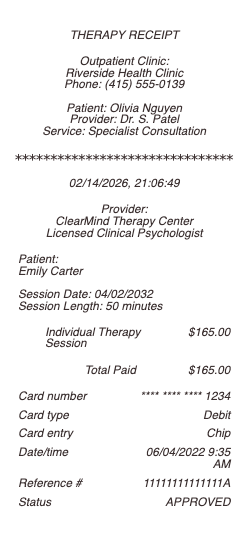
What’s on a Therapy Receipt
Provider name, license, and NPI — the credentials a claim needs
Client name and date(s) of service
The session CPT code — identifying the type and length of session
An ICD-10 diagnosis code, which insurers require to reimburse
The fee per session and what you paid
Place of service — office or telehealth
Whether it’s a superbill intended for out-of-network submission
Session CPT Codes — 90834, 90837, and More
Therapy is billed with a small set of standard psychotherapy CPT codes, and the one on your receipt describes the session. The most common are 90832 (about 30 minutes), 90834 (about 45 minutes — the typical “therapy hour”), and 90837 (about 60 minutes). A first visit is often 90791, the psychiatric diagnostic evaluation. Couples or family therapy is 90847, and group therapy is 90853. The code matters because insurers reimburse different amounts for each, and it must match the session that actually happened. When you compare your receipt to an insurer’s reimbursement, the CPT code is the line they price against — so a 45-minute session billed as 90834 should read that way on the document.
Out-of-Network Superbills and the Diagnosis Trade-off
Mental-health care is out-of-network more often than almost any other specialty — many therapists don’t contract with insurers — so the superbill is the norm rather than the exception. You pay the full fee, receive an itemized superbill, and submit it for out-of-network reimbursement at your plan’s rate. But there’s a real trade-off worth understanding: reimbursement requires a diagnosis code. To claim, an insurer needs an ICD-10 mental-health diagnosis (for example a code in the anxiety or mood-disorder range) placed in your record. Some clients choose to pay privately and skip the superbill specifically to keep a diagnosis off their insurance file. Neither choice is wrong — but the receipt makes the trade-off concrete, because the same document that unlocks reimbursement is the one that records the diagnosis.
Sliding Scale, Telehealth, HSA/FSA, and Getting a Copy
Therapy receipts reflect a few practice-specific realities. Many therapists offer a sliding-scale fee based on income, so your receipt may show a reduced rate — legitimate, and worth noting for your own records. Telehealth sessions carry a place-of-service indicator (and sometimes a modifier) showing the session was virtual, which some plans need to reimburse. Therapy is a qualified medical expense, so the itemized receipt also works for HSA or FSA reimbursement. Practices increasingly use client portals (many on platforms like SimplePractice) that generate a superbill on request, so getting a copy is usually a portal download or a quick email. When reimbursement is the goal, ask specifically for a superbill — a plain payment receipt without the CPT and diagnosis codes won’t be accepted.
Related medical receipts: see also our Physiotherapy receipt guide and our Dental receipt guide.
Create a Therapy Receipt
Our generator builds an itemized therapy receipt or superbill layout — provider credentials and NPI, session CPT code, diagnosis, place of service, fee, and total — as a clean PDF when you need a legible copy for an out-of-network claim, an HSA/FSA reimbursement, or your own records.
Use it responsibly: recreate only real sessions that took place, with the actual codes and amounts. Fabricating a therapy superbill to claim reimbursement for sessions that didn’t happen is insurance fraud — payers verify CPT codes and dates against the provider’s NPI and records. Your provider’s own superbill is the authoritative document; this tool is for legitimate record-keeping only.
Frequently asked questions
Everything you need to know about the product and billing.
What does a therapy receipt show?
The provider’s name, license, and NPI, the client and dates of service, the session CPT code, an ICD-10 diagnosis code, the fee and amount paid, the place of service (office or telehealth), and whether it’s a superbill meant for out-of-network submission.
What do the CPT codes on a therapy receipt mean?
They identify the session type and length: 90832 (~30 min), 90834 (~45 min, the typical therapy hour), 90837 (~60 min), 90791 (first-visit evaluation), 90847 (family), and 90853 (group). Insurers reimburse different amounts per code, so it must match the session.
What is a superbill and why do I need one for therapy?
A superbill is an itemized receipt with the CPT code, ICD-10 diagnosis, and provider NPI. Because many therapists are out-of-network, you pay up front and submit the superbill for reimbursement at your plan’s out-of-network rate. Ask your provider for one specifically.
Why does a therapy superbill include a diagnosis?
Insurers require an ICD-10 mental-health diagnosis to reimburse a claim, so submitting a superbill places that diagnosis in your insurance record. Some clients pay privately and skip the superbill specifically to keep a diagnosis off their file — a real trade-off to weigh.
Is therapy HSA or FSA eligible?
Yes — mental-health therapy is a qualified medical expense, so you can pay with or be reimbursed from an HSA or FSA. Keep the itemized receipt, as the account administrator may ask for substantiation showing it was medical care.
How do I get a copy of a therapy receipt or superbill?
Most practices use a client portal (often on platforms like SimplePractice) that generates a superbill on request, so it’s usually a download or a quick email. If you need reimbursement, ask for a superbill rather than a plain payment receipt.