Proof of purchase is what a warranty desk, a returns counter, or a rebate processor asks for before honoring anything — and it is a broader idea than a receipt. Order confirmations, gift receipts, packing slips, and account histories all qualify in the right context. This page covers what counts, where the receipt fits, and how to produce proof when the paper is long gone.
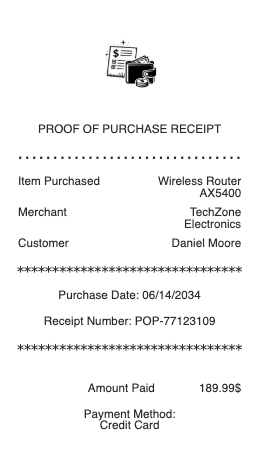
Proof of Purchase Receipt
Add custom logo
Edit line items
Choose payment method
Add/remove elements
Customize business information
Choose font
What Counts as Proof of Purchase
The receipt — retail slip or emailed copy, the strongest general-purpose proof
Order confirmations and account order history for online purchases
Gift receipts — item-valid without exposing the price paid
Packing slips and invoices that name the item, seller, and date
Card or bank statements — accepted by many retailers, though they show a total, not items
Warranty registrations and serial numbers tying the unit to its sale date
For rebates, the UPC plus the dated receipt, the classic combination
What Is Proof of Purchase, Exactly?
The phrase means any documentation that establishes three facts together: this item was bought from this seller on this date. A receipt does it in one document, which is why receipt and proof of purchase get used interchangeably — but the concept is functional, not a specific paper. That distinction cuts both ways: a card statement proves you spent $214 at a store without proving what you bought, while a serial-numbered warranty registration proves the item without the price. Which combination suffices depends on who is asking — returns desks, warranty processors, and rebate centers each set their own bar.
Proof of Purchase for Warranty Claims, Returns, and Rebates
Warranties ask for dated proof because coverage runs from the purchase date: the receipt or order confirmation naming the product is the standard, and registering the product at purchase pre-positions the claim. Returns are policy territory: with a receipt you get the refund to the original payment; without one, many chains can look the purchase up from the card used, or offer store credit at the current price with an ID. Rebates and promotions are strictest — typically the original dated receipt plus the UPC from the package, submitted inside a deadline. In every case, the itemized document beats the summary one.
No Receipt? How to Produce Proof of Purchase Anyway
For online orders the answer is the account: Amazon and most retailers keep order history indefinitely, and a printed order page or emailed invoice is accepted proof. For in-store purchases, start with the card statement and the store’s own lookup — many chains can reprint from the card number and date. Product registration, serial numbers, and even the box with its dated shipping label have carried claims. For a car or other private-party purchase, the bill of sale is the proof of purchase — which is why it should be written and kept like one. The pattern is consistent: reconstruct the same three facts — item, seller, date — from whatever records survive.
Related transaction receipts: see also our Sales receipt guide and our Receipt of Payment guide.
Create a Proof-of-Purchase Receipt
Our generator rebuilds a purchase record — seller, date, itemized lines, total, and payment method — as a clean PDF for your warranty files and records when the original slip is gone and the purchase itself is not in doubt.
Use it responsibly: a rebuilt receipt documents a real purchase for your own records. Submitting a fabricated proof of purchase for a warranty claim, return, rebate, or settlement is fraud — where a third party must verify the purchase, the right document is a reprint or statement from the original seller.
Adjacent documents: the proof of payment receipt (the payer’s side), the return receipt, and the credit card receipt.
Frequently asked questions
Everything you need to know about the product and billing.
What is a proof of purchase?
Any documentation establishing that a specific item was bought from a specific seller on a specific date — a receipt, order confirmation, gift receipt, invoice, or a combination like a card statement plus product registration.
Is a receipt the same as proof of purchase?
A receipt is the most complete single proof, but the concept is broader. Order histories, packing slips, and gift receipts all serve as proof of purchase where the checker’s policy accepts them.
What counts as proof of purchase without a receipt?
Order confirmations and account history for online buys; for in-store purchases, a card statement, the store’s own card-based lookup, product registration, or the serial number tied to the sale.
What proof of purchase do warranty claims need?
Dated documentation naming the product — the receipt or order confirmation. Coverage runs from the purchase date, so the date is the field that matters most; registering the product at purchase makes later claims smoother.
What is proof of purchase for a car?
The bill of sale — the signed document recording buyer, seller, vehicle, price, and date. For private-party sales it plays the role a receipt plays in a store, and titling offices ask for it.
Is a bank statement enough for a return?
Sometimes. It proves the transaction amount and date but not the items, so stores treat it as partial proof — often enough for a card-based lookup or store credit, less often for a full cash refund.