A refund receipt is proof that money was returned — issued by a business to a customer, or by a landlord returning a security deposit. It's the flip side of a sales receipt, and it matters for both bookkeeping and disputes. This guide explains what's on a refund receipt, how to issue one, the security-deposit version, and how a refund receipt is recorded in accounting.
Refund Receipt
Add custom logo
Edit line items
Choose payment method
Add/remove elements
Customize business information
Choose font
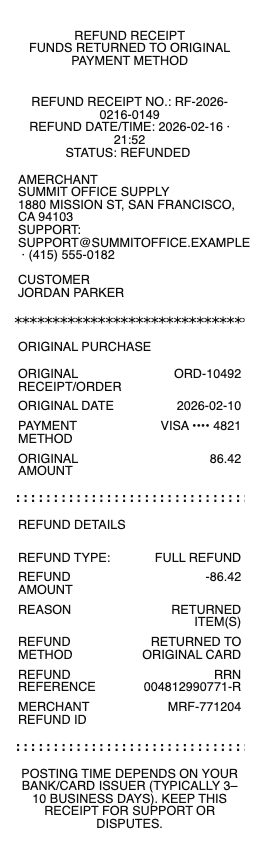
What's on a refund receipt
A refund receipt documents money going back to the payer, so it mirrors a sales receipt in reverse:
Business / issuer and recipient — who is refunding and who is receiving the money back.
Original sale reference — the original receipt or invoice number the refund relates to.
Refund amount & reason — how much is being returned and why (return, overpayment, cancellation).
Refund method — back to the original card, cash, check, or store credit.
Date & a refund/transaction number — when it was issued and a reference for records.
Signature or confirmation — acknowledgment that the refund was made and received.
How to issue a refund receipt to a customer
When a business gives money back, a refund receipt is the record for both sides. To issue one, reference the original sale, state the refund amount and reason, note the method (typically back to the original payment), and date it with a reference number. Give the customer a copy and keep one for your books. It protects the business by showing the refund was authorized and completed, and it gives the customer proof the money is coming back — useful if a card refund takes several days to post.
Security deposit refund receipts
A very common use is a landlord returning a security deposit. A security deposit refund receipt records the tenant, property, original deposit, any deductions (with an itemized reason, such as cleaning or repairs), and the amount returned. Many states require landlords to provide an itemized statement when they keep any part of a deposit, so this receipt does double duty as that record. Both sides sign or acknowledge it, which prevents disputes later about how much was returned and why.
Recording a refund receipt in your books
In accounting, a refund receipt is how you record money paid back to a customer — for example, the "refund receipt" transaction in QuickBooks Online reduces income and the cash or bank balance to reflect the return. Recording refunds properly keeps your sales figures and tax reporting accurate, since a refund isn't a new expense — it reverses part of a prior sale. Whether you use software or a manual ledger, matching each refund receipt to its original sale is what keeps the books clean at month-end.
Related transaction receipts: see also our Receipt of Payment guide and our Return receipt guide.
Create a refund receipt
Our refund receipt template and generator lays out the fields a proper refund record needs — issuer and recipient, original sale reference, amount and reason, method, date, and a confirmation line — in a clean printable format for customers, tenants, or your books.
For genuine refunds only. A refund receipt should document money that was actually returned; creating one for a refund that didn't happen, or misstating an amount, is fraud. Use these templates to record real refunds between a payer and a recipient.
Related receipts: for deposits and rentals, see the security deposit receipt and rent receipt templates.
Frequently asked questions
Everything you need to know about the product and billing.
What is a refund receipt?
It's proof that money was returned — from a business to a customer, or a landlord to a tenant. It references the original sale, states the refund amount, reason, and method, and is dated with a reference number, mirroring a sales receipt in reverse.
What's the difference between a refund receipt and a return receipt?
A return receipt documents that an item was returned; a refund receipt documents that money was given back. They often go together, but the refund receipt focuses on the money — the amount, method, and confirmation that it was issued.
How do I write a security deposit refund receipt?
Record the tenant, property, original deposit, any itemized deductions and their reasons, and the amount returned, then date it and have both sides acknowledge it. Many states require an itemized statement whenever a landlord keeps part of a deposit.
What is a refund receipt in QuickBooks?
It's the QuickBooks transaction used to record money refunded to a customer. It reduces income and your cash or bank balance so your books reflect that part of a prior sale was reversed, rather than logging a new expense.
Why should a business give a refund receipt?
It proves the refund was authorized and completed, protects the business in a dispute, and gives the customer written confirmation the money is coming back — helpful when a card refund takes several days to appear.
What should a refund receipt include?
The issuer and recipient, the original sale or invoice reference, the refund amount and reason, the method (original card, cash, check, or store credit), the date, a refund or transaction number, and a signature or confirmation.