A school fee receipt covers the payments that surround a child’s schooling — registration, activity and lab fees, lunch accounts, field trips, uniforms — the running costs that pile up even at “free” public schools. It’s a different document from a tuition receipt, and the tax treatment surprises parents in both directions: most school fees aren’t deductible, but a few specific ones connect to real benefits. This page sorts out what the receipt shows and which fees matter at tax time.
School Fee Receipt
Add custom logo
Edit line items
Choose payment method
Add/remove elements
Customize business information
Choose font
What’s on a School Fee Receipt
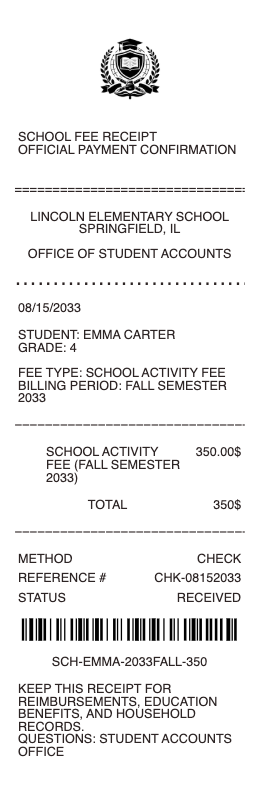
The school and the student’s name and grade/class
The fee type — registration, activity, lab, technology, lunch account, field trip, uniform, exam
The term or year the fee applies to
The amount, and any family discount or waiver applied
The payment date and method — increasingly a school payment portal
A receipt or reference number
The remaining balance, for accounts paid across a term
The Fees Beyond Tuition — What Schools Actually Charge
Tuition is one line; school fees are everything else, and they arrive all year. Registration or enrollment fees hold a place; activity and athletic fees fund sports, clubs, and arts; lab and technology fees cover materials and devices; lunch accounts run as prepaid balances topped up through a portal; field trips, uniforms, yearbooks, and exam fees (AP tests and the like) round out the list. Public schools charge many of these too — free tuition doesn’t mean free schooling. Two practical notes: schools commonly offer fee waivers or reductions tied to family income (often the same eligibility as reduced-price lunch), which the receipt should reflect; and because payments now flow through school payment portals, every fee leaves a downloadable receipt — worth saving, since year-end you may need the full picture of what a school year actually cost.
The Tax Reality — What’s Deductible and What Isn’t
Here’s the answer parents look up every spring: K-12 school fees and tuition are generally not deductible on a US federal return — no matter how mandatory the fee felt. But three genuine connections exist. First, 529 plans: federal rules allow up to $10,000 per year per student of 529 money for K-12 tuition — tuition specifically, not activity fees — with state treatment varying. Second, some states run their own credits or deductions for education expenses, each with its own list of what counts. Third — covered next — care-shaped fees can qualify for the dependent care credit. The receipt’s fee-type line is what sorts a payment into the right bucket, which is why an itemized school receipt beats a lump “school payment” when tax season comes. When in doubt, keep the receipt and let the preparer classify it.
After-School Care, Reimbursements, and Records
The care angle is the one worth knowing. Fees for before- and after-school care programs — care so parents can work — can qualify for the Child and Dependent Care Credit (or a Dependent Care FSA) for children under 13, even though regular schooling doesn’t. The receipt needs to show the program, the child, the period, and the provider’s details, and pure academics (tutoring, the school day itself) stay excluded. Beyond taxes: employer benefits and assistance programs sometimes reimburse school costs and want itemized receipts; divorced or co-parenting households use school fee receipts to split costs per their agreement, where the paper trail prevents disputes; and scholarship or voucher programs require receipts for disbursement. The pattern across all of it: the school portal already generates the documents — the parent’s job is saving them per child, per year, so any claim, split, or reimbursement has its proof ready.
Related education receipts: see also our Tutoring receipt guide and our Tuition receipt guide.
Create a School Fee Receipt
Our generator produces a clean school fee receipt — school and student, fee type, term, amount, and reference — as a PDF for a family’s records, a cost-sharing agreement, a dependent-care claim file, or a reimbursement request.
Use it responsibly: recreate only fees that were actually paid, with true amounts. Fabricating school fee receipts to claim a dependent-care credit, inflate a cost-sharing bill to a co-parent, or obtain a reimbursement you’re not owed is fraud — schools keep payment ledgers per student, and portals record every transaction. This tool is for legitimate record-keeping only.
Frequently asked questions
Everything you need to know about the product and billing.
What does a school fee receipt show?
The school and student (with grade or class), the fee type — registration, activity, lab, technology, lunch account, field trip, uniform, exam — the term it applies to, the amount and any waiver or discount, the payment date and method, a reference number, and any remaining balance.
Are school fees tax-deductible?
K-12 school fees and tuition are generally not deductible federally. The real connections are narrower: 529 plans can pay up to $10,000 per year per student of K-12 tuition specifically, some states run their own education credits, and care-shaped fees can qualify for the dependent care credit.
Can a 529 plan pay school fees?
Federal rules allow up to $10,000 per year per student of 529 funds for K-12 tuition — tuition specifically, not activity or lab fees — and state tax treatment varies. The receipt’s fee-type line is what shows whether a payment was tuition or something else.
Do after-school program fees qualify for the dependent care credit?
Often yes — before- and after-school care that lets parents work can qualify for the Child and Dependent Care Credit or a Dependent Care FSA for children under 13. The receipt should name the program, child, period, and provider; the school day itself and pure tutoring don’t count.
Do public schools charge fees?
Yes — registration, activity and athletic fees, lab and technology fees, lunch accounts, field trips, and uniforms are common even where tuition is free. Many schools offer income-based fee waivers, typically on the same eligibility as reduced-price lunch, which the receipt reflects.
Why keep school fee receipts?
For taxes (sorting fees into 529, state-credit, or dependent-care buckets), for splitting costs between co-parents per agreement, and for employer or scholarship reimbursements. School portals generate receipts for every payment — save them per child, per year, and every claim has its proof.