A landlord rent receipt is the written acknowledgment a landlord gives a tenant for each rent payment — and in several states, providing one isn't optional. This guide is for the landlord's side of the receipt: what it must include, when the law requires it, why issuing receipts protects you as much as the tenant, and what tenants can do when a landlord won't provide one.
Landlord Rent Receipt
Add custom logo
Edit line items
Choose payment method
Add/remove elements
Customize business information
Choose font
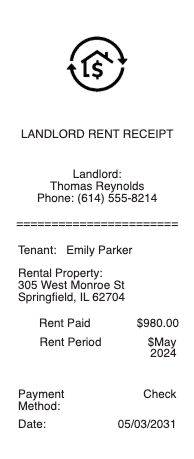
What a landlord's rent receipt should include
A proper rent receipt leaves no room for a payment dispute:
Landlord (or manager) and tenant names — who received and who paid.
Property & unit — the rental address the payment applies to.
Rental period — the month or period the payment covers, the detail that prevents "which month was that?" disputes.
Amount & payment method — the sum and whether it was cash, check, transfer, or online.
Balance or paid-in-full — any remaining balance for partial payments.
Date & signature — when the payment was received and the landlord's signature.
When landlords are required to give rent receipts
Requirements vary by state, but the pattern is consistent: receipts are most strictly required for cash payments, because cash leaves no bank trail. States like New York, Maryland, and Washington require landlords to provide receipts in common situations (especially cash or money-order payments, or on request), and many cities add their own rules. A lease can also obligate receipts regardless of state law. Even where no rule applies, a tenant who asks for a receipt is entitled to a reasonable answer — and refusing tends to invite exactly the disputes receipts prevent.
Payment method changes what the receipt must do. Cash makes the receipt the only record in existence — which is why cash-payment receipt requirements are the strictest everywhere. Bank transfers and payment apps generate their own trails, and there the receipt's job shifts to interpretation: confirming which tenancy, which month, and that the payment was accepted as rent.
Why issuing receipts protects the landlord too
Receipts aren't just tenant protection. For a landlord, a consistent receipt trail documents rental income for taxes (the payment records behind your Schedule E reporting), proves which months were paid if a non-payment case ever reaches court, and shows professionalism that tends to attract better tenants. Partial payments are where receipts matter most: recording the amount received and the balance due keeps a late-paying tenancy documented instead of ambiguous. A duplicate receipt book or a digital template gives you a copy of every receipt automatically.
The mechanics matter as much as the intent: a duplicate receipt book — carbon copies, sequential numbers — or a simple invoicing app gives the landlord the retained-copy habit automatically. Sequential numbering is quiet insurance: a numbered run with no gaps is self-evidently complete, which is exactly the property a tax return or a court exhibit wants.
What tenants can do if the landlord won't give receipts
If you're a tenant and your landlord won't provide rent receipts, take two steps. First, ask in writing (email or text), which itself creates a record of the request. Second, make your payments self-documenting: pay by check, bank transfer, or a payment app rather than cash, so your bank record proves each payment even without a receipt. If you must pay cash, bring a pre-filled receipt for the landlord to sign, or bring a witness. Your state or city's tenant resources can confirm whether receipts are legally required where you live.
Related rent and housing receipts: see also our Storage Unit receipt guide and our Rent receipt guide.
Landlord rent receipt template (PDF)
Our landlord rent receipt template and generator produces a clean, printable PDF receipt — landlord and tenant, property and unit, rental period, amount and method, balance, and a signature line — ready to issue every month or bulk-print for a receipt book.
For genuine payments only. Rent receipts should reflect rent actually received; issuing or requesting receipts for payments that didn't happen, or misstating amounts, is fraud. Use these templates to document real tenancy payments.
Related receipts: see also the general rent receipt, the house rent receipt, and the refund receipt.
Frequently asked questions
Everything you need to know about the product and billing.
Are landlords required to give rent receipts?
It depends on the state, but receipts are most commonly required for cash payments — states like New York, Maryland, and Washington require them in common situations, and leases can require them too. Even where optional, providing receipts is standard good practice. Requirements are strictest for cash everywhere — a cash receipt is the only record in existence, while transfers at least leave a bank trail to interpret.
What should a landlord rent receipt include?
The landlord and tenant names, the property and unit, the rental period the payment covers, the amount and payment method, any balance due for partial payments, and the date with the landlord's signature.
Why should a landlord give receipts even when not required?
Receipts document rental income for taxes (supporting Schedule E records), prove which months were paid if a non-payment dispute reaches court, and keep partial payments unambiguous by recording the balance due. A duplicate receipt book with sequential numbers makes this near-automatic — an unbroken numbered run is self-evidently complete, which is what tax returns and court exhibits want.
What can a tenant do if the landlord won't give a receipt?
Ask in writing to create a record, and make payments self-documenting — check, bank transfer, or payment app instead of cash. If paying cash, bring a pre-filled receipt for the landlord to sign or bring a witness, and check your state's tenant rules.
Do rent receipts matter for partial payments?
Especially then. A receipt that records the amount received and the remaining balance keeps a late-paying tenancy documented, protecting both sides if the shortfall is ever disputed.
Is a rent receipt different from a rent ledger?
A receipt documents one payment; a ledger is the running record of all payments and balances across the tenancy. Landlords typically issue receipts per payment and keep a ledger (or software record) for the overall account.