A tax-exempt receipt records a purchase where no sales tax was charged because the buyer qualifies for an exemption — a nonprofit, a government body, or a reseller buying goods to sell on. The distinctive feature is a sales-tax line of $0, backed by an exemption or resale certificate. This page explains what a tax-exempt receipt shows, who qualifies, how the certificate works, and why the seller keeps a copy.
Tax-Exempt Receipt
Add custom logo
Edit line items
Choose payment method
Add/remove elements
Customize business information
Choose font
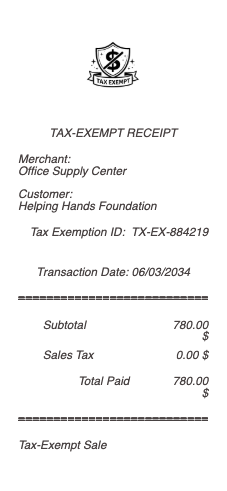
What’s on a Tax-Exempt Receipt
The seller and buyer, and the purchase date
Itemized goods or services with prices
A sales tax line of $0 — the defining feature
The exemption reason — resale, nonprofit, government, or other
The exemption or resale certificate number on file
The tax-exempt entity’s name and identifier
The total, equal to the pre-tax subtotal
Who Qualifies for a Tax Exemption
Sales-tax exemptions are specific, not general — you don’t choose to skip tax, you must qualify under your state’s rules. Common categories are resellers (a business buying inventory it will resell and collect tax on later), nonprofit organizations (charities, churches, schools with 501(c)(3) or state nonprofit status, for purchases furthering their exempt purpose), and government entities. Some states also exempt certain farmers, manufacturers, or specific goods. Crucially, the exemption applies to qualifying purchases, not everything the entity buys — a nonprofit’s purchase for its mission may be exempt while an unrelated purchase isn’t. And exemptions are state-specific: a certificate valid in one state may not transfer to another. The receipt showing $0 tax should tie to the exemption category and certificate that justifies it, because the exemption is a claim that has to be supportable.
Resale and Exemption Certificates
The document that makes a tax-exempt purchase legitimate is the exemption certificate — or, for resellers, a resale certificate. The buyer provides this state-issued certificate to the seller, who then doesn’t charge sales tax and keeps the certificate on file. For a reseller, the logic is avoiding double taxation: they buy inventory tax-free with a resale certificate, then charge sales tax to the end customer when they sell it, so tax is collected once, at the final sale. For a nonprofit or government buyer, the exemption certificate proves the entity’s status. The receipt’s $0 tax line is only as good as the certificate behind it — which is why a compliant tax-exempt receipt references the certificate number. Misusing a resale certificate to buy tax-free for personal use, rather than resale, is a form of tax evasion, so the certificate ties the exemption to a legitimate qualifying use.
The Seller’s Records and Audit Exposure
Here’s why the paperwork matters as much to the seller as the buyer: when a business doesn’t collect sales tax on a sale, it has to be able to justify why if a state tax authority audits it. The exemption certificate on file is that justification — without it, the auditor can hold the seller liable for the uncollected tax, plus penalties, even though the buyer claimed the exemption. So sellers keep exemption and resale certificates carefully, and the tax-exempt receipt documenting the $0-tax sale ties to that certificate. For the buyer, the receipt is proof they purchased tax-free properly and a record for their own accounting (a reseller tracks tax-free inventory purchases; a nonprofit documents mission-related spending). Both sides have a stake in the record being clean, because a sales-tax exemption is a position that must hold up under review — the receipt and certificate together are what make it defensible.
Related tax and fee receipts: see also our Tax Payment receipt guide and our VAT receipt guide.
Create a Tax-Exempt Receipt
Our generator produces a clean tax-exempt receipt — seller and buyer, itemized purchase, a $0 sales-tax line, and the exemption reason and certificate reference — as a PDF when you need a legible copy for your records, resale accounting, or nonprofit documentation.
Use it responsibly: recreate only a genuine tax-exempt purchase that actually occurred, for an entity that truly qualifies, with a valid certificate on file. Fabricating a tax-exempt receipt to evade sales tax on a purchase that wasn’t exempt, or to misuse a resale certificate for personal purchases, is tax fraud — sellers must retain exemption certificates for audit, and tax authorities verify them. This tool is for legitimate record-keeping only.
Frequently asked questions
Everything you need to know about the product and billing.
What does a tax-exempt receipt show?
The seller and buyer, the date, itemized goods with prices, a sales tax line of $0 (the defining feature), the exemption reason (resale, nonprofit, government), the exemption or resale certificate number on file, the exempt entity’s name and identifier, and a total equal to the pre-tax subtotal.
Who qualifies for a sales-tax exemption?
Specific categories under state rules — resellers buying inventory to resell, nonprofit organizations for mission-related purchases, and government entities, with some states also exempting certain farmers, manufacturers, or goods. It applies to qualifying purchases, not everything the entity buys, and is state-specific.
What is a resale certificate?
A state-issued certificate a reseller gives a seller so no sales tax is charged on inventory they’ll resell. Tax is collected once, at the final sale to the end customer — avoiding double taxation. Using it to buy tax-free for personal use, rather than resale, is tax evasion.
Why does the seller keep the exemption certificate?
Because if a business doesn’t collect sales tax, it must justify why in an audit. The exemption certificate on file is that justification — without it, the auditor can hold the seller liable for the uncollected tax plus penalties, even though the buyer claimed the exemption.
Does a tax exemption apply to every purchase an organization makes?
No. It applies only to qualifying purchases — for a nonprofit, typically those furthering its exempt purpose — not to everything it buys. Exemptions are also state-specific, so a certificate valid in one state may not transfer to another. The receipt should tie to the qualifying category.
Is a tax-exempt receipt proof I purchased correctly?
Yes — for the buyer it documents a properly tax-free purchase and is a record for accounting (a reseller tracks tax-free inventory; a nonprofit documents mission spending). But its $0-tax line is only as good as the valid certificate behind it, which both sides should retain.