A tax payment receipt is proof that you paid taxes owed — income tax, estimated quarterly taxes, or property tax — and its most important element is usually a single line: the confirmation number. Because a tax payment can be questioned by the IRS, a lender, or a county long after the fact, keeping that proof is what protects you. This page explains what a tax payment receipt shows, the confirmation numbers that matter, and where each kind comes from.
Tax Payment Receipt
Add custom logo
Edit line items
Choose payment method
Add/remove elements
Customize business information
Choose font
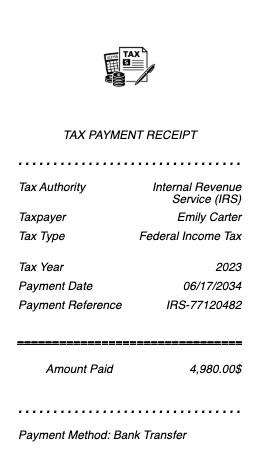
What’s on a Tax Payment Receipt
The tax authority — IRS, a state department of revenue, or a county/municipality
The taxpayer name and identifier (often masked)
The tax type and period/year the payment applies to
The amount paid and payment date
A confirmation or transaction number — the key proof
The payment method — bank, card, or check
For property tax, the parcel number and the paid-through date
The Confirmation Number Is the Proof
When you pay federal tax electronically, the system gives you a confirmation number, and that is the heart of your receipt. IRS Direct Pay (a free bank transfer) provides a confirmation and can email you one; EFTPS (the Electronic Federal Tax Payment System, used for business and many estimated payments) issues an acknowledgment number; and paying by debit or credit card through an authorized processor returns a transaction confirmation (card payments carry a processing fee). That number is what lets you — or the IRS — locate the exact payment if a return is later questioned, a payment is misapplied to the wrong year, or you need to prove timeliness to avoid a penalty. Recording the confirmation number, amount, date, and the tax year it was applied to is the single most useful thing you can do at payment time, because reconstructing an unconfirmed payment months later is far harder.
Income Tax, Estimated Payments, and Property Tax
Different taxes produce different receipts. Income tax owed with a return is paid once, with a confirmation. Estimated taxes — for the self-employed and others without withholding — are paid quarterly (with Form 1040-ES), and each of the four payments generates its own confirmation you should keep, since you’ll reconcile all four against your return. Property tax is paid to a county or municipality, and its receipt shows the parcel number and the period paid through; it matters for a few specific reasons covered next. State income and sales taxes work similarly through each state’s system. Because these payments span the year and multiple authorities, a consolidated habit — saving each confirmation as it happens, labeled by tax type and year — turns tax season and any later inquiry from a scramble into a lookup. The receipt for each is the atomic proof behind your filed return.
Why Keep Tax Payment Receipts
Tax payment receipts earn their keep in several situations. For deductions, property and certain state taxes may be deductible (subject to the SALT cap), and the receipt substantiates the amount and date. For a mortgage escrow, if your lender pays property tax from escrow, the receipt lets you confirm it was actually paid and reconcile your account. For loan or benefit applications, proof of tax payment is sometimes requested. In some states, a paid property-tax receipt is required for another transaction entirely — vehicle registration renewal, for instance. And if the IRS or a county ever claims a payment wasn’t received or was late, your dated confirmation number is the evidence that resolves it. Keeping tax payment receipts — ideally the official confirmation, not just a bank line — for several years is prudent, since tax matters can surface well after the fact.
Related tax and fee receipts: see also our Property Tax receipt guide and our Tax-Exempt receipt guide.
Create a Tax Payment Receipt
Our generator produces a clean tax payment receipt — authority, tax type and period, amount, date, and confirmation reference — as a PDF when you need a legible copy of a payment for your records, an escrow reconciliation, or a deduction file.
Use it responsibly: recreate only a tax payment you actually made, with its true amount, date, and confirmation. Fabricating a tax payment receipt to fake a payment to the IRS or a taxing authority, claim a deduction you’re not entitled to, or mislead a lender is fraud, and misrepresenting tax payments carries serious legal consequences — the tax authority’s own records are the authoritative and verifiable source. This tool is for legitimate record-keeping only.
Frequently asked questions
Everything you need to know about the product and billing.
What does a tax payment receipt show?
The tax authority (IRS, a state, or a county), the taxpayer name and a masked identifier, the tax type and period, the amount paid and date, a confirmation or transaction number, the payment method, and — for property tax — the parcel number and paid-through date.
What is the confirmation number on a tax payment?
The reference the payment system issues — IRS Direct Pay gives a confirmation, EFTPS an acknowledgment number, and card processors a transaction confirmation. It’s the key proof, letting you or the IRS locate the exact payment if a return is questioned or a payment is misapplied.
How do I get a receipt for an IRS payment?
Electronic methods provide one automatically: IRS Direct Pay gives (and can email) a confirmation, EFTPS issues an acknowledgment number, and card payments return a transaction confirmation. Record the number, amount, date, and the tax year it applied to as your proof.
Do estimated tax payments each need a receipt?
Yes — estimated taxes are paid quarterly, and each of the four payments generates its own confirmation you should keep, since you’ll reconcile all four against your return. Saving each as it happens, labeled by year, avoids reconstructing them later.
Why keep a property tax payment receipt?
It substantiates a potential deduction (subject to the SALT cap), lets you confirm a mortgage-escrow payment was actually made, and in some states is required for another transaction like vehicle registration. It also proves timeliness if the county ever questions a payment.
Is a bank statement enough proof of a tax payment?
It shows a payment left your account, but the official confirmation number ties it to the specific tax and period and is what resolves a dispute if a payment is misapplied or claimed late. Keep the authority’s confirmation, not just the bank line, for several years.