A VAT receipt is proof of a purchase from a VAT-registered business, showing the tax that was charged on top of the price. Unlike a plain till slip, it carries the seller’s VAT registration number and the rate and amount of tax — the details a business needs before it can reclaim that VAT as an expense.
VAT Receipt
Add custom logo
Edit line items
Choose payment method
Add/remove elements
Customize business information
Choose font
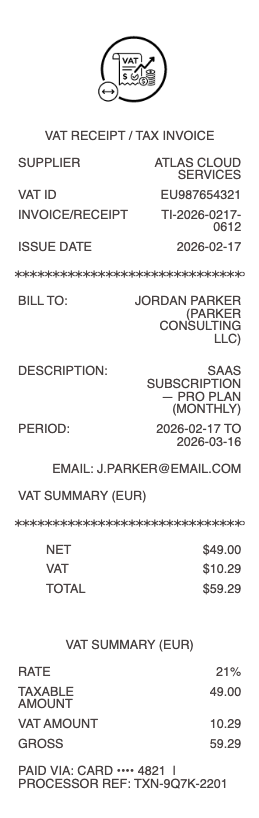
What’s on a VAT Receipt
Seller’s name and address
The seller’s VAT registration number — the line that separates a VAT receipt from an ordinary receipt
Date of supply and a receipt or invoice number
Description of the goods or services
The VAT rate applied to each item or rate group
Net amount, VAT amount, and gross total — or, on simplified receipts, the gross price with the rate shown
Customer details on full VAT invoices issued business-to-business
What Is a VAT Receipt and What Does VAT on a Receipt Mean?
VAT — value-added tax — is a consumption tax added at each stage of sale in most of the world outside the United States. When VAT appears on a receipt, it means the seller is VAT-registered and has charged the tax on the government’s behalf. The receipt is the evidence trail: a VAT-registered business that buys something for the business can normally reclaim the input VAT it paid, but only against a receipt or invoice that actually shows the seller’s VAT number and the tax breakdown. That is the whole reason accountants keep asking for “a proper VAT receipt” rather than the card slip.
Full, Simplified, and Non-VAT Receipts
Tax authorities generally allow two levels of documentation. A simplified VAT receipt — in the UK, permitted for retail sales up to £250 including VAT — needs the seller’s name, address, and VAT number, the date, a description, and the rate charged. A full VAT invoice adds the customer’s details, an invoice number, and a per-rate breakdown of net, VAT, and gross, and is the standard for business-to-business supplies. A non-VAT receipt is simply one issued by a seller who is not VAT-registered — common for small traders — and it carries no reclaimable tax, however the purchase is otherwise documented.
Do You Need a VAT Receipt to Claim Expenses?
To reclaim the VAT itself — yes. Reclaiming input VAT on a return requires a valid VAT receipt or invoice; without one you can usually still book the cost as a business expense for income-tax purposes, but the VAT portion stays unrecovered. Travel is where this bites most: airlines, hotels, and booking platforms typically hide the VAT document behind your account, so download the receipt or invoice from the booking rather than relying on the confirmation email. US readers meet VAT mainly on purchases from UK and EU sellers or while traveling — the US itself levies sales tax, not VAT — and foreign VAT can sometimes be recovered through refund schemes if the paperwork survives the trip.
Related tax and fee receipts: see also our Tax-Exempt receipt guide and our Visa Fee receipt guide.
Create a VAT-Style Receipt
Our generator builds a VAT-style receipt with the fields that matter — seller details and VAT number line, itemized goods or services, the rate, and the net / VAT / gross breakdown — useful for reconstructing a damaged record or producing a clean copy for your files. Download it as a PDF.
Use it responsibly: recreate only transactions that genuinely happened, with their real amounts. Submitting a fabricated VAT receipt to reclaim tax is tax fraud in every jurisdiction that operates VAT. When in doubt, request a duplicate from the original seller instead.
Other tax-adjacent records: the invoice payment receipt, property tax receipt, and personal expense receipt pages.
Frequently asked questions
Everything you need to know about the product and billing.
What is a VAT receipt?
A receipt issued by a VAT-registered seller that shows the VAT registration number and the tax charged on the sale. It is the document a business needs to reclaim the VAT it paid on a purchase.
What must be shown on a VAT receipt?
The seller’s name, address, and VAT registration number, the date, a description of the goods or services, the VAT rate, and the tax amount — either as a net/VAT/gross breakdown or, on simplified receipts, as a gross price with the rate stated.
What is the difference between a VAT receipt and a normal receipt?
A normal till receipt proves you paid; a VAT receipt additionally identifies the seller as VAT-registered and breaks out the tax. Only the latter supports a VAT reclaim.
Do I need a VAT receipt to claim expenses?
You need one to reclaim the VAT itself. Without it you can generally still record the cost as a business expense, but the VAT portion cannot be recovered on your return.
What is a non-VAT receipt?
A receipt from a seller who is not VAT-registered. It contains no VAT number and no tax breakdown, so there is nothing to reclaim — the full price is simply your cost.
Does the United States use VAT receipts?
No — the US levies state and local sales tax instead of VAT. Americans normally encounter VAT receipts when buying from UK or EU businesses or traveling abroad, where refund schemes may apply to some purchases.