A childcare receipt covers the care that happens outside daycare centers — the nanny, the babysitter, the neighbor who watches the kids after school, the in-home caregiver on a weekly rate. Those arrangements rarely produce paperwork on their own, and this page is about writing the receipt that makes informal care claimable: what it must say, who signs it, and how the year-end version works.
Childcare Receipt
Add custom logo
Edit line items
Choose payment method
Add/remove elements
Customize business information
Choose font
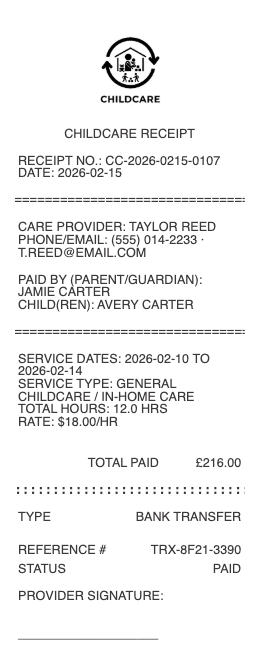
What’s on a Childcare Receipt
Caregiver’s full name — and address, since claims ask where care was provided
The caregiver’s tax identification number — SSN or EIN, the field tax forms require from individual providers
Parent or guardian’s name
The children cared for, by name
The period of care — dates or the week/month covered, with hours if paid hourly
Amount paid, payment method, and date received
Caregiver’s signature — the line that turns a note into a receipt
Receipts for Nannies, Babysitters, and In-Home Care
The difference between a daycare invoice and a receipt for childcare services from an individual is who produces it: centers have billing systems, caregivers have a notebook. So the practical pattern is parent-prepared receipts the caregiver signs — one per payment or one per month, listing the dates, the children, the rate, and the amount, signed at handover. Regular arrangements deserve a simple template used consistently; occasional babysitting can be receipted per evening. Handwritten is fine. What matters is contemporaneous: a signed slip from the week the care happened outweighs a reconstructed summary written in March.
For a full-time nanny the stakes rise: regular wages can make the family a household employer with payroll obligations of its own. The receipts still matter — they sit alongside that payroll paperwork, not in place of it.
The Tax ID Line: Why Childcare Receipts Ask for an SSN or EIN
Every childcare tax receipt eventually feeds a claim — and the claim forms ask not just what was paid but to whom, by tax identification number. An individual caregiver provides an SSN (or an EIN if they have set one up, which many prefer for privacy); without that number, parents hit a wall at filing time and benefits administrators reject the claim. Ask for it once, when the arrangement starts, and keep it with the receipts rather than on them when sharing copies — the receipt can reference “TIN on file” for privacy, with the number supplied on the actual tax form.
The End-of-Year Childcare Receipt
Alongside per-payment slips, informal arrangements benefit from one annual childcare receipt: a single statement the caregiver signs in January totaling the year — children, period covered, total paid, caregiver details. It mirrors the year-end statements daycare centers issue and does the same job: one document for the tax file instead of fifty-two. For parents splitting care between a center and a babysitter, keep the two trails separate; each provider’s total is claimed under its own name and TIN. And where an employer benefit reimburses informal care, the signed receipt with dates and the provider’s details is exactly what the administrator wants attached.
Related childcare and education receipts: see also our Tutoring receipt guide and our Daycare receipt guide.
Create a Childcare Receipt
Our generator builds a childcare receipt template in a minute — caregiver and parent blocks, children and period of care, hours and rate or the agreed amount, payment method, and a signature line — as a clean PDF for weekly slips or the year-end statement.
Use it responsibly: childcare receipts document care that actually happened, at the amounts actually paid. Fabricating them for tax credits or dependent-care claims is fraud that implicates both the parent and the named caregiver.
Center-based care and its tax-credit paperwork live on the daycare receipt page; school-age costs on the tuition receipt page.
Paying an occasional sitter rather than a provider? The babysitting receipt example covers sitter payments and the household-employer threshold.
Frequently asked questions
Everything you need to know about the product and billing.
What should a childcare receipt include?
The caregiver’s name, address, and tax ID (SSN or EIN), the parent’s name, the children cared for, the period of care with hours if hourly, the amount and payment method, and the caregiver’s signature.
Can a babysitter write a handwritten receipt?
Yes — handwritten is fine. The reliable pattern is a parent-prepared slip the caregiver signs at payment, one per evening or per week, so the record is created when the care happens.
Why does a childcare receipt need the caregiver’s SSN or EIN?
Tax claims for childcare identify the provider by tax ID. Without it the claim stalls — so collect it when the arrangement begins. Caregivers who prefer not to share an SSN can obtain an EIN instead.
What is an end-of-year childcare receipt?
A single signed statement totaling the year’s care — children, period, total paid, and provider details. It condenses the weekly slips into the one document tax filing actually uses.
Is a childcare receipt different from a daycare receipt?
The fields match, but daycare centers issue statements from billing systems, while individual-caregiver receipts are usually parent-prepared and signed by the caregiver. Claims treat each provider separately, under their own name and TIN.
Do I need childcare receipts for a dependent-care benefit at work?
Yes — administrators reimburse against documentation showing the provider, the dates of care, and the amount. A signed receipt with those fields, or the annual statement, is the standard attachment.