A valet parking receipt is half of a two-document system: the numbered claim ticket that gets your car back, and the payment receipt that proves what you paid. Valet also does something self-parking never does — you hand a stranger your keys — which makes the paperwork part of a custody arrangement, not just a fee record. This page explains what a valet receipt shows, how the claim ticket works, and what to do about damage.
Valet Parking Receipt
Add custom logo
Edit line items
Choose payment method
Add/remove elements
Customize business information
Choose font
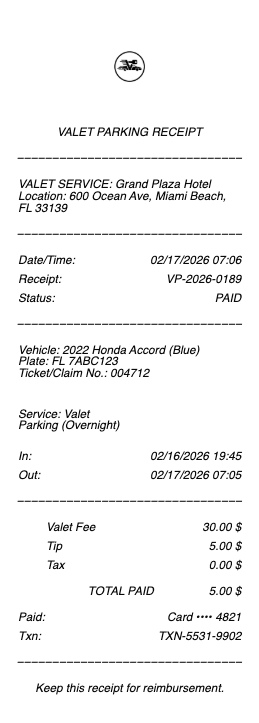
What’s on a Valet Parking Receipt
The venue or valet operator — hotel, restaurant, event, hospital
The claim/ticket number matching the tag on your keys
Time in and time out
The rate — flat event rate, hourly, or overnight hotel valet
A tip line, on card payments
Vehicle details — make, color, sometimes plate
Validation, if the venue stamps or discounts
The Claim Ticket and the Receipt — Two Different Documents
Valet runs on a numbered three-part ticket: one tag goes on your keys, one on or in the car, and the claim check goes in your pocket. That claim check is not a receipt — it’s the custody token you exchange to retrieve the car, and its number ties your keys, your car, and you together in the valet’s system. The payment receipt is the separate slip (or card confirmation) proving the fee was paid. Lose the claim ticket and you don’t lose the car — but expect the slow lane: photo ID, registration or proof of ownership, and a manager’s sign-off before the keys come back, precisely because the ticket is the security system. The habit that prevents all of it: photograph the claim check the moment it’s handed over, so the number survives even if the paper doesn’t.
Handing Over the Keys — Custody and Damage
Legally, valet is a bailment: you transfer temporary custody of the car to the operator, which is why valet damage claims work differently from a scraped door in a self-park lot. While the car is in the valet’s hands, the operator bears responsibility for it — and the fine print on tickets (“not responsible for…”) is not the last word, since an operator generally can’t disclaim its own negligence. The protocol that makes a claim winnable is simple and time-sensitive: inspect the car at pickup, before driving off; report any new damage immediately, on the spot, with the ticket number; get an incident report from the attendant or manager; and photograph everything. A claim raised the next day is a fight; one raised at the podium with photos and the ticket number is usually just a process. The receipt and claim number anchor the whole file.
Hotels, Events, Validation, and Expenses
Where valet shows up shapes the paperwork. Hotel valet is typically an overnight per-day rate charged to the room folio, so the “receipt” is a line on your hotel bill — with in-and-out privileges usually included. Restaurants and events run flat rates paid at the podium; hospitals often subsidize or validate. Validation — the venue stamping or discounting your ticket — turns a paid service into a free or reduced one, and the receipt should show it. For business travel, valet is a legitimate travel expense (parking while on business), and the receipt — or the folio line — is the substantiation an expense report wants. Tips are the last piece: cash to the attendant is customary and invisible to paperwork, while card payments add a tip line that puts the gratuity on the record — worth noting when your statement total exceeds the podium price.
Related parking and travel receipts: see also our Airport Taxi receipt guide and our Taxi receipt guide.
Create a Valet Parking Receipt
Our generator produces a clean valet receipt — venue and operator, claim number, times in and out, rate, tip, and total — as a PDF for an expense report, a damage-claim file, or your records when the original slip is lost or faded.
Use it responsibly: recreate only real valet transactions that actually happened, with true details. Fabricating a valet receipt to pad an expense report, invent a parking cost, or support a false damage claim is fraud — operators keep ticket logs matching claim numbers to vehicles and times, and expense audits check exactly these small recurring items. This tool is for legitimate record-keeping only.
Frequently asked questions
Everything you need to know about the product and billing.
What does a valet parking receipt show?
The venue or valet operator, the claim/ticket number matching your key tag, time in and out, the rate (flat, hourly, or overnight hotel), a tip line on card payments, vehicle details like make and color, and any validation stamp or discount from the venue.
What’s the difference between the claim ticket and the receipt?
The claim ticket is the custody token — the numbered check you exchange to get the car back, tying your keys, car, and you together in the valet’s system. The payment receipt separately proves the fee was paid. Photograph the claim check when it’s handed over, so the number survives the paper.
What happens if I lose my valet ticket?
You’ll still get the car, but through the slow lane: photo ID, registration or proof of ownership, and usually a manager’s sign-off — the friction is deliberate, because the ticket is the security system. A photo of the ticket number shortcuts most of it.
Is the valet responsible if my car is damaged?
Valet is a bailment — a transfer of custody — so the operator bears responsibility while the car is in its hands, and ticket fine print generally can’t disclaim its own negligence. The key is timing: inspect at pickup, report damage on the spot with the ticket number, and get an incident report.
How does hotel valet billing work?
Usually an overnight per-day rate charged to your room folio — the receipt is a line on the hotel bill, with in-and-out privileges typically included. For expense reports, that folio line is the substantiation, just like a standalone valet receipt.
Is valet parking a deductible business expense?
When it’s parking during business travel or a business meeting, yes — it’s a standard travel expense, substantiated by the valet receipt or hotel folio line. Card-paid tips appear on the tip line; cash tips to the attendant never reach the paperwork.