A fuel receipt is the working document of anyone who drives for a living. Where an ordinary gas receipt proves one fill-up, fuel receipts get kept in bulk — logged per truck, per state, per quarter — because owner-operators, fleets, and IFTA filings all run on them. This page covers the commercial side: logs, IFTA requirements, diesel, and fleet cards.
Fuel Receipt
Add custom logo
Edit line items
Choose payment method
Add/remove elements
Customize business information
Choose font
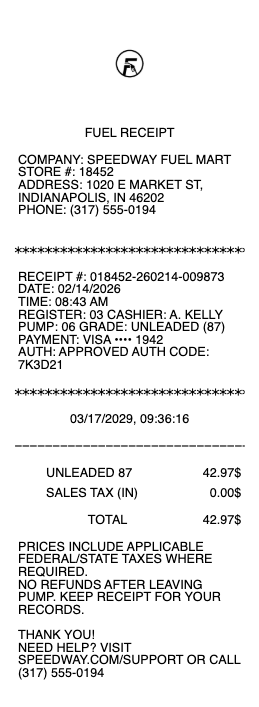
What’s on a Fuel Receipt (When It Has to Survive an Audit)
Seller’s name and address — the station and, crucially for IFTA, the state or jurisdiction
Date of purchase
Fuel type — diesel, gasoline, or DEF as its own line
Gallons purchased and price per gallon
Total paid and payment method — fleet card, company card, or cash
Vehicle or unit number — written on the slip or captured by the fleet-card prompt
Odometer reading, where your log or card program requires it
The Fuel Receipt Log: Per Truck, Per State, Per Quarter
A fuel receipt log is what turns a shoebox of slips into a defensible record. The working format is simple: one row per purchase — date, state, station, fuel type, gallons, amount, unit number — kept per vehicle and totaled per quarter. Drivers keep it as a notebook, a spreadsheet, or a fuel receipt app that photographs each slip and files it automatically; fleets pull the same rows from card statements. The log matters because thermal receipts fade and audits arrive years later: the row plus the stored image is the pair that answers every question a reviewer asks.
Personal-vehicle business drivers face a fork the log resolves: the standard mileage rate replaces fuel receipts with a mileage log, while the actual-expense method needs every fuel slip. Choosing the method decides which paper matters — but keeping both for a first year is how you learn which method actually pays more for your driving.
IFTA Fuel Receipt Requirements
Interstate carriers file quarterly fuel-tax returns under IFTA, and the receipts behind them must show the purchase date, the seller’s name and address, the fuel type, the gallons, the price, and the purchaser or unit — with the jurisdiction identifiable, since IFTA allocates tax by where fuel was bought versus where miles were driven. Pre-pay pump slips that show a dollar amount but no gallons do not satisfy the requirement; get the completed receipt after fueling. Keep receipts and logs for the retention period your base jurisdiction sets (four years is the common rule), because an IFTA audit reconstructs quarters entirely from this paper.
Diesel, DEF, and Fleet Card Statements
Diesel fuel receipts carry the same fields with two commercial additions worth capturing: DEF purchases, which belong in the log as their own line rather than folded into fuel, and reefer fuel, which many jurisdictions treat separately from propulsion fuel for tax purposes — mark it on the receipt at the pump. Fleet cards (the industry standard for owner-operators and fleets alike) generate consolidated statements with per-transaction detail, which simplifies the log but does not replace receipt retention: the statement summarizes, the receipt substantiates. Match one to the other monthly and quarter-end stops being an event.
Related vehicle receipts: see also our Vehicle Registration receipt guide and our Gas receipt guide.
The pay-at-pump workflow has a receipt trap of its own: the pump asks after fueling, the driver taps no or the printer is empty, and the only record becomes a card statement line without gallons, fuel type, or station address — none of which satisfies a tax or IFTA file. Fleet policy worth having: receipt every fill, and when the printer fails, the inside counter can reprint from the pump number.
Create a Fuel Receipt
Our generator rebuilds a station-style fuel receipt — seller block with location, date, fuel type, gallons, price per gallon, total, and unit line — as a clean PDF for the log when an original has faded past reading or gone missing from a trip envelope.
Use it responsibly: recreate only genuine purchases, with the real gallons and amounts. Fabricating fuel receipts for IFTA filings, tax deductions, or expense claims is fraud — and fuel-tax audits are precisely the audits that check.
The personal fill-up side lives on the gas receipt page; fleet files often also carry toll receipts and tow truck receipts.
Frequently asked questions
Everything you need to know about the product and billing.
What must a fuel receipt show for IFTA?
The date, the seller’s name and address with the jurisdiction identifiable, the fuel type, gallons purchased, the price, and the purchaser or unit number. A pre-pay slip without gallons does not qualify — take the completed receipt after fueling.
How do I keep a fuel receipt log?
One row per purchase — date, state, station, fuel type, gallons, amount, unit — kept per vehicle and totaled per quarter, with the receipt image stored alongside. A notebook, spreadsheet, or receipt app all work; consistency is what matters.
How long should fuel receipts be kept?
For IFTA carriers, the common retention rule is four years from the return date — check your base jurisdiction. Thermal slips fade long before that, so photograph or scan them when they are fresh. And receipt every fill — a declined pay-at-pump receipt leaves only a card line, which carries no gallons or fuel type; the inside counter can reprint from the pump number.
Do fleet card statements replace fuel receipts?
No — the statement consolidates and summarizes, but the receipt substantiates. Keep both and reconcile monthly; auditors ask for the receipt behind the statement line.
Why is DEF listed separately on fuel receipts?
DEF is an additive, not propulsion fuel, and fuel-tax reporting treats it differently. Logging it as its own line keeps gallons-of-fuel totals clean for IFTA and keeps the expense categorized correctly.
Is a personal gas receipt different from a fuel receipt?
Same document, different job. A gas receipt proves a fill-up for an expense report; commercial fuel receipts are kept in bulk, logged by state and vehicle, and feed quarterly tax filings — this page covers that side. Which paper matters depends on the method — standard mileage runs on a mileage log, actual-expense runs on every fuel slip; keeping both for a year shows which pays more.