A visa fee receipt is proof you paid the application fee for a travel or immigration visa — and it matters more than most receipts, because you usually can’t book your appointment or submit your application without it, and the fee is non-refundable even if the visa is denied. (This is the government visa fee, not a Visa card charge.) This page explains what the receipt shows, the fees involved, and why keeping it is essential.
Visa Fee Receipt
Add custom logo
Edit line items
Choose payment method
Add/remove elements
Customize business information
Choose font
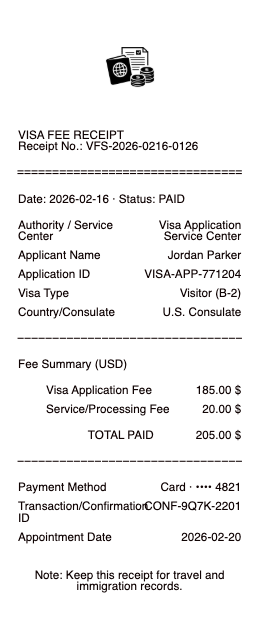
What’s on a Visa Fee Receipt
The issuing authority — embassy, consulate, or visa application center (e.g. VFS Global, TLScontact)
The applicant’s name and often a reference or application number
The visa type or category the fee applies to
The fee amount and currency, and the payment date
A payment/transaction reference needed to schedule an appointment
The payment method
Any separate fees — biometrics, service, or courier charges
Visa Fees Are Non-Refundable — and Required to Proceed
Two facts make this receipt critical. First, visa application fees are almost always non-refundable: you pay to have your application processed, not to be approved, so a denial does not get your money back. That makes the receipt your only proof of a payment you can’t recover. Second, the payment usually comes before the rest of the process — many systems require you to pay the fee first and enter the receipt/reference number to book your biometrics or interview appointment. Lose the reference and you can be stuck unable to schedule, sometimes having to pay again. The receipt (and its transaction number) is therefore a working document, not just a record: it unlocks the next step. Keeping it safe from the moment you pay — screenshot, download, and print — is the single most practical piece of visa-application admin.
The Different Fees You Might Pay
“Visa fee” often covers several charges, and the receipt may itemize them. The core application fee varies by visa category and destination country — the US calls its nonimmigrant application fee the MRV fee (Machine Readable Visa), and other countries set their own (a Schengen visa fee, a UK visa fee, and so on). On top of that you may pay a biometrics fee (fingerprints and photo), a service fee to the visa application center handling logistics, and optional courier or premium-processing charges. Some routes add category-specific costs — a SEVIS fee for US students, or a health surcharge for certain long-stay visas. Because amounts change and depend on type and country, the receipt is where you confirm exactly what you paid for. Keeping each fee’s receipt matters if you need to prove the full cost — for records, or for reimbursement.
Reimbursement, Records, and Getting a Copy
Visa fee receipts frequently need to be presented later. Employers sponsoring or relocating staff typically reimburse work-visa fees, and the itemized receipt is what an employee submits to be paid back — often required by an HR or finance policy. For expense and tax records, business-travel visa costs may be deductible or reimbursable, again on the strength of the receipt. And for the application file itself, keeping the payment confirmation with your other documents avoids problems if a fee payment is ever queried. To get a copy, the online payment portal or visa application center account usually lets you download or reprint the receipt, and a confirmation email is typically sent at payment — save it. Because the fee is non-refundable and often a prerequisite to proceed, the receipt is worth treating as one of the more important documents in an application, not a disposable slip.
Related tax and fee receipts: see also our VAT receipt guide and our Property Tax receipt guide.
Create a Visa Fee Receipt
Our generator produces a clean visa fee receipt — issuing authority, applicant, visa category, fee amount, and payment reference — as a PDF when you need a legible copy for your application file, an employer reimbursement, or your own records.
Use it responsibly: recreate only a fee you actually paid, with its true amount and reference. Fabricating a visa fee receipt to fake a payment to an embassy or visa center, support a false reimbursement claim, or mislead an immigration authority is fraud — and immigration-related misrepresentation carries serious legal consequences. The issuing authority’s and payment processor’s own records are authoritative and verifiable. This tool is for legitimate record-keeping only.
Frequently asked questions
Everything you need to know about the product and billing.
What does a visa fee receipt show?
The issuing authority (embassy, consulate, or a visa application center like VFS Global or TLScontact), the applicant’s name and a reference number, the visa type, the fee amount and currency, the payment date, a transaction reference needed to book an appointment, the payment method, and any separate biometrics or service fees.
Is a visa fee refundable if my visa is denied?
Almost never. You pay for your application to be processed, not for approval, so a denial does not refund the fee. That’s why the receipt matters — it’s your only proof of a payment you can’t recover, and you may need to pay again to reapply.
Why do I need the visa fee receipt before my appointment?
Many visa systems require you to pay the fee first and enter the receipt or transaction reference to schedule your biometrics or interview appointment. Without it you can be unable to book — and losing the reference sometimes means paying again — so keep it safe from the moment you pay.
What is the MRV fee?
The US term for its nonimmigrant visa application fee — MRV stands for Machine Readable Visa. Other countries have their own application fees (a Schengen visa fee, a UK visa fee, etc.). The amount varies by visa category and destination, which the receipt confirms.
What fees are included in a visa application?
Often several: the core application fee (which varies by category and country), a biometrics fee, a service fee to the visa center, and optional courier or premium-processing charges. Some routes add costs like a SEVIS fee for US students. The receipt may itemize each.
Can I use a visa fee receipt for employer reimbursement?
Yes — employers sponsoring or relocating staff typically reimburse work-visa fees, and the itemized receipt is what you submit to be paid back, often required by HR or finance. Business-travel visa costs may also be a deductible or reimbursable expense on the strength of the receipt.