A business lunch receipt must prove more than the amount — it must substantiate who was there and why. This guide explains the five facts a deduction requires and the record-keeping that survives an audit.
Business Lunch Receipt
Add custom logo
Edit line items
Choose payment method
Add/remove elements
Customize business information
Choose font
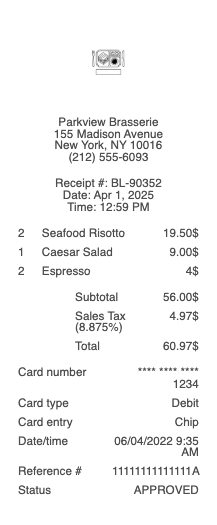
The receipt is only half the evidence
An itemised business lunch receipt establishes exactly two things: what was bought, and what it cost. A deduction requires considerably more — and the missing half is not on the receipt, has to be captured at the time, and is what actually fails at audit.
The deduction rests on five facts: who, where, when, how much, and why. The receipt supplies where, when, and how much. You must supply who and why — and nobody reconstructs those honestly eleven months later from a stack of paper.
The five facts, precisely
Who — the names of the people present and their business relationship to you. "Client" is weak; "Sarah Chen, procurement lead at Acme, existing customer" is evidence.
Where — the venue and its location.
When — the date.
How much — the itemised cost, including tax and tip.
Why — the business purpose. Not "lunch", but what was actually discussed or sought: a renewal, a proposal, a specific negotiation.
The habit that makes this effortless is thirty seconds long: write the names and the purpose on the back of the receipt before you leave the table, then photograph it. Done at the table it is trivial. Done at year-end it is impossible.
The two conditions that decide whether it qualifies at all
Before any of the substantiation matters, the meal must clear the statutory tests. A business meal is only deductible — at 50% — if:
The expense is not lavish or extravagant in the circumstances.
You, or an employee of yours, were present when the food or beverages were furnished.
The presence condition is the one that trips people. Sending a client to lunch on your card while you attend another meeting is a kind gesture and a nondeductible one. Similarly, a meal cannot be transformed into a deduction by a business conversation that never happened — the purpose has to be real, which is why writing it honestly at the table is better protection than any clever categorisation later.
Where business lunches get disallowed
No attendees recorded. The most common failure by a distance — a receipt with a total and no names.
A vague purpose. "Business development" on twenty receipts in a row invites exactly the scrutiny it is meant to avoid.
Only a card slip. It shows a total, not what was bought, and cannot separate alcohol from food.
Personal meals reclassified. Lunch alone at your desk, or with a friend who happens to work in the industry, is not a business meal because a business topic was mentioned.
Employees only. A meal with colleagues is a work meal, taxed differently — and from 2026, employer-provided meals are nondeductible.
Keeping records that survive scrutiny
Digitise the receipt with the annotation already on it — a photograph of an annotated receipt is worth far more than a pristine receipt in a drawer and a memory. Keep the itemised bill and the card slip where both exist: the first proves what, the second proves paid.
Retain the records for the period your jurisdiction requires, which is usually several years. If a receipt is lost while the meal genuinely happened, a clear reconstructed record from your card statement documents that real payment for your files — matching the charge exactly. It cannot manufacture the attendees or the purpose, and it should never be used to. The substantiation must be true; the reconstruction only ever restores the record of a payment you actually made.
Frequently
asked questions
Everything you need to know about the product and billing.
What do I need to substantiate a business lunch?
Five facts: who was present and their business relationship to you, where, when, how much (itemised), and why — the actual business purpose. The receipt supplies where, when, and how much; you must supply who and why, at the time.
Is a business lunch fully deductible?
No. A qualifying business meal is generally 50% deductible, and only if the expense is not lavish or extravagant and you or an employee were present when the food was furnished.
Can I deduct a meal I paid for but did not attend?
No. Your presence — or that of an employee — is a statutory condition. Sending a client to lunch on your card while you are elsewhere is not a deductible business meal, however genuine the business relationship.
Is a credit card slip enough?
No. It shows a total but not what was bought, and cannot separate alcohol from food. Keep the itemised bill as well, and annotate it with the attendees and purpose.
What is the most common reason a business meal is disallowed?
No attendees recorded. A receipt showing a total with no names and no purpose is the single most frequent failure — and it is the one that takes thirty seconds at the table to prevent.
Is lunch with colleagues a business lunch?
No. A meal with your own employees is a work meal, treated differently — and from 2026, employer-provided meals are nondeductible. The business-meal rules concern clients, customers, and business contacts.