A receipt of payment is the universal document that confirms a transaction has been completed — whether cash, check, wire transfer, card payment, or money order. It's what landlords give tenants after rent, what freelancers send clients after invoicing, what nonprofits issue for donations, and what any business needs to maintain clean records for tax filings and audits. With over 5,200 monthly US searches for "receipt of payment" alone (plus 15,000+ across the full keyword cluster), this is the most-requested receipt format on the internet. Generate a clean, professional receipt of payment in seconds with our tool above — covers any payment method, any transaction type, fully customizable.
Receipt of Payment
Add custom logo
Edit line items
Choose payment method
Add/remove elements
Customize business information
Choose font
What a Receipt of Payment Actually Is — And Why It Matters
A receipt of payment (sometimes written "payment receipt" or "receipt for payment") is a written or digital document acknowledging that one party has received money from another. It serves three distinct legal and practical purposes:
Proof for the payer — evidence that the obligation was satisfied. If a dispute arises, the receipt is the payer's first line of defense.
Bookkeeping record for the recipient — required by accounting standards (GAAP, IFRS) and tax authorities (IRS, HMRC, CRA, etc.) for any business transaction.
Audit trail for both parties — receipts are the primary evidence reviewed during tax audits, contract disputes, and small claims court cases.
Unlike an invoice (which requests payment), a receipt of payment confirms payment has been made. The two are easy to confuse: an invoice opens the loop, a receipt closes it.
What Belongs on a Receipt of Payment
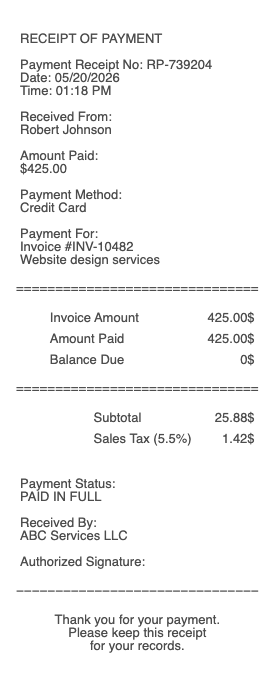
For a receipt of payment to be legally and practically valid, it should include:
Receipt number — a unique transaction ID for your records
Date of payment — when the money changed hands (not when invoiced)
Name and address of the payer (the person or business paying)
Name and address of the recipient (the person or business receiving)
Amount paid — written in both numerals and words to prevent alteration (e.g. "$500.00 — Five hundred dollars and 00/100")
Payment method — cash, check (with check number), bank transfer (with reference), card (last four digits), money order (with serial number), PayPal/Venmo/Zelle (with transaction ID), wire transfer (with confirmation code)
Purpose of payment — what the payment was for (rent for May 2026, invoice #1234, services rendered, donation, etc.)
Outstanding balance, if any — if this is a partial payment
Signature of the recipient — handwritten or digital; required for legal weight in some jurisdictions
Optional: tax identification — needed for tax-deductible payments, donations to 501(c)(3) organizations, or business-to-business transactions
Common Use Cases — When You Need a Receipt of Payment
Rent payments. Landlords are legally required in many US states (California, Maryland, Massachusetts, New York, and others) to provide a receipt of payment to tenants who pay in cash. Even where not legally required, providing one prevents the most common landlord-tenant dispute: "I paid rent already." A clean monthly receipt of payment for rent shows the payer name (tenant), the recipient (landlord or property management), property address, month covered, amount paid, and payment method.
Freelance and contractor work. When a freelancer collects payment from a client (whether by wire, ACH, or Venmo), issuing a receipt closes the project's financial paper trail. The receipt should reference the original invoice number, the services rendered, and the payment method. For 1099 contractors, monthly receipts of payment serve as the supporting documentation behind the year-end Form 1099 issued by clients.
Cash purchases. Any cash transaction over $25 in a business context typically requires a receipt for the buyer's records — IRS Schedule C filers need receipts for business expense deductions, and the burden of proof is on the taxpayer. For private sales (Craigslist, Facebook Marketplace, garage sales), a receipt of payment protects both parties: the seller has proof the sale happened, the buyer has proof of ownership.
Donation receipts. Charitable donations to qualified 501(c)(3) organizations are tax-deductible, but the IRS requires written acknowledgment for any donation of $250 or more. The receipt must include the donor's name, the date and amount, a description of any goods or services provided in exchange, and a statement that the organization is tax-exempt.
Wire transfers and money orders. Banks issue automatic receipts for wire transfers and money orders, but these are often summary-only and lack the descriptive detail needed for business expense reports or vendor reconciliation. A separate receipt of payment matching the wire reference number provides the full context.
Reimbursable expenses. For corporate expense submissions, finance teams generally accept any properly-formatted receipt of payment in lieu of a vendor-issued receipt. This is especially useful when the vendor's receipt is missing line items, lost, or in an unusable format.
Receipt of Payment vs Invoice vs Sales Receipt — The Key Distinctions
These three documents are often confused, but each has a distinct purpose in the accounting cycle:
Invoice — issued before payment. Requests payment for goods or services delivered. Includes amount due, payment terms (NET 30, due upon receipt, etc.), and instructions for how to pay.
Receipt of payment — issued after payment. Confirms money has been received. References the original invoice if applicable. Closes the financial transaction.
Sales receipt — issued at the moment of payment, typically for retail or point-of-sale transactions. Combines the invoice and receipt-of-payment functions into one document. Common at grocery stores, restaurants, gas stations.
For B2B transactions: invoice → payment → receipt of payment is the standard flow. For B2C retail: sales receipt is usually sufficient.
Legal Requirements by State and Country
United States: No federal law requires a receipt of payment in most contexts, but state landlord-tenant laws often do (especially for cash rent). The IRS recommends keeping receipts for any business deduction, but the actual format is flexible.
United Kingdom: HMRC requires receipts for VAT recovery on business expenses. The receipt must show the supplier's VAT registration number, total amount, VAT charged, and date.
European Union: Most EU countries require a receipt for transactions over a threshold (typically €150–€500 depending on country) and require VAT itemization for business-deductible expenses.
Canada: CRA requires receipts to include the vendor's GST/HST registration number, business address, and itemized tax breakdown for business expense deductions.
Generate a Receipt of Payment in Seconds
Use the generator above to create a professional, properly-formatted receipt of payment for any transaction type. Specify the payer, recipient, amount, payment method, purpose, and any reference numbers. Download as PDF or PNG instantly — no login required. Works for rent payments, freelance work, contractor invoices, donation acknowledgments, cash sales, and any other payment confirmation you need to document.
Best Practices for Issuing a Receipt of Payment
Two practices separate legally durable receipts from informal ones. First, write the amount in both digits and words ("$500.00 — Five hundred dollars and 00/100"). This prevents anyone from altering the amount after the fact. The same convention is used on personal checks for the same reason. Second, have both parties sign the receipt when possible — or at minimum, ensure the recipient signs. A signature isn't strictly required for the receipt to be a record, but it dramatically strengthens its evidentiary weight if a dispute reaches small claims court or arbitration. For digital receipts, an emailed PDF with timestamps and IP-address-bound electronic signatures (DocuSign, Adobe Sign, HelloSign) provide the same legal weight in most jurisdictions.
Partial Payments and Receipt Sequences
When a transaction is paid in installments, each payment requires its own receipt of payment — and each receipt should reference the original total and the remaining balance after this payment. For example: an invoice for $1,500 paid in three $500 installments generates three separate receipts. The first shows "$500 paid, $1,000 remaining." The second shows "$500 paid, $500 remaining." The third shows "$500 paid, $0 remaining (PAID IN FULL)." This sequencing matters legally: if a dispute arises, the receipts together prove the full payment timeline. Without the running balance, each receipt looks like an isolated $500 transaction.
Digital vs Paper Receipts — Both Are Legally Valid
Both paper and digital receipts of payment are legally valid in the US, UK, EU, Canada, and most other jurisdictions, provided they contain the required information. The IRS explicitly accepts digital receipts as substitutes for paper since 1997 (Revenue Procedure 97-22), and most tax authorities worldwide have followed suit. For practical purposes, digital receipts have advantages: they don't fade, they're searchable, they can be backed up, and they include automatic timestamping. The standard for business record retention is 7 years in the US (matches the IRS audit lookback window) — far longer than thermal-paper receipts physically survive. For long-term records, digital is the only viable option.
Common Mistakes That Make a Receipt of Payment Invalid
Three errors regularly cause receipts to be rejected by auditors or in legal disputes. First, missing payment method — a receipt that doesn't specify "cash," "check #1234," or "Zelle transfer ref XYZ" can be challenged because the payment itself can't be traced. Second, vague purpose — "for services" is too generic. Use "for plumbing services performed on May 15, 2026 at 123 Main St, per invoice #4567." Specificity protects against re-billing claims. Third, backdating — never issue a receipt with a date earlier than the actual payment date. Tax authorities and courts treat backdated receipts as fraud, even if the underlying payment was legitimate. Always use the actual transaction date.
Generate a Receipt of Payment Online — Free, No Login
Our receipt of payment generator creates a professional, legally-formatted receipt in under a minute. Add the payer and recipient names and addresses, transaction date, amount paid (with the dollar-and-words notation for legal durability), payment method (cash, check, wire transfer, money order, Zelle, Venmo, PayPal, ACH, or card), purpose of payment, any reference invoice number, and outstanding balance if it's a partial payment. Download as PDF or PNG instantly. Works for rent payments, freelance services, contractor work, charitable donations to 501(c)(3) organizations, cash purchases, wire transfer confirmations, money order acknowledgments, and any other payment that needs documentation. Especially useful for landlords providing rent receipts to tenants (legally required in many US states for cash payments), freelancers closing the financial paper trail with clients, nonprofits issuing tax-deductible donation acknowledgments, small businesses maintaining audit-ready records for Schedule C deductions, and individuals documenting private sales for tax records.
Frequently
asked questions
Everything you need to know about the product and billing.
What is a receipt of payment?
A receipt of payment is a written or digital document confirming that money has been received from one party by another. It's distinct from an invoice (which requests payment) and a sales receipt (which is issued at the point of sale). A proper receipt of payment includes the receipt number, transaction date, payer and recipient names, amount paid in both digits and words, payment method, and purpose of payment. It serves as proof for the payer, bookkeeping record for the recipient, and audit trail for both.
Is a receipt of payment legally required?
It depends on the context and jurisdiction. In the US, no federal law universally requires a receipt of payment, but many states require landlords to issue receipts for cash rent payments (California, Maryland, Massachusetts, New York, among others). The IRS strongly recommends keeping receipts for any business expense deduction. The UK's HMRC requires receipts with VAT itemization for VAT recovery. The EU and Canada have similar requirements. When in doubt, issue and keep the receipt — the cost is minimal, the benefit is large.
What's the difference between a receipt of payment and an invoice?
An invoice requests payment — it's issued before money changes hands and includes amount due, payment terms, and instructions. A receipt of payment confirms payment has been made — it's issued after money has been received. The two together form a complete transaction record: invoice opens the loop, receipt closes it. For B2B transactions, the standard flow is invoice → payment → receipt. For retail/point-of-sale, a single sales receipt combines both functions.
Can I issue a receipt of payment digitally instead of on paper?
Yes. Digital receipts of payment are legally valid in the US (since IRS Revenue Procedure 97-22 in 1997), UK, EU, Canada, and most other jurisdictions, provided they contain the required information. Digital receipts have practical advantages: they don't fade, they're searchable, they can be backed up, and they include automatic timestamping. For long-term record retention (7 years for US business records), digital is the only viable option — thermal paper fades within months.
What should I do if I receive payment in installments?
Issue a separate receipt of payment for each installment, and each receipt should clearly show the original total, the amount paid this transaction, and the remaining balance. For example: a $1,500 invoice paid in three installments generates three receipts. The first shows '$500 paid, $1,000 remaining.' The second shows '$500 paid, $500 remaining.' The third shows '$500 paid, $0 remaining (PAID IN FULL).' This running-balance approach is important if a dispute arises — it proves the full payment timeline.
What information must be on a receipt of payment for tax purposes?
For the IRS in the US, a tax-valid receipt of payment must include: the date of the transaction, the amount paid, the name and address of the recipient, a description of what the payment was for, and the form of payment. For business expense deductions on Schedule C, any payment over $75 generally needs a receipt (though best practice is to keep receipts for all business expenses). For charitable donations to 501(c)(3) organizations of $250 or more, the IRS additionally requires a written acknowledgment from the organization stating that no goods or services were provided in exchange, or describing any that were.