Need a Spectrum receipt for internet, cable TV, home phone, or Spectrum Mobile service? Spectrum (Charter Communications) services nearly 32 million customers — the second-largest US ISP — and the "spectrum receipt" search commands $700 CPC, signaling extreme commercial intent. Home internet and TV bills are essential business expense documentation for self-employed remote workers, content creators, and small business owners working from home. Generate a clean Spectrum bill in seconds using our tool above.
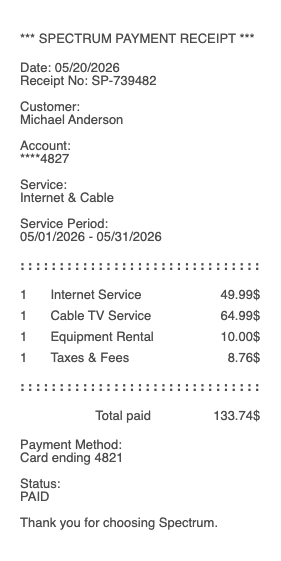
Spectrum Internet & Cable Receipt
Add custom logo
Edit line items
Choose payment method
Add/remove elements
Customize business information
Choose font
Why Spectrum Receipts Matter for Business Expenses
The $700 CPC on "spectrum receipt" reflects a real market: home internet bills are tax-deductible for self-employed workers, freelancers, content creators, and remote employees claiming home-office expenses. The IRS allows deduction of the business-use portion of home internet — typically 30–80% depending on actual usage. Schedule C filers, LLCs, and S-Corps all need monthly Spectrum bills as documentation.
Where to find your Spectrum receipt:
Sign in at spectrum.net
Click Billing in the top menu
Click Statements → select past month
Click View Statement or Download PDF
Spectrum retains statements for approximately 16 months in the online portal. For older bills, call 1-833-267-6094 or visit a Spectrum retail store — paper copies typically arrive 7–10 business days later.
What's on a Complete Spectrum Bill
Spectrum account number
Service address (the physical location where service is delivered)
Billing period and statement date
Services bundled: Spectrum Internet (Standard, Ultra, Gig), Spectrum TV (Select, Mi Plan Latino, Silver, Gold), Spectrum Voice (home phone), Spectrum Mobile (wireless on Charter's MVNO)
Equipment charges: modem, WiFi router, cable box, DVR, voice modem (typically $5–$15/equipment/month)
Broadcast TV surcharge (~$25/month — often the biggest "hidden" line)
Sports surcharge if TV package includes sports networks
Franchise fee (varies by jurisdiction)
FCC fees, taxes, regulatory recovery
Promotional discounts applied (with expiration dates)
Auto Pay discount ($5–$10/month if enrolled)
Total amount due and payment due date
The Hidden Cost — Broadcast TV Surcharge and Sports Surcharge
Spectrum bills almost always include a Broadcast TV Surcharge (currently ~$25/month) and often a Sports Programming Surcharge (~$10–$13/month) — fees that aren't in the advertised plan price but appear on every bill. The Broadcast TV Surcharge alone has been the subject of multiple class-action lawsuits because it's described in marketing as an "FCC fee" but is actually a Spectrum-set markup. For business expense reports, these fees are part of the legitimate cost of service and reimbursable — just document them clearly on your receipt.
Spectrum Promotional Pricing and Bill Increases
Spectrum heavily uses promotional pricing — sign up at $49.99/month for Internet, then jump to $89.99/month at month 13 when the promo expires. Your bill shows the promotional discount as a separate line that disappears on the renewal date. For tax records, document the actual amount paid each month (post-promo) rather than the advertised rate. If your bill suddenly increased $40, the promo expired — that's the actual ongoing cost going forward.
Spectrum Business Internet
Spectrum Business (formerly Time Warner Cable Business Class) has its own billing portal at business.spectrum.com with different invoice formats than residential. Business bills show: company name as account holder, business-grade SLA pricing (higher than residential, but with service guarantees), static IP if configured, tax-exempt status for nonprofits/government, and itemized line items per service location for multi-site businesses. Business Internet starts at $49.99/month and goes up to several hundred per month for fiber and dedicated bandwidth tiers.
Spectrum Mobile — Bundled Wireless on Verizon's Network
Spectrum Mobile uses Verizon's network as an MVNO (mobile virtual network operator). Spectrum Internet customers can add mobile lines at $29.99–$49.99/month per line. The Spectrum Mobile portion appears on the same bill as Spectrum Internet/TV — itemized as separate lines per mobile number. For tax purposes, mobile and internet expenses may need to be documented separately even though they appear on one consolidated bill.
Generate a Replacement Spectrum Bill
Use the generator above to create a clean Spectrum bill with all line items your finance team needs: account number, service address, billing period, services bundled, equipment charges, Broadcast TV surcharge, taxes, promotional discounts, AutoPay credit, and total due. Download as PDF or PNG. Especially useful for self-employed home-office deductions, replacing lost statements for tax records, business-account reconciliation, and Spectrum Mobile line itemization.
Spectrum $700 CPC — Why Internet Bill Searches Are So Valuable
The "spectrum receipt" head term commands $700 cost-per-click in Google Ads — among the highest CPCs in the receipt-generator space. The reason: advertisers in the home-internet competition space (Verizon Fios, AT&T Fiber, T-Mobile Home Internet, Frontier, Cox) bid aggressively to capture customers actively reviewing their Spectrum bill — i.e., people who might be ready to switch. Plus business-expense automation and tax-prep services bid for self-employed audiences scrutinizing recurring household costs. The high CPC signals a high-value audience.
Spectrum vs Xfinity vs Cox Bill Formats
The big three cable ISPs have different bill formats. Spectrum (Charter) has the simplest bills with services bundled in clear sections. Xfinity (Comcast) has the most itemized bills with extensive surcharge breakdowns. Cox falls between. All three include broadcast TV surcharges and sports surcharges that aren't in advertised pricing. For corporate expense reports comparing residential ISPs for home-office allowances, document the carrier on each receipt — finance teams may apply different reimbursement caps depending on carrier.
Home Internet Tax Deduction — IRS Rules for Schedule C Filers
The IRS allows deduction of the business-use portion of home internet for self-employed workers, freelancers, and content creators. The standard method: track total hours of internet use per week, then calculate business hours as a percentage. A typical work-from-home professional might claim 50–70% business use. Document each monthly Spectrum bill for the tax year. If audited, the IRS may request bills + usage justification — keep clean PDFs of every monthly statement. Missing months can be reconstructed via the Spectrum portal (last 16 months) or generated as clean replacements for older periods.
Spectrum Business vs Residential — When to Use Which
For LLC owners and incorporated businesses running operations from a home office, Spectrum Business Internet (rather than residential) offers: business-grade SLA with credits for outages, static IP option, dedicated business support phone line, and bills issued to the business name. The trade-off: business plans cost 30–80% more than residential. For tax purposes, business plan costs are 100% deductible as business expense (no business-use percentage calculation needed). Document the plan type clearly — residential bills require usage allocation; business bills don't.
Generate a Spectrum Bill — Free, No Login
Our Spectrum receipt generator creates clean, expense-ready bills for any Spectrum service: Spectrum Internet (Standard, Ultra, Gig), Spectrum TV (Select, Mi Plan Latino, Silver, Gold), Spectrum Voice home phone, Spectrum Mobile, and Spectrum Business. Add account number, service address, billing period, bundled services per line, equipment charges (modem, router, cable box, DVR), Broadcast TV Surcharge, Sports Surcharge, franchise fee, FCC fees, taxes, promotional discounts with expiration dates, AutoPay credit, and total due. Especially useful for self-employed Schedule C tax record reconstruction documenting home-office internet deductions, replacing lost monthly statements for IRS audit support, business account reconciliation against residential pricing, Spectrum Mobile line-by-line itemization, and documenting promotional pricing expiration transitions. Download as PDF or PNG instantly.
Frequently
asked questions
Everything you need to know about the product and billing.
How do I get a copy of my Spectrum bill?
Sign in at spectrum.net → click Billing in the top menu → click Statements → select past month → View Statement or Download PDF. Spectrum retains statements for about 16 months. For older bills, call 1-833-267-6094 or visit a Spectrum retail store — paper copies arrive 7–10 business days later. For self-employed tax records, save monthly PDFs as soon as available.
Why is my Spectrum bill higher than the advertised plan price?
Spectrum bills include charges beyond the advertised plan rate: Broadcast TV Surcharge (~$25/month), Sports Programming Surcharge if your TV package includes sports (~$10–$13/month), equipment charges (modem $5, router $5–$10, cable box $10–$15 each), franchise fee, FCC fees, and applicable taxes. The advertised price is the base — actual bills run $30–$60 higher per month. Promotional pricing also expires at month 13, often causing a $40+ jump.
Can I deduct my Spectrum internet bill as a business expense?
Yes, for self-employed workers, freelancers, content creators, and small business owners. The IRS allows deduction of the business-use portion of home internet — typically 30–80% depending on actual usage. Schedule C filers need monthly Spectrum bills as documentation. If you're missing months, generate clean replacement bills with the original charge amounts. Spectrum Business Internet (versus residential) is 100% deductible without usage allocation.
What's the Broadcast TV Surcharge on my Spectrum bill?
The Broadcast TV Surcharge (~$25/month) is a Spectrum-set fee that covers retransmission costs for local broadcast channels. It's marketed as an 'FCC fee' but is actually a Spectrum markup — the subject of multiple class-action lawsuits. It appears on virtually every Spectrum TV bill. For business expense reports, it's a legitimate part of the cost of service and reimbursable — just document it clearly as a separate line.
Why did my Spectrum bill suddenly increase by $40+?
Your promotional pricing expired. Spectrum heavily uses promo pricing — sign up at $49.99/month, then jump to $89.99/month at month 13 when the promo ends. The promo discount is shown as a separate line on your bill that disappears on the renewal date. To get a new promo, you typically need to call retention (1-833-267-6094) and negotiate — or threaten to switch. For tax records, document the post-promo rate as the ongoing actual cost.
Is Spectrum Business worth it for home offices?
For LLC owners and incorporated businesses, Spectrum Business Internet offers business-grade SLA (outage credits), static IP option, dedicated business support, and bills issued to the business name. Business plans cost 30–80% more than residential, but 100% of the cost is tax-deductible (no business-use percentage calculation). For a sole proprietor doing freelance work from home, residential plus tax allocation is usually cheaper. For an incorporated business with multiple remote workers, Spectrum Business often makes financial sense.