A freelance receipt is what an independent contractor gives a client to confirm a payment was received — and for the freelancer it’s also a piece of their own tax record. Because no employer withholds taxes from freelance income, these receipts do double duty: they reassure the client and they document income you’ll report yourself. This page explains what a freelance receipt shows, how it differs from an invoice, and why it matters at tax time.
Freelance Receipt
Add custom logo
Edit line items
Choose payment method
Add/remove elements
Customize business information
Choose font
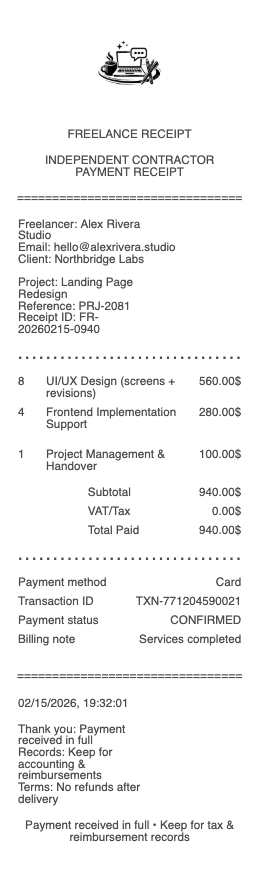
What’s on a Freelance Receipt
Your name or business and contact details (the freelancer as payee)
The client and the date payment was received
A description of the work — project, service, or hours billed
The amount paid, and whether it’s a deposit, milestone, or final balance
Payment method — bank transfer, PayPal, Stripe, Wise, or business Venmo
An invoice or receipt number for your records
Any remaining balance and applicable tax, if you charge it
Invoice vs Receipt — Freelancers Issue Both
Freelancers deal in two documents, and mixing them up causes confusion. An invoice is a request for payment — sent before the client pays, stating what’s owed and when. A receipt is a confirmation — issued after payment lands, proving the money was received. A typical project generates an invoice up front and a receipt once paid, and many freelancers send both so the client has a clean paper trail. It’s common to bill in stages: a deposit to book the work, then milestone payments, then a final balance — each of which should get its own receipt showing what it was. When a client asks for “the receipt” for their bookkeeping, they mean the paid confirmation, not the invoice — so issuing a clear receipt at payment keeps both sides’ records straight.
1099-NEC and Self-Employment Tax
This is where freelance receipts really earn their place. No client withholds tax from your pay, so you report the income and pay the tax yourself — and your receipts are the record behind it. A client who pays you $600 or more in a year files a 1099-NEC reporting what they paid; but you must report all freelance income, including from clients who never send a 1099, and your receipts are how you total it accurately. On that income you owe self-employment tax (about 15.3% for Social Security and Medicare) on top of income tax, typically paid in quarterly estimated installments to avoid a penalty. Reconciling your issued receipts against the 1099-NECs you receive is the standard year-end check — it catches a client who under-reported and confirms your own total is right.
Tracking Income, Deductions, and Getting Organized
Beyond individual payments, your receipts are your bookkeeping. The receipts you issue total your income; the receipts you keep (software subscriptions, equipment, a home-office share, contractor payments you make) total your deductible business expenses, which lower the income you’re taxed on. Keeping both sides organized through the year is what turns tax season from a scramble into a summation. Many freelancers use invoicing tools that generate sequential receipts automatically, but the essentials never change: who paid, when, for what, how much. For a clean record, give every payment its own numbered receipt and file it alongside the matching invoice — that pairing is what an accountant, or the IRS, wants to see if your return is ever questioned.
Related creative service receipts: see also our Software Services receipt guide and our Photography receipt guide.
Create a Freelance Receipt
Our generator produces a clean freelance receipt — your details and the client’s, the work, the amount and whether it’s a deposit or final payment, the method, and a receipt number — as a PDF you can send a client or keep for your own income records and tax file.
Use it responsibly: recreate only real payments you actually received, with their true amounts and dates. Fabricating freelance receipts to inflate income for a loan, understate it for taxes, or invent business expenses is fraud — the figures must match what you report on your return and what clients report on their 1099-NECs, which the IRS cross-checks. This tool is for legitimate record-keeping only.
Frequently asked questions
Everything you need to know about the product and billing.
What does a freelance receipt show?
Your name or business as payee, the client and the date payment was received, a description of the work, the amount paid and whether it’s a deposit, milestone, or final balance, the payment method, a receipt or invoice number, and any remaining balance or tax you charge.
What’s the difference between a freelance invoice and receipt?
An invoice is a request for payment sent before the client pays, stating what’s owed. A receipt confirms payment was received afterward. A project usually generates an invoice up front and a receipt once paid — when a client asks for “the receipt,” they mean the paid confirmation.
Do I need to report freelance income if I don’t get a 1099?
Yes. A client who pays you $600 or more files a 1099-NEC, but you must report all freelance income, including from clients who never send one. Your issued receipts are how you total that income accurately for your return.
What taxes do freelancers pay on their income?
Because no one withholds tax from your pay, you owe income tax plus self-employment tax — about 15.3% for Social Security and Medicare — usually paid in quarterly estimated installments to avoid a penalty. Your receipts document the income those taxes are based on.
How do freelance receipts help at tax time?
The receipts you issue total your income; the receipts you keep for expenses (software, equipment, home office) total your deductions. Reconciling issued receipts against the 1099-NECs clients send is the standard year-end check that your reported total is correct.
Should I give a receipt for a deposit or partial payment?
Yes — give each payment its own receipt showing what it was: deposit, milestone, or final balance. It keeps both your records and the client’s clean, and it clearly documents a staged project where several payments add up to the total fee.