A medical receipt is the payment record a clinic, hospital, therapist, or private practice gives a patient — proof of what was paid, for which service, on which date. It is the document insurance reimbursements, HSA and FSA claims, and medical-expense tax records all ask for, and it is not the same thing as the bill or the EOB that arrive around it.
Medical Receipt
Add custom logo
Edit line items
Choose payment method
Add/remove elements
Customize business information
Choose font
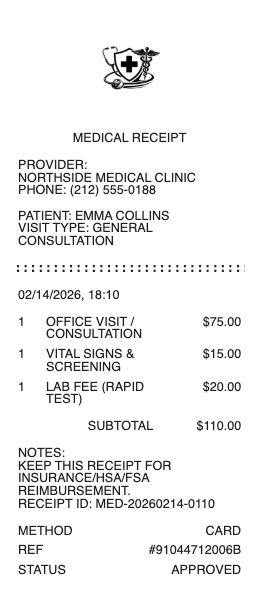
What’s on a Medical Receipt
Provider name, practice address, and phone
Patient name — and the account or patient ID the office uses
Date of service, which is not always the payment date
Description of each service — visit, procedure, test, or therapy session, itemized
Amount charged per service, adjustments, and what insurance covered
The amount the patient actually paid — copay, coinsurance, or self-pay — and the payment method
Balance remaining, if the receipt covers a partial payment
Medical Bill, Receipt, and EOB — Which Document Is Which
Three documents follow almost every visit and they get confused constantly. The medical bill asks for money: it lists charges and a due date. The EOB (explanation of benefits) comes from your insurer and is explicitly not a bill — it shows what the plan allowed and paid. The medical receipt is the one that proves you paid: it exists only after money changes hands. When a bill says “due upon receipt,” it means payment is expected as soon as the bill reaches you, not that a receipt is due — another reason the terms blur. For any reimbursement or dispute, the receipt is the document that counts.
Itemized Medical Receipts for Insurance, HSA, and FSA Claims
A card slip showing “$240 — Family Practice” gets rejected; an itemized medical receipt gets paid. Insurers, HSA custodians, and FSA administrators want the service level of detail: each visit or procedure described, its date, its price, and who paid what. If the front desk hands you a bare payment slip, ask for an itemized receipt or a superbill — practices produce them on request, and therapists and out-of-network providers do it routinely so patients can self-file claims. Keep them with your tax records too: unreimbursed medical expenses can count toward an itemized deduction once they clear the IRS threshold for the year.
Medical Receipt Template: What a Valid One Needs
A usable medical receipt template mirrors the anatomy above — provider block, patient, date of service, itemized services with amounts, insurance adjustment if any, amount paid, and balance. Two details make or break it. First, the date of service must be distinct from the payment date, because claims are keyed to when care happened. Second, the amounts must reconcile: charged, adjusted, covered, paid. Receipts that skip the arithmetic get bounced back by claims reviewers, which is exactly the delay an organized patient is trying to avoid.
Related medical receipts: see also our Dental receipt guide and our Vet receipt guide.
Create a Medical-Style Receipt
Our generator rebuilds a clean, itemized medical-style receipt — provider details, patient, date of service, each service with its amount, and the payment line — as a downloadable PDF for your health-expense files.
Use it responsibly and firmly: recreate only payments that genuinely happened, with real amounts. Submitting a fabricated medical receipt to an insurer, HSA, FSA, or tax authority is fraud with serious consequences. For claims, the safest document is always a duplicate receipt or superbill requested from the provider’s billing office — they are required to keep the records and reissue them.
Specific health receipts have their own pages: pharmacy receipt, prescription receipt, and dental receipt.
Frequently asked questions
Everything you need to know about the product and billing.
What is a medical receipt?
The payment record a healthcare provider issues after you pay — showing the provider, patient, date of service, the services received, and the amount paid. It proves payment, unlike a bill (a request for payment) or an EOB (an insurer’s summary).
What does “due upon receipt” mean on a medical bill?
It means payment is expected as soon as the bill reaches you rather than by a later due date. In practice, most billing offices still allow a short window or a payment plan if you call them.
What needs to be on a receipt for an HSA or FSA claim?
The provider’s name, patient’s name, date of service, a description of each service, and the amount paid. Administrators routinely reject bare card slips that show only a total.
What is an itemized medical receipt or superbill?
A receipt that breaks the visit into individual services with their own amounts — often with provider credentials and service codes. Ask the billing desk for one; out-of-network and therapy practices issue them routinely for self-filed claims.
Can I get a duplicate medical receipt later?
Yes. Billing offices keep payment records and can reissue receipts or print an account statement listing your payments — usually the fastest fix for a lost receipt at claim or tax time.
Are medical receipts needed for taxes?
If you itemize and claim medical expenses, receipts are the substantiation — keep them for every unreimbursed payment. Only expenses above the IRS threshold for the year count toward the deduction.