An NGO donation receipt acknowledges a gift to a non-governmental organization — and because “NGO” usually means an organization working across borders, these receipts live in a more complicated world than a domestic charity slip. Whether a donation is tax-deductible depends on where the NGO is registered versus where you pay tax, and each country runs its own scheme. This page explains what an NGO receipt shows and the cross-border rules donors most often get wrong.
NGO Donation Receipt
Add custom logo
Edit line items
Choose payment method
Add/remove elements
Customize business information
Choose font
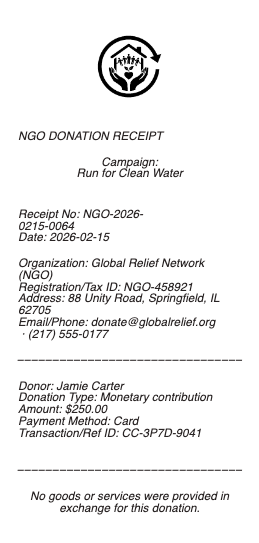
What’s on an NGO Donation Receipt
The NGO’s name and registration — its charity/nonprofit number in its home country
The donor’s name and the donation date
The amount, or a description of an in-kind gift
A statement of whether goods or services were received in return
The tax-scheme reference — e.g. a 501(c)(3) EIN, a UK charity number, an Indian 80G registration
An authorized signature or stamp
A receipt number for the NGO’s donor records
The Cross-Border Catch — Where the NGO Is Registered Decides
Here’s the rule that surprises generous people at tax time: for US taxpayers, a donation is deductible only if it goes to a US-registered 501(c)(3) organization — a gift made directly to a foreign NGO is generally not deductible on a US return, no matter how genuine the cause. The standard solution is the “friends of” structure: many international NGOs maintain a US 501(c)(3) affiliate (or accept gifts via a donor-advised fund or fiscal sponsor) so that US donors give to the US entity, get a deductible receipt with its EIN, and the funds are granted onward. The same logic runs in reverse for donors in other countries giving to US charities. So before assuming a deduction, check which entity issued your receipt and where it’s registered — the receipt’s registration line, not the cause’s worthiness, is what your tax authority looks at.
Country Schemes — Gift Aid, 80G, and Local Rules
Each country wraps donations in its own scheme, and the receipt reflects it. In the UK, Gift Aid lets a registered charity reclaim basic-rate tax on a donation (25p per £1) — but it needs a Gift Aid declaration from the donor, and higher-rate taxpayers claim the difference themselves, so the receipt and declaration together do the work. In India, donations to NGOs approved under Section 80G earn the donor a percentage deduction, and the receipt must carry the NGO’s 80G registration details to be usable. Other countries run comparable regimes with their own registration numbers and receipt requirements. And on the NGO’s side, organizations that receive foreign donations often face their own compliance — India’s FCRA registration for accepting overseas funds is a well-known example. The practical takeaway: an NGO receipt is written to satisfy a specific country’s scheme, and it should name that scheme’s registration.
Donor Records, In-Kind Gifts, and Corporate Giving
For an individual donor, the essentials mirror any charitable record: keep the receipt (and your bank record) for each gift, and for in-kind donations expect the NGO to describe the goods while the donor establishes the value — NGOs generally don’t appraise. Regular donors should ask for an annual giving statement, one document totaling the year. For corporate donors, NGO receipts feed CSR and grant reporting: a company supporting an international program needs the receipt trail matching its grant agreement, and foundations require receipts and reports for disbursed funds. If a receipt goes missing, NGOs keep donor ledgers and can reissue — ask with your donation date and amount. Whatever the country, the pattern holds: the receipt proves the gift, the registration line determines the tax treatment, and the annual statement keeps a year of giving auditable.
Related donation receipts: see also our Donation receipt guide and our Tax Exempt receipt guide.
Create an NGO Donation Receipt
Our generator produces a clean NGO donation receipt — organization and registration, donor, amount or in-kind description, the no-goods-or-services statement, and a receipt number — as a PDF an NGO can issue or a donor can keep with their tax records.
Use it responsibly: recreate only genuine donations that actually happened, with true amounts and the NGO’s real registration details. Fabricating donation receipts to claim tax deductions, inflate giving, or invent charitable contributions is tax fraud — authorities verify registration numbers and can cross-check with the organization’s donor records. This tool is for legitimate record-keeping only.
Frequently asked questions
Everything you need to know about the product and billing.
What does an NGO donation receipt show?
The NGO’s name and its charity/nonprofit registration in its home country, the donor and date, the amount or a description of an in-kind gift, a statement of whether goods or services were received, the relevant tax-scheme reference (EIN, charity number, 80G), a signature, and a receipt number.
Is a donation to a foreign NGO tax-deductible in the US?
Generally not if given directly — US deductions require a US-registered 501(c)(3). Many international NGOs solve this with a US “friends of” affiliate or a donor-advised fund: you give to the US entity, receive a deductible receipt with its EIN, and funds are granted onward.
What is Gift Aid on a UK donation?
A UK scheme letting a registered charity reclaim basic-rate tax on your donation — 25p per £1 — provided you’ve made a Gift Aid declaration. Higher-rate taxpayers claim the additional difference themselves, so keep the receipt and declaration together.
What is an 80G receipt in India?
A receipt from an NGO approved under Section 80G of India’s tax law, which entitles the donor to a percentage deduction. To be usable it must carry the NGO’s 80G registration details — without that line, the deduction can’t be claimed.
How are in-kind donations to NGOs receipted?
The NGO describes the donated goods on the receipt, but establishing their value is the donor’s job — organizations generally don’t appraise. Keep the receipt with your own valuation records, and note that different countries cap or condition in-kind deductions differently.
Can an NGO reissue a lost donation receipt?
Usually yes — NGOs keep donor ledgers and can reissue a receipt if you provide the date and amount. Regular donors should also request an annual giving statement, which totals the year’s gifts in one auditable document.