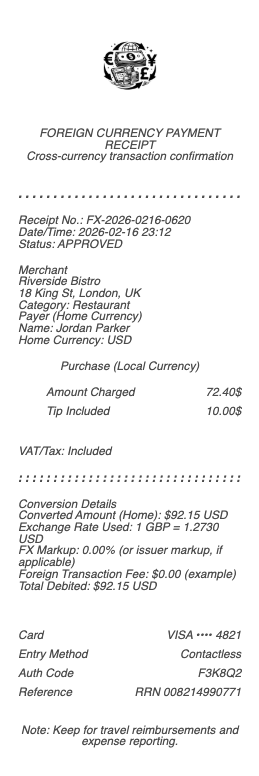
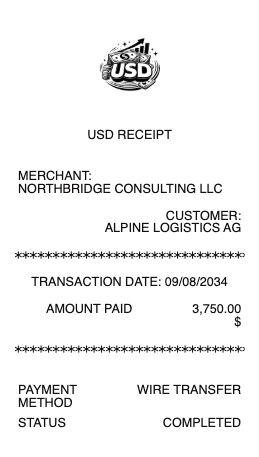
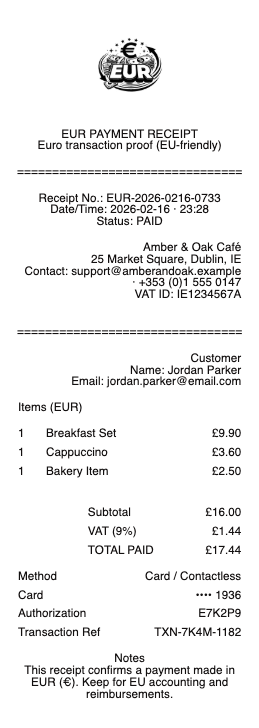
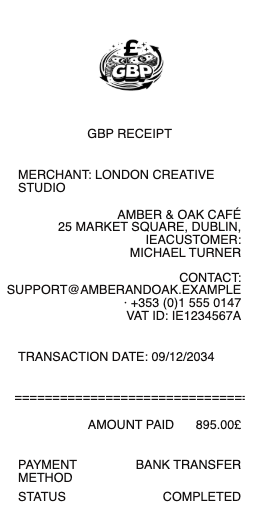
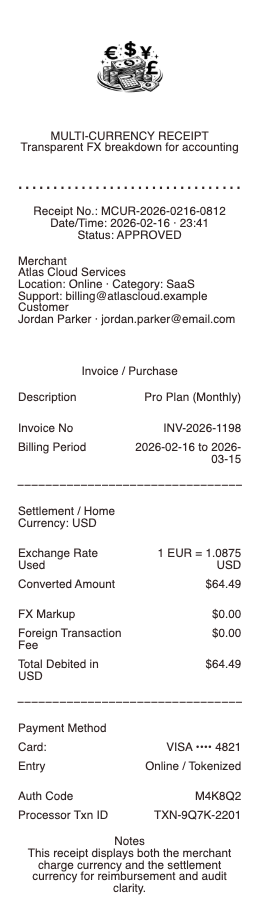
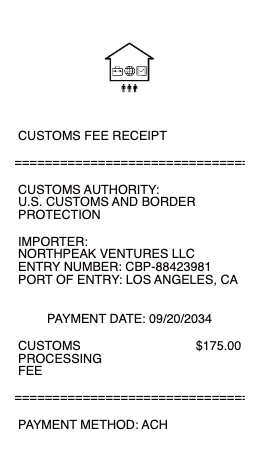
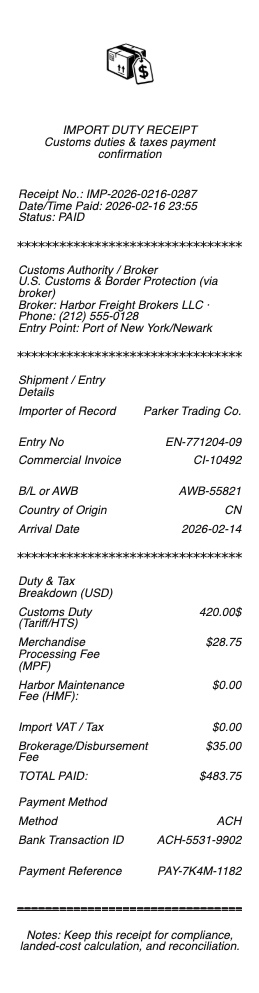
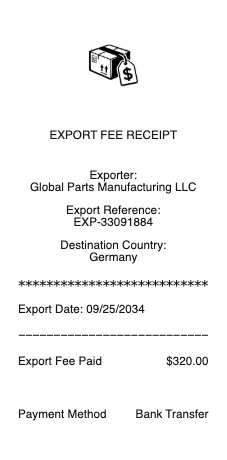
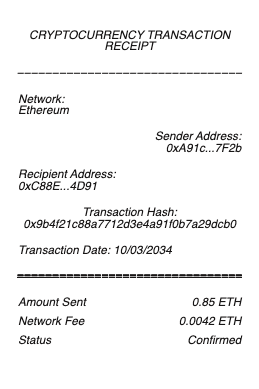
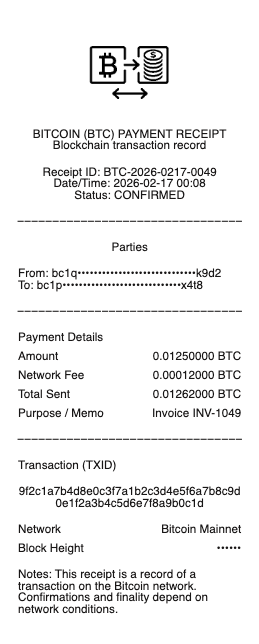
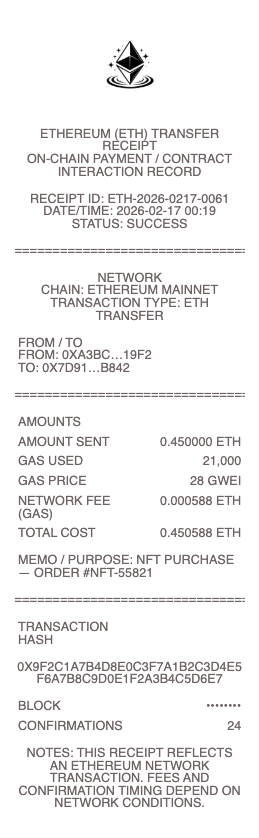
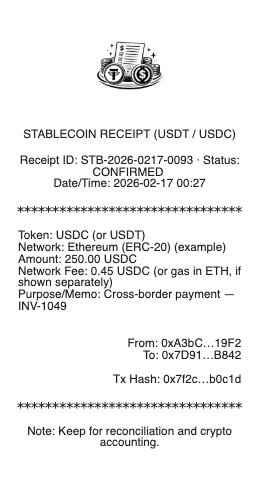
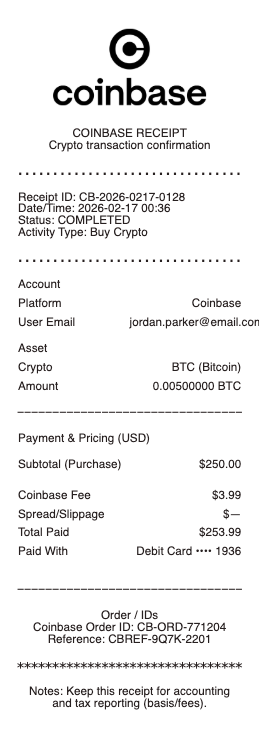
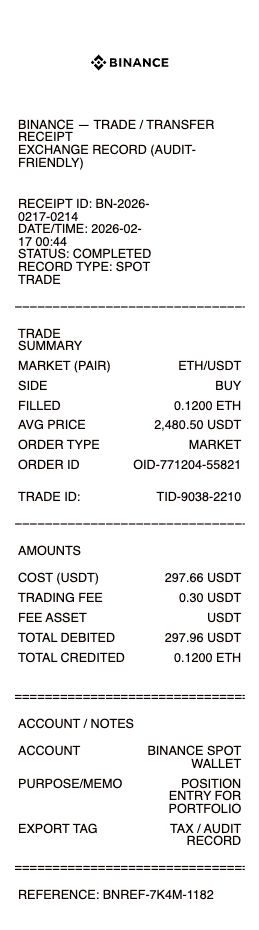
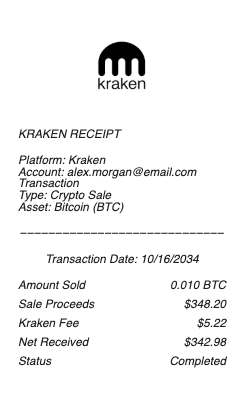
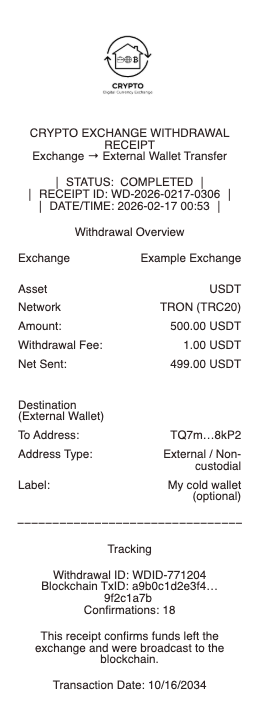
An international or cross-border receipt is the document that records a transaction crossing currencies, jurisdictions, or tax regimes — VAT receipts in the EU and UK, GST receipts in Canada and Australia, JCT receipts in Japan, customs and import-duty receipts, foreign-currency exchange receipts, Wise / Payoneer / Revolut transfer receipts, and any cross-border B2B sale subject to specific tax disclosure. Any Receipt Generator gives small exporters, freelancers billing abroad, and travelers a free template to issue or reconstruct an international receipt and download as a PNG or JPG image.
A note on legitimate use. This template is for businesses and individuals issuing or reconstructing receipts for cross-border transactions that actually occurred. Producing a receipt for an international transaction that did not happen, falsifying VAT or GST amounts, fabricating a customs-declaration receipt, falsely claiming a tax-free or duty-free status, or fabricating documentation to support a tourist VAT-refund claim, an import duty drawback, or any third-party qualification is fraud and is not what this tool is for. International tax fraud and customs fraud carry severe penalties in every jurisdiction.
Who needs an international receipt
• US-based freelancers and small businesses billing clients in the EU, UK, Canada, Australia, or Japan
• Foreign freelancers billing US clients who need to reconcile a USD payment to local-currency accounting
• Tourists requesting VAT refunds in the EU, UK, or Switzerland under the Global Blue, Premier Tax Free, or Planet schemes
• Importers documenting customs duty, brokerage, and excise-tax payments for inventory landed cost calculations
• Exporters issuing receipts to overseas buyers that meet local invoicing requirements (EU VAT directive, UK Making Tax Digital, German GoBD, Italian SDI, French B2B e-invoicing)
• International contractors paid via Wise, Payoneer, Revolut, or international wire who need a clean record reflecting the foreign-currency conversion
• Small e-commerce sellers shipping internationally (Etsy, Shopify, Amazon Global) who must document destination-country VAT or GST collection
• Travelers reconstructing hotel, restaurant, or transport receipts in foreign currency for corporate expense reimbursement
What to include in an international receipt
Cross-border receipts have additional fields beyond a domestic receipt:
• Issuer business name, address, and country
• Issuer tax identification number — VAT number for EU/UK, ABN for Australia, GST number for Canada, EIN for US, etc.
• Customer name, address, and country
• Customer tax ID where applicable (especially for B2B reverse-charge transactions in the EU)
• Date of transaction and date of supply (these can differ in cross-border services)
• Receipt or invoice number — sequential per local rules
• Description of goods or services
• Amount in transaction currency
• Currency code (EUR, GBP, CAD, AUD, JPY, USD, etc.)
• Exchange rate and equivalent in your home reporting currency
• VAT, GST, JCT, or sales tax broken out by rate (with country-specific rate notation)
• "Reverse charge applies" notation where the buyer accounts for VAT in their jurisdiction
• "Zero-rated" or "Exempt" notation for tax-free supplies
• Total in transaction currency and home currency
• Payment method and platform (Wise, Payoneer, Revolut, SWIFT wire, PayPal cross-border)
VAT, GST, and consumption-tax basics
Each major jurisdiction has its own consumption-tax framework — receipts must comply with local invoicing rules for the tax to be recoverable or reportable:
• European Union VAT — standard rates 17–27% depending on member state. Receipts above small thresholds require buyer VAT number for B2B transactions. Reverse charge applies on most cross-border B2B services
• United Kingdom VAT — 20% standard rate post-Brexit. Making Tax Digital (MTD) requires digital recording of every VAT transaction
• Canada GST/HST — federal GST 5%, with HST in five provinces (13–15%); Quebec also has separate QST
• Australia GST — 10% on most supplies. Tax-invoice requirements include ABN of supplier and total GST amount
• Japan JCT — 10% standard, 8% reduced. Qualified invoice system (introduced October 2023) requires registered-business invoice number
• Switzerland VAT — 8.1% standard, 2.6% reduced (2026). Visitor refund available at airports under tax-free shopping
Tourist VAT refund schemes
Non-EU residents can claim a VAT refund on goods purchased in the EU and exported within 90 days. Three main aggregators run the process:
• Global Blue — largest network, supported at most major luxury and department stores
• Premier Tax Free — competitor network in the EU
• Planet — formed from acquisitions, also widespread
Process: ask for the tax-free form at point of sale, present the goods and the form at customs at departure for stamping, then submit to the refund operator. The original boutique receipt and stamped tax-free form are mandatory; a reconstructed receipt is not accepted as the primary document.
Customs and import duties
Importers receive a customs entry summary (US: CBP Form 7501) showing duty, merchandise processing fee, harbor maintenance fee, and any antidumping or countervailing duties. Receipts substantiate landed cost and tax basis:
• Schedule C and inventory — duty and fees are part of the cost of goods sold
• Section 321 de minimis — currently $800 per shipment threshold for duty-free entry into the US (subject to legislative change)
• Drawback claims — refunds of duty paid on goods later exported require precise documentation; CBP audits these
• Free trade agreements — USMCA (formerly NAFTA), CAFTA, and others reduce duty rates with proper certificates of origin
Recovering a lost international receipt
• Wise, Payoneer, and Revolut all archive every transfer in your account; receipts re-downloadable
• PayPal cross-border transactions show full conversion history in account activity
• Hotel, restaurant, and transport chains in major markets retain billing records for years; ask the property
• VAT-refund operators (Global Blue, Premier Tax Free, Planet) keep records of stamped tax-free forms
• US Customs (CBP) entry summaries are accessible via your customs broker or via ACE for direct importers
Download formats
Every international receipt exports as PNG or JPG. These work for upload to corporate expense systems, attaching to bookkeeping software (QuickBooks, Xero, Wave handle multi-currency), and personal records. They are not accepted as primary documentation for VAT refunds — only original boutique receipts and stamped tax-free forms qualify.
Generate your international receipt now →
See also: VAT Receipt · EU VAT Receipt · Wise Transfer Receipt · Finance & Banking Receipts · Freelance & Small Business Receipts
Tax invoice vs international receipt
A tax invoice is a billing document required in VAT/GST jurisdictions (UK, EU, Australia, Canada, India, Singapore, and many others) that must show the seller’s tax registration number, the applicable VAT/GST rate, the tax amount broken out separately, and the legal entity name. An international receipt is the proof of payment after the tax invoice is settled. For cross-border B2B transactions, accountants and customs typically require both: the tax invoice for tax recovery (input VAT credit) and the receipt for proof of payment.
Use this template for tax-compliant invoicing or post-payment receipts in any VAT/GST country. Update the tax label (VAT, GST, IVA, BTW, MwSt, TVA, etc.), tax rate, and currency to match your jurisdiction.
Legal disclaimer
Any Receipt Generator does not validate, certify, or verify the authenticity of any generated document. This tool is provided strictly for legitimate purposes — businesses and individuals issuing or reconstructing receipts for cross-border transactions that actually occurred.
The following uses are strictly prohibited: producing a receipt for an international transaction that did not happen; falsifying VAT, GST, JCT, sales tax, customs duty, or any other foreign tax amount; fabricating a customs-declaration receipt or import-entry summary; falsely claiming tax-free or duty-free status; fabricating documentation to support a tourist VAT-refund claim under Global Blue, Premier Tax Free, Planet, or any other scheme; fabricating a receipt to support a Section 321 de minimis declaration, a duty-drawback claim, or any free-trade-agreement preferential-rate claim; or any use intended to deceive, defraud, or mislead any tax authority, customs authority, banking institution, employer, or third party in any country.
Federal & international law. Use of this tool to fabricate documentation or otherwise commit fraud may constitute violations of US federal law, including wire fraud (18 U.S.C.
1343), mail fraud (18 U.S.C.
1341), bank fraud (18 U.S.C.
1344), false statements (18 U.S.C.
1001), tax fraud (26 U.S.C.
7206), customs fraud (18 U.S.C.
542 — Entry of goods by means of false statements), money laundering (18 U.S.C.
1956), and parallel criminal statutes in every other jurisdiction (UK Fraud Act 2006, EU PIF Directive, Canadian Criminal Code, Australian Criminal Code, etc.). Penalties include substantial fines, imprisonment, restitution, civil liability, and seizure of imported goods. Customs and tax authorities cooperate internationally on cross-border fraud investigations.
No professional advice. Information provided through this tool is for general informational purposes only and does not constitute legal, tax, accounting, financial, customs-brokerage, or other professional advice. International tax and customs rules vary widely by country and are subject to frequent change. Consult a qualified professional (international tax accountant, licensed customs broker, attorney) before relying on any generated document for tax filing, VAT-refund submission, customs entry, court proceedings, or any third-party transaction.
"AS IS" service; no warranty. Any Receipt Generator is provided "AS IS" and "AS AVAILABLE" without warranties of any kind, express or implied, including merchantability, fitness for a particular purpose, accuracy, completeness, or non-infringement. We make no representation that any generated document will satisfy the legal, regulatory, or evidentiary requirements of any specific jurisdiction, tax authority, customs authority, recipient, or use case.
Indemnification. By using this tool, the user agrees to defend, indemnify, and hold harmless Any Receipt Generator and its operators, employees, contractors, and affiliates from and against any and all claims, damages, fines, penalties, losses, costs, and expenses (including reasonable attorneys' fees) arising from or related to the user use or misuse of the tool, including violation of these terms or any applicable foreign or domestic law.
Acceptance & Terms. By accessing or using this tool, the user acknowledges having read and agreed to these terms and to our Terms of Service and Privacy Policy. Continued use after any update to these terms constitutes acceptance of the revised terms.
Any Receipt Generator is not affiliated with, endorsed by, or authorized by Wise, Payoneer, Revolut, Global Blue, Premier Tax Free, Planet, US Customs and Border Protection, the European Commission, HM Revenue & Customs, the Canadian Revenue Agency, the Australian Taxation Office, or any other tax authority, customs authority, or money-services business in any jurisdiction. All trademarks, service marks, trade names, and brand references mentioned remain the property of their respective owners and are used only for descriptive reference purposes under the doctrine of nominative fair use.