A wire transfer receipt is the bank's confirmation that a wire was sent — showing the sender, beneficiary, amount, and the federal reference numbers that prove the money moved. Because wires are same-day and effectively irreversible, this receipt is the standard proof of payment for real estate closings, car purchases, and international invoices. This guide explains what's on a wire transfer receipt, the reference numbers that matter, and how to get a copy from your bank.
Wire Transfer Receipt
Add custom logo
Edit line items
Choose payment method
Add/remove elements
Customize business information
Choose font
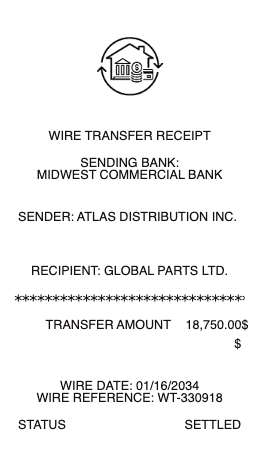
What's on a wire transfer receipt
A wire confirmation carries more identifying detail than a normal payment receipt:
Sender & beneficiary — both parties' names and their banks, with the beneficiary's account details.
Amount & currency — the sum wired, and the currency for international transfers.
Date & execution time — wires are typically same-business-day, so timing matters.
Reference numbers — for US domestic wires, the Fedwire IMAD/OMAD numbers; for international wires, the SWIFT reference.
Fees — the sending (and sometimes receiving or intermediary) bank fees.
Status — confirmation that the wire was sent or completed.
The reference numbers that prove a wire
Two numbers let a bank trace a wire from start to finish. For a domestic US wire, the Fedwire system gives it an IMAD (Input Message Accountability Data) number. The bank that receives the money gets an OMAD (Output Message Accountability Data) number for the same wire. For an international wire, look for the UETR (Unique End-to-end Transaction Reference). It is a 36-character code that stays the same at every bank the money passes through.
The old SWIFT MT103 message was retired for cross-border payments on 22 November 2025. Banks now send international wires in the ISO 20022 format, in a message called pacs.008. Many banks still call the confirmation an "MT103 copy", so you may see either name. If someone asks you to prove a wire was sent, the receipt with the IMAD (domestic) or the UETR (international) is that proof.
Domestic US wire (Fedwire): the IMAD is on the sender's side and the OMAD on the receiver's side.
International wire (SWIFT): the UETR, a 36-character tracking code.
Consumer transfers from the US to another country: federal rules (Regulation E) require the receipt to show a "Date Available" — the date the money should be ready for the recipient.
How to get a wire transfer receipt from your bank
If you send the wire at a branch, the banker prints a confirmation before you leave — keep it. For online wires, the confirmation screen and the transfer's detail page in online banking serve as the receipt, usually downloadable as a PDF. Need stronger documentation later? Call your bank and request the wire confirmation with its IMAD or UETR for the transfer — banks produce these routinely, sometimes for a small fee. Every major bank (Bank of America, Chase, Wells Fargo, and the rest) follows this same pattern, with the details living in your wire activity history.
When you'll need wire transfer proof
Wire receipts matter most in high-stakes moments: real estate closings, where escrow and title companies confirm receipt of your down payment against the wire reference; vehicle and large purchases, where the seller releases the car or goods on proof of wire; international invoices, where a supplier wants the payment confirmation and its UETR before shipping; and disputes or delays, where the reference numbers let both banks trace the money. Because a wire generally can't be recalled once executed, the receipt is also your record that the details you authorized were correct.
How to check that a wire really arrived
A wire receipt shows that a payment was sent. It does not prove the money reached you. Fake wire receipts are a known scam, because a real wire is very hard to reverse. Before you hand over keys, goods, or a title, check these three things:
Look at your own account. The money counts only when your bank shows it as received — not when you see an email, a PDF, or a screenshot.
Ask for the reference number. Get the IMAD (US wire) or the UETR (international wire) from the sender and give it to your bank. Your bank can trace the wire with it.
Call your bank at a number you trust. Use the number on your card or on the bank's own website, never a number printed on the receipt you were sent.
Related money transfer receipts: see also our bank transfer receipt guide and our SWIFT transfer receipt guide. For a simple record of any payment, see our receipt of payment guide.
Create a wire transfer receipt record
Our wire transfer receipt template and generator lays out a clean confirmation-style record — sender and beneficiary, banks, amount, date, reference number, and fees — useful for keeping legible copies of wires you actually sent in your closing or purchase files.
For legitimate record-keeping only — and this one is serious. Fake wire transfer receipts are a well-known fraud tool (fake "proof" sent to sellers or escrow). Creating one for a wire that didn't happen is a crime. Use this only to reproduce or organize your own genuine wire confirmations — and if you RECEIVE a wire receipt as proof, verify with your bank that the funds actually arrived before releasing anything.
Other transfer paperwork: the Zelle receipt, cash payment receipt, and proof of payment receipt examples.
Sent the wire from Bank of America? Use the Bank of America wire transfer receipt instead; it is set up for that bank's wire details.
Frequently asked questions
Everything you need to know about the product and billing.
What does a wire transfer receipt look like?
It shows the sender and beneficiary with their banks, the amount and currency, the date, the bank's fees, and a reference number — the Fedwire IMAD for US domestic wires or the SWIFT UETR for international ones — plus a sent or completed status.
What is an IMAD number on a wire receipt?
The Input Message Accountability Data number is the Fedwire system's tracking reference for a US domestic wire. Your bank uses it to trace the wire end to end, and it's the standard proof the wire was executed.
What is an MT103?
The SWIFT MT103 was the message banks used to send international wires. It was retired for cross-border payments on 22 November 2025. Banks now use the ISO 20022 format, where the matching message is called pacs.008. Many banks still call the confirmation an "MT103 copy". The most useful number to ask for today is the UETR — a 36-character tracking code that stays the same at every bank the payment passes through.
How do I get a copy of a wire transfer receipt?
Branch wires are printed on the spot; online wires have a confirmation and detail page you can save as PDF. For stronger documentation, request the wire confirmation, with its IMAD or UETR, from your bank — they produce these routinely, sometimes for a small fee.
Is a wire transfer receipt proof of payment?
Yes — with its reference numbers it's among the strongest proofs, which is why escrow companies, car sellers, and international suppliers rely on it. That said, recipients should still verify the funds actually arrived before releasing goods, since fake wire receipts are a known scam.
Can a wire transfer be reversed?
Generally no — once executed, a wire is effectively final, which is why the receipt matters: it's your record that the amount and beneficiary details you authorized were correct, and the reference to quote immediately if something went wrong.