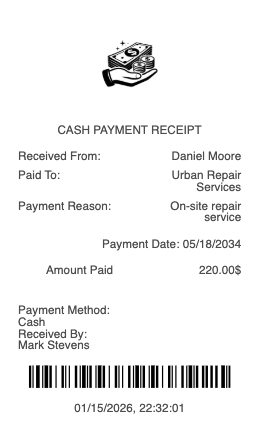
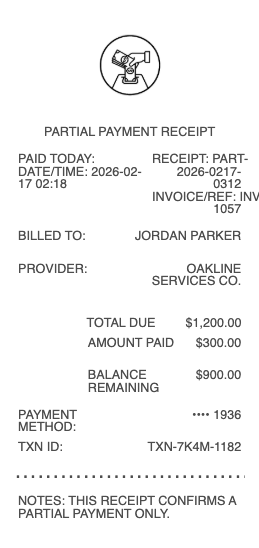
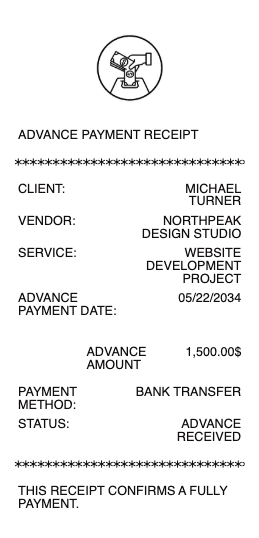
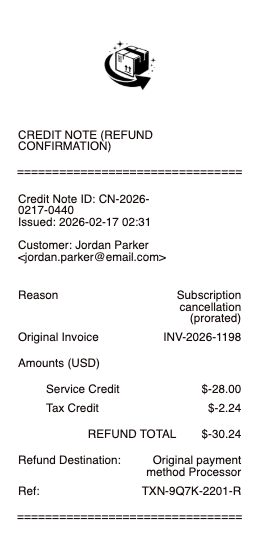
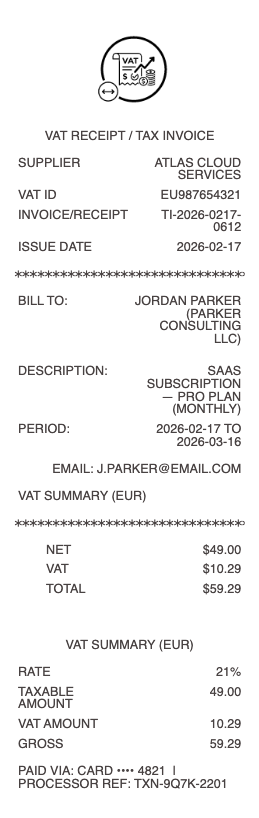
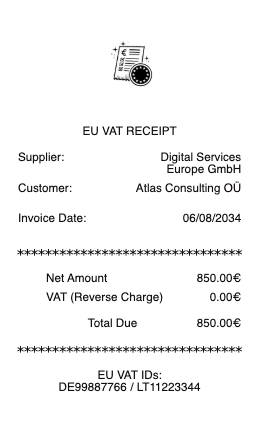
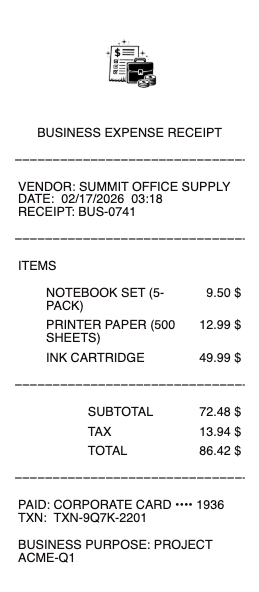
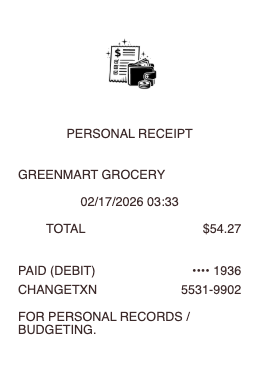
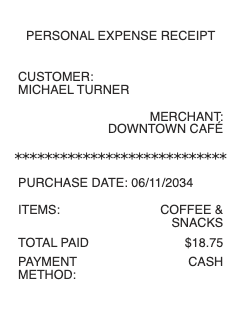
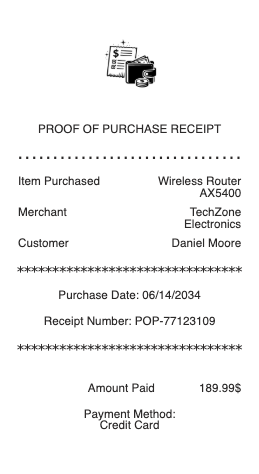
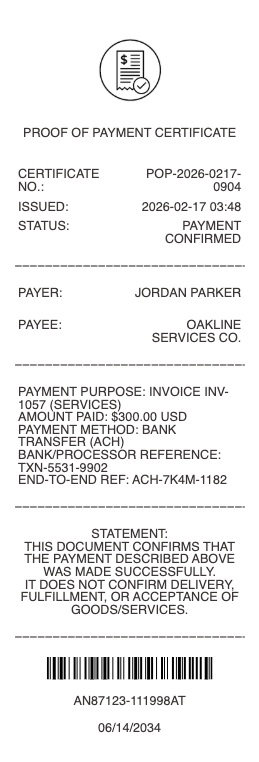
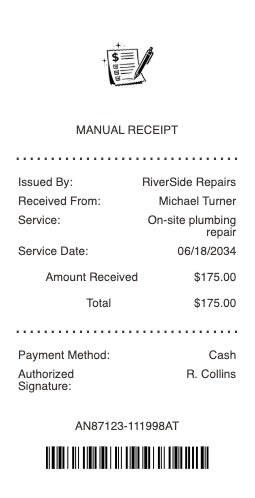
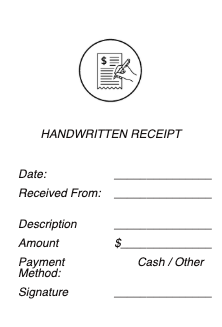
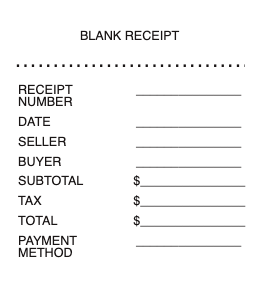
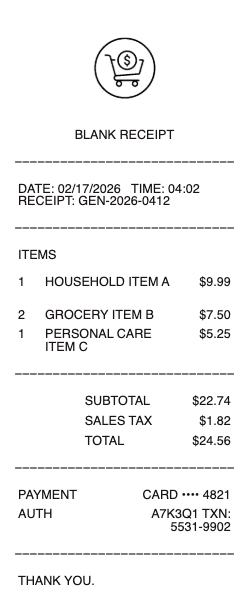
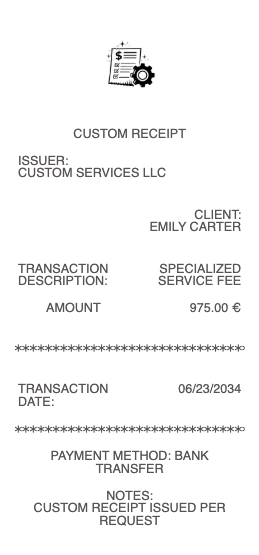
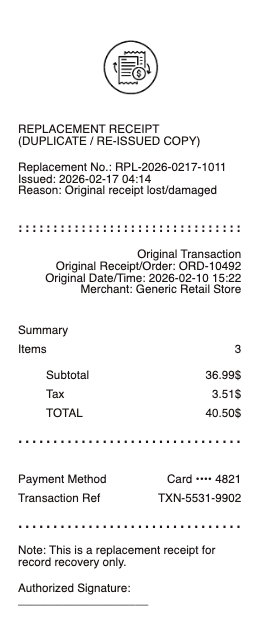
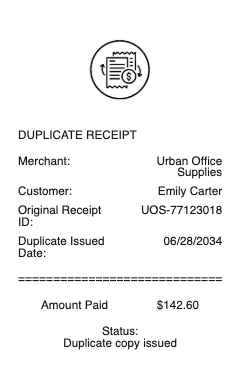
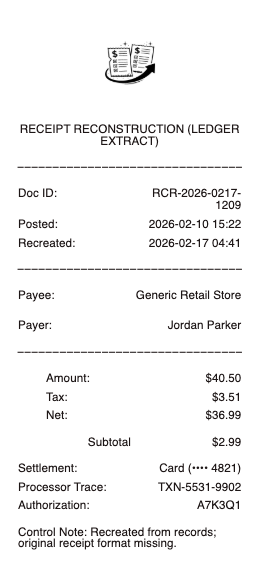
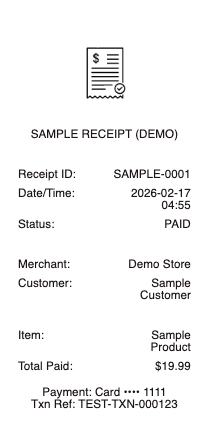
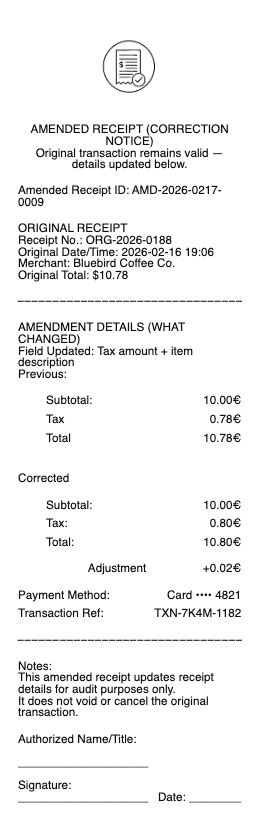
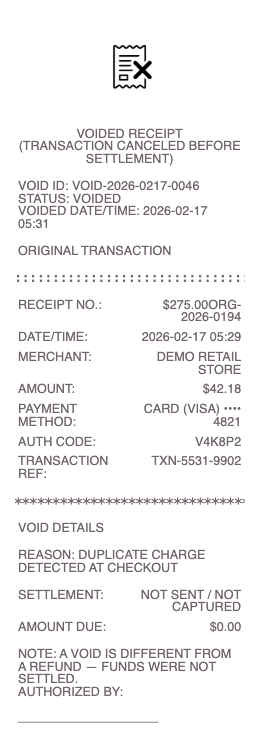
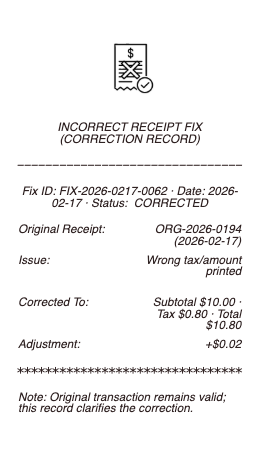
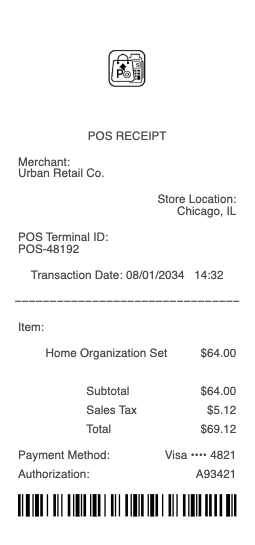
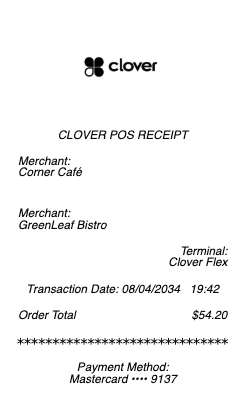
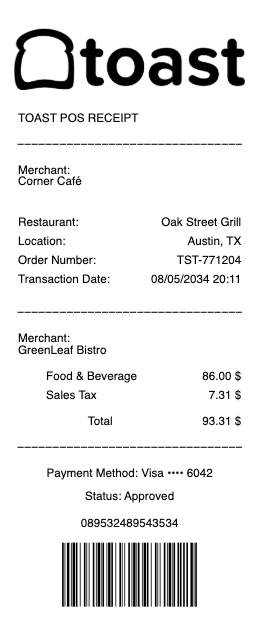
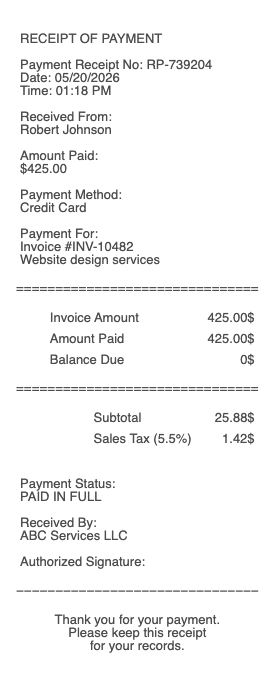
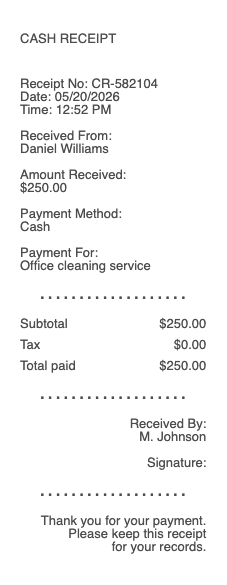
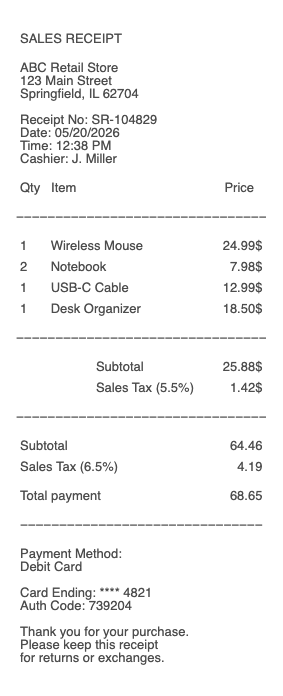
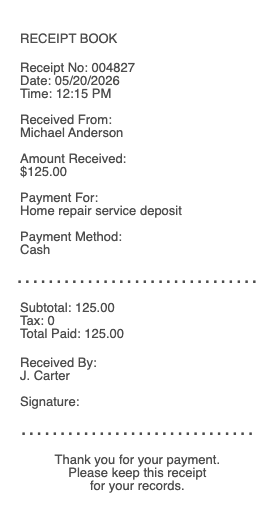
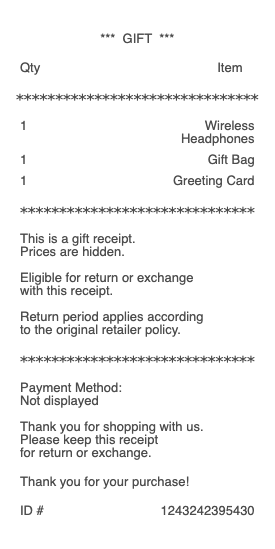
A payment receipt is the document that records a financial transaction without being tied to a specific industry — cash payments between individuals, partial payments on a longer balance, advance payments before delivery, refunds, returns, exchanges, generic blank slips, and proof-of-payment confirmations. Any Receipt Generator publishes free templates for every common payment scenario, ready to fill in and download as a PNG or JPG image.
A note on legitimate use. This template is for individuals, small businesses, and organizations issuing payment receipts to document money that was actually received, refunded, or partially paid. Producing a receipt for a payment that was not made, inflating an amount, or fabricating documentation to support a false IRS filing, a falsified Form 8300 cash report, an SBA or PPP loan application, an unemployment claim, or any third-party qualification is fraud and is not what this tool is for.
Who needs a payment receipt
• Sole proprietors, freelancers, and small businesses accepting cash, check, Zelle, Venmo, Cash App, or other non-card payments
• Private sellers in person-to-person transactions (used cars, furniture, electronics, collectibles)
• Landlords accepting partial rent payments under a payment plan or back-rent agreement
• Service providers accepting deposits or advance payments before scheduling work
• Retail businesses issuing refund, return, or exchange receipts
• Religious organizations, community groups, and informal clubs collecting dues or donations from members
• Anyone who paid a private party and needs a written acknowledgment for personal records
• Customers requesting a "proof of payment" letter for a transaction the seller didn’t document
What to include in a payment receipt
A generic payment receipt has fields that flex across many transaction types:
• Receipt number — sequential, no gaps
• Date of payment
• Payer’s name (the person or business who paid)
• Recipient’s name (the person or business who received the payment)
• Description of the transaction or what the payment was for
• Total amount received
• Payment method — cash, check (with check number), Zelle, Venmo, Cash App, ACH, money order, wire transfer
• For partial payments: original total owed, amount paid this transaction, balance remaining
• For advance payments: what the payment is toward and when full delivery is expected
• For refunds: original transaction date, original amount, refund reason, refund amount
• Recipient’s signature (and printed name) confirming receipt
How to fill out a payment receipt
1. Open the payment receipt generator or the cash receipt generator depending on your transaction
2. Enter your name (or business name) and the payer’s name
3. Add the date and a clear description of what the payment is for
4. Enter the amount received and the payment method
5. For partial payments, add the prior balance and the new remaining balance
6. Add a sequential receipt number
7. Sign the receipt as the recipient (typed or uploaded)
8. Click Download to export as PNG or JPG
9. Give one copy to the payer; keep one for your records
Cash payment receipts and IRS reporting
Cash transactions have specific federal reporting rules under the Bank Secrecy Act:
• $10,000 cash threshold — businesses receiving more than $10,000 cash in a single transaction (or related transactions) must file IRS Form 8300 within 15 days. This applies to dealers, service providers, attorneys, and most for-profit entities
• FinCEN reporting — financial institutions file Currency Transaction Reports (CTR) for cash deposits over $10,000
• Structuring is illegal — splitting a transaction into multiple sub-$10,000 cash payments to avoid Form 8300 is a federal crime under 31 USC
5324
• Payee TIN required — Form 8300 requires the payer’s tax identification number; declining to provide it is a separate violation
For everyday cash transactions under $10,000, no special federal filing is required — but the receipt itself becomes the only record. Keep a copy.
Partial and advance payment receipts
Two common payment scenarios that need their own receipt format:
• Partial payment — when a full balance is paid in installments. The receipt shows the original total, this payment’s amount, and the remaining balance. Also called a "running balance" or "installment" receipt.
• Advance payment / deposit — when payment is collected before the goods or services are delivered. The receipt should clearly say "deposit toward [description]" and reference the expected delivery or service date. For non-refundable deposits, mark explicitly.
• Retainer payment — like an advance, but for ongoing services (consulting, legal, accounting). The receipt should reference the engagement letter or retainer agreement.
Refund, return, and exchange receipts
When money flows back to the customer, a different receipt format applies:
• Refund receipt — money returned to the customer in full or part. Should reference the original transaction date, amount, and reason for refund (e.g., "defective product," "service not rendered," "customer dissatisfaction")
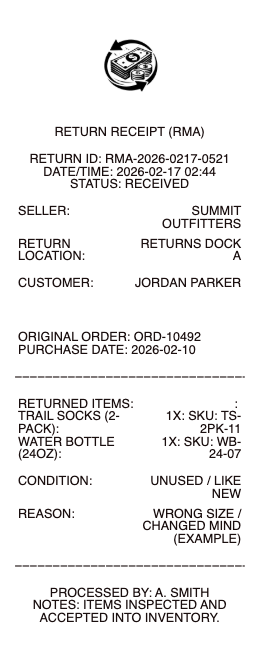
• Return receipt — goods returned with money refunded. References original purchase, item description, condition (new / opened / damaged), and refund amount and method
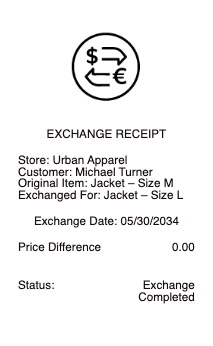
• Exchange receipt — goods returned and replaced. Shows item swapped out, item swapped in, and any difference in price (paid by customer or refunded)
For tax-deductible business expenses, refund receipts may require an adjustment to a prior tax return if the original expense was already claimed.
Payment receipt vs invoice vs proof of payment
• Invoice — issued before payment. The legal demand for what is owed.
• Payment receipt — issued after payment. Confirms the transaction occurred.
• Proof of payment — a document or pair of documents (receipt + bank record) that proves the transaction to a third party. The receipt alone is usually sufficient; for higher-value transactions, the bank or wire confirmation should accompany it.
• Bill of sale — used for transferring ownership of an asset (used vehicle, large furniture, equipment). Includes more than a receipt: serial numbers, "as-is" disclosures, transfer of title language.
Recovering a lost payment receipt
• Bank or card statements show the transaction and are usually accepted by the IRS as backup if the original receipt is lost
• For Zelle, Venmo, Cash App, and PayPal payments, the in-app transaction history is exportable and date-stamped
• For cash transactions between individuals, the only record is what you wrote at the time — reconstruct from memory and a bank withdrawal slip if applicable, but understand the IRS may not accept reconstruction for amounts above the $75 substantiation rule
• For private-party sales (used car, furniture), the buyer or seller may be willing to issue a duplicate if asked
Download formats
Every payment receipt exports as PNG or JPG. Both work for personal records, attaching to landlord disputes or court filings, email to the other party, and small-business bookkeeping.
Generate your payment receipt now →
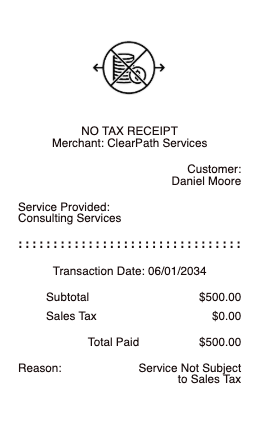
See also: Cash Payment Receipt · Proof of Payment Receipt · Refund Receipt · Return Receipt · Exchange Receipt · Partial Payment Receipt · Advance Payment Receipt · Blank Receipt · Custom Receipt · No-Tax Receipt · Freelance & Small Business Receipts
Legal disclaimer
Any Receipt Generator does not validate, certify, or verify the authenticity of any generated document. This tool is provided strictly for legitimate purposes — individuals, small businesses, and organizations issuing payment receipts to document money that was actually received, refunded, or partially paid in a real transaction.
The following uses are strictly prohibited: producing a receipt for a payment that was not made; inflating the amount of a payment that was made; fabricating documentation to support a false IRS Form 8300 cash report, a falsified Currency Transaction Report (CTR), structuring transactions to avoid the $10,000 cash reporting threshold, an SBA or PPP loan application, a Schedule C or business-expense filing, an unemployment or hardship claim, an immigration filing, a security-deposit deduction, a court filing, or any third-party qualification; or any use intended to deceive, defraud, or mislead any tax authority, bank, lender, court, government agency, or other third party.
Use of this tool for the creation of fraudulent documentation or to engage in any unlawful activity is strictly prohibited and may constitute wire fraud, mail fraud, tax fraud, bank fraud, money laundering, structuring (31 USC
5324), or other criminal offenses depending on jurisdiction. Users assume full legal responsibility for the accuracy and intended use of any files they generate.
Federal & state law. Use of this tool to fabricate documentation or otherwise commit fraud may constitute violations of US federal law, including wire fraud (18 U.S.C.
1343), mail fraud (18 U.S.C.
1341), bank fraud (18 U.S.C.
1344), false statements to federal agencies (18 U.S.C.
1001), tax fraud (26 U.S.C.
7206), money laundering (18 U.S.C.
1956), structuring transactions to avoid reporting (31 U.S.C.
5324), and parallel state and foreign criminal statutes. Penalties include fines up to $250,000 per offense, imprisonment, restitution, and civil liability.
No professional advice. Information provided through this tool is for general informational purposes only and does not constitute legal, tax, accounting, financial, banking, or other professional advice. Consult a qualified professional (attorney, tax preparer, accountant) before relying on any generated document for tax filing, IRS Form 8300 reporting, claim submission, court proceedings, or any third-party transaction.
"AS IS" service; no warranty. Any Receipt Generator is provided "AS IS" and "AS AVAILABLE" without warranties of any kind, express or implied, including merchantability, fitness for a particular purpose, accuracy, completeness, or non-infringement. We make no representation that any generated document will satisfy the legal, regulatory, or evidentiary requirements of any specific jurisdiction, recipient, or use case.
Indemnification. By using this tool, the user agrees to defend, indemnify, and hold harmless Any Receipt Generator and its operators, employees, contractors, and affiliates from and against any and all claims, damages, fines, penalties, losses, costs, and expenses (including reasonable attorneys' fees) arising from or related to the user's use or misuse of the tool, including violation of these terms, the Bank Secrecy Act, or any other applicable law.
Acceptance & Terms. By accessing or using this tool, the user acknowledges having read and agreed to these terms and to our Terms of Service and Privacy Policy. Continued use after any update to these terms constitutes acceptance of the revised terms.
Any Receipt Generator is not affiliated with, endorsed by, or authorized by the IRS, FinCEN, the Treasury Department, any bank, payment processor, or financial institution. All trademarks, service marks, trade names, and brand references mentioned remain the property of their respective owners and are used only for descriptive reference purposes.