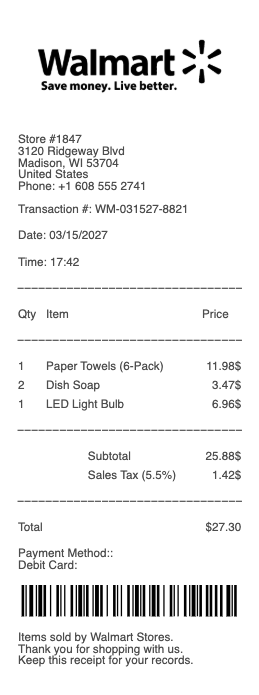
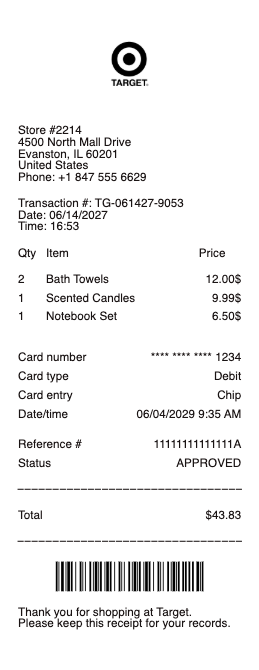
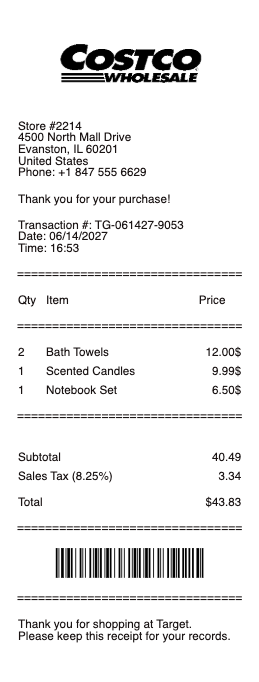
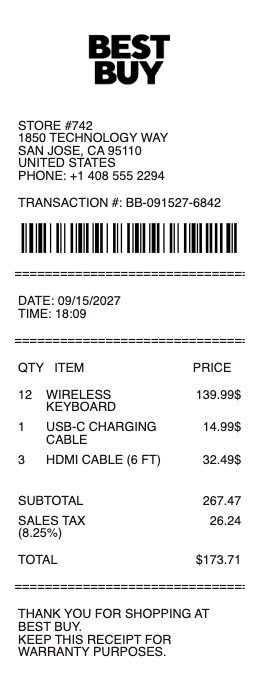
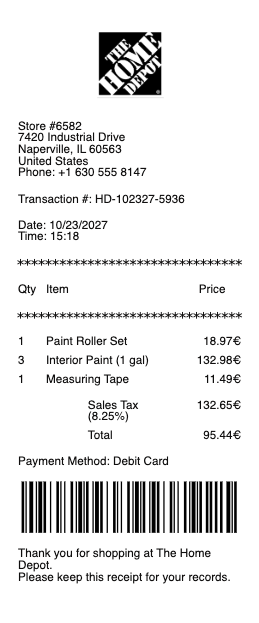
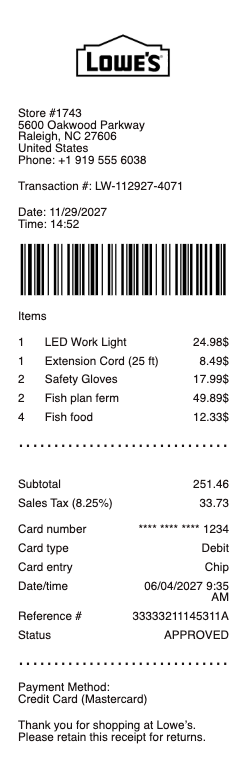
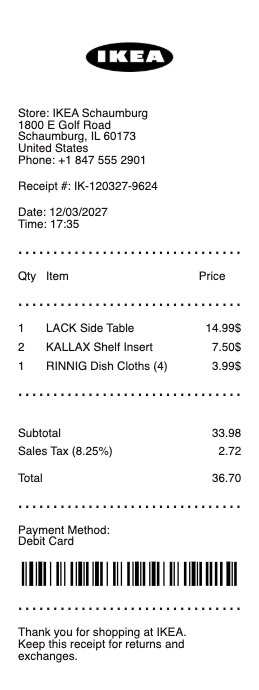
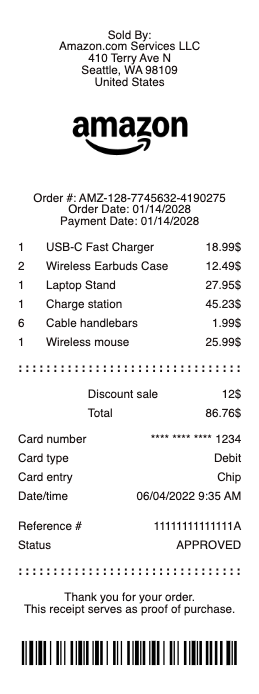
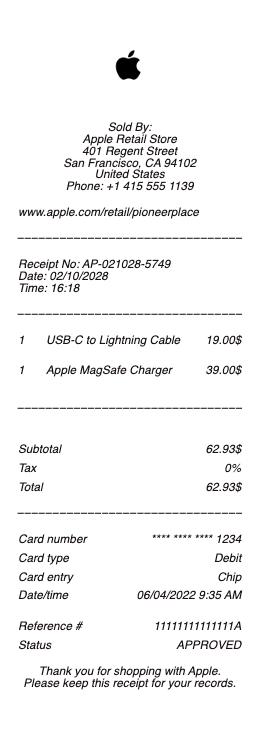
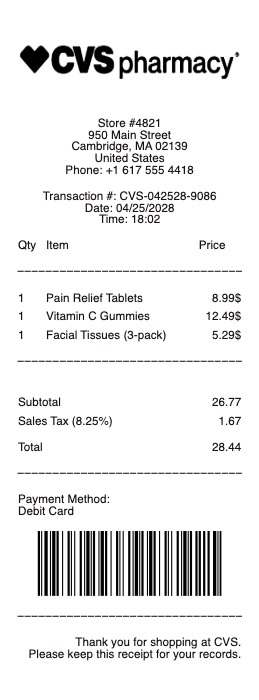
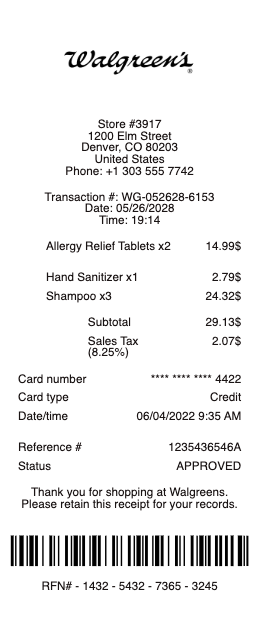
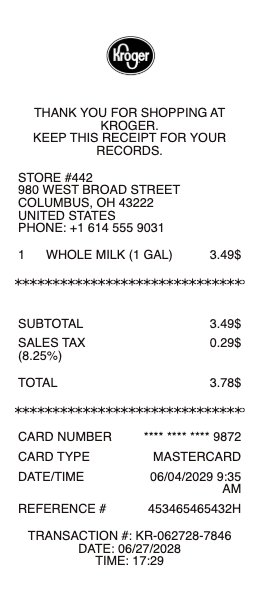
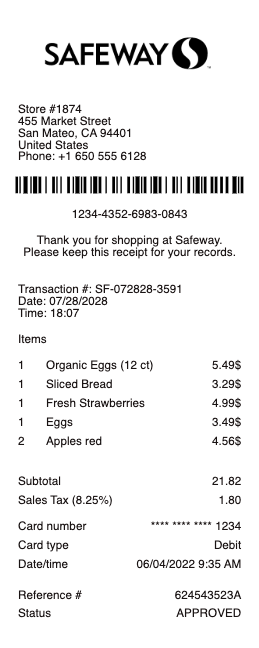
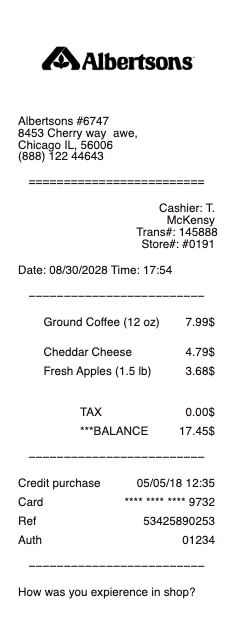
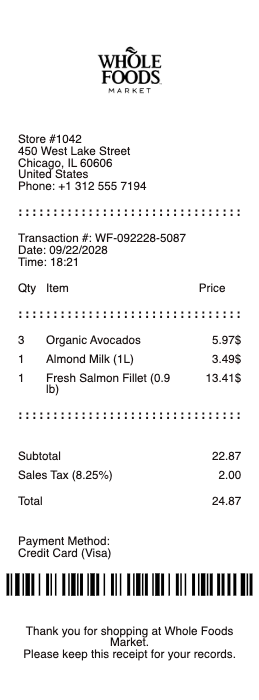
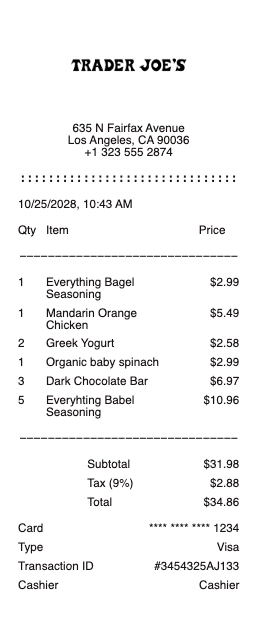
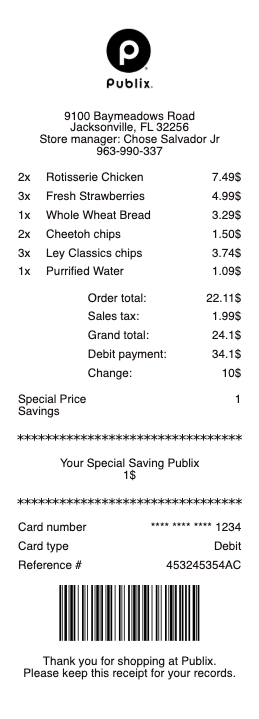
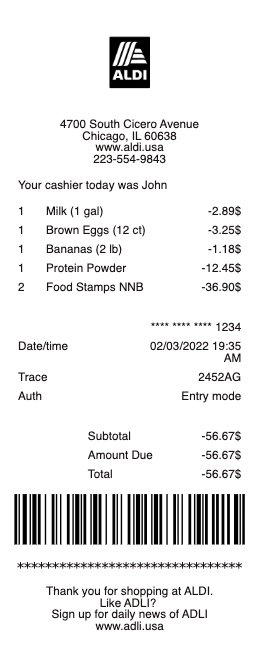
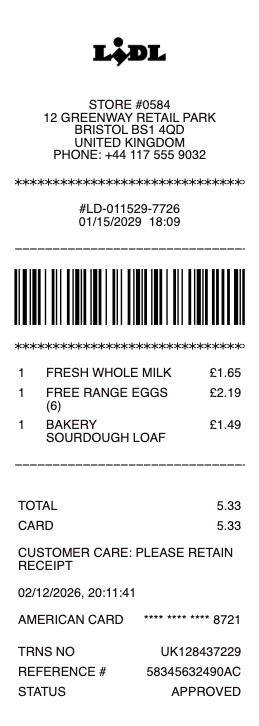
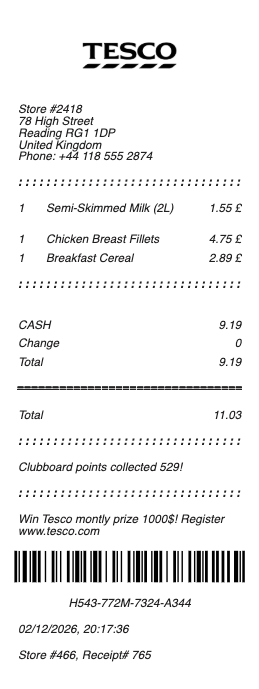
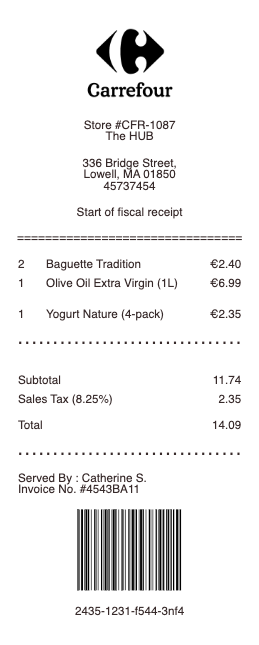
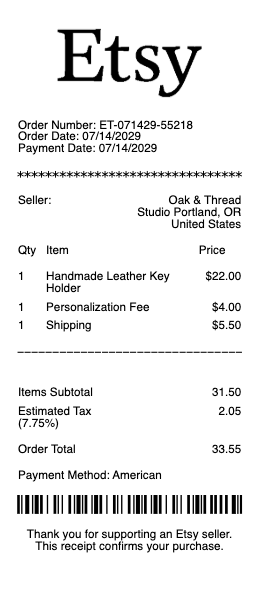
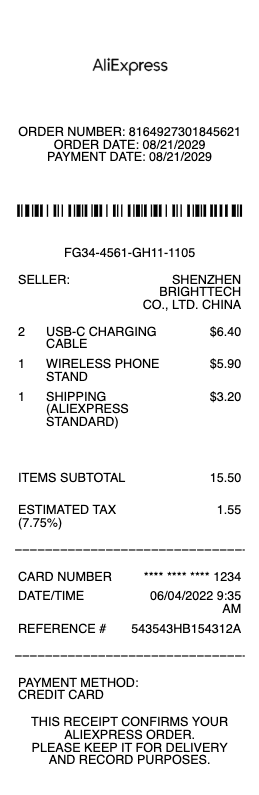
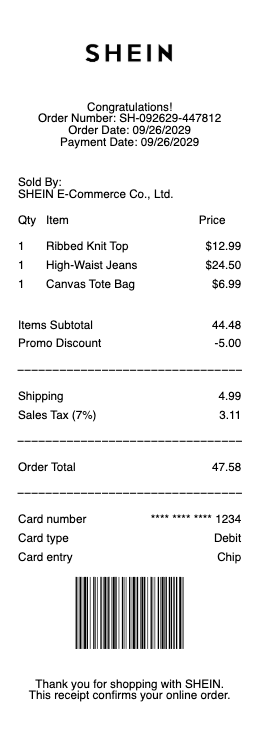
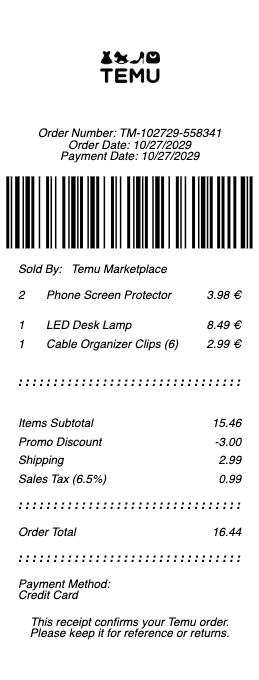
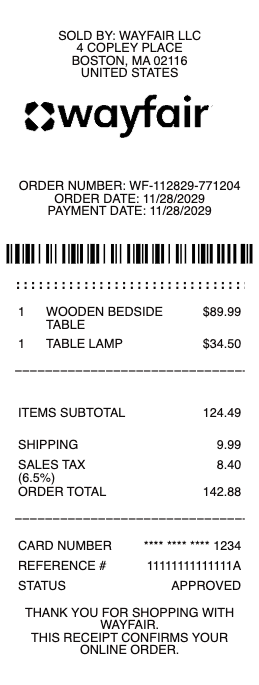
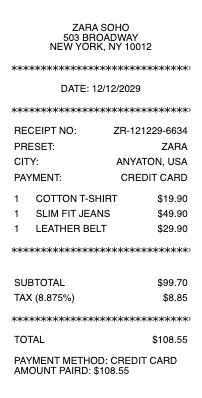
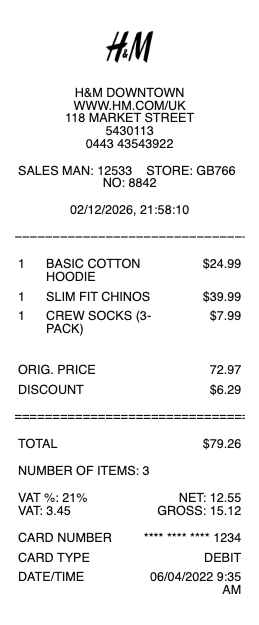
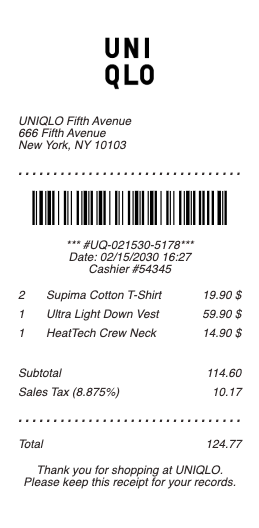
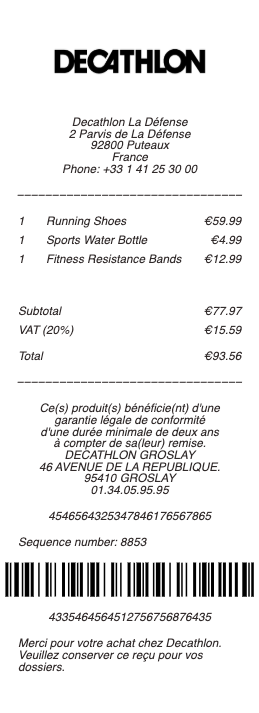
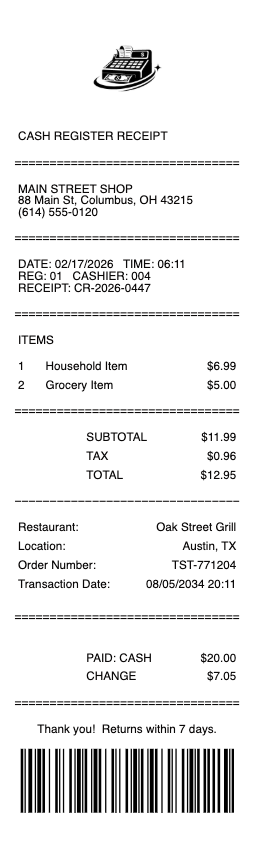
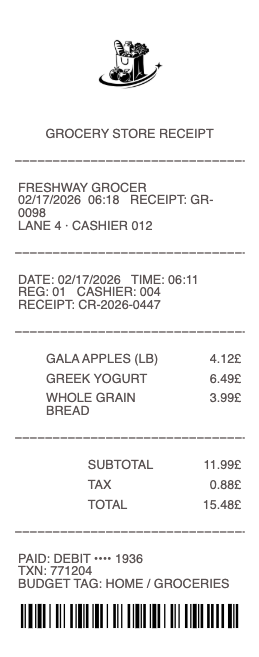
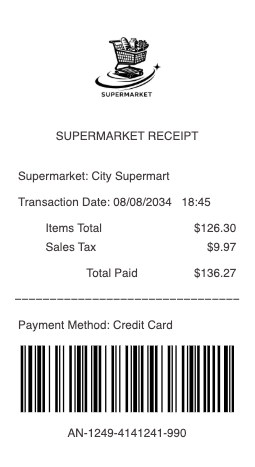
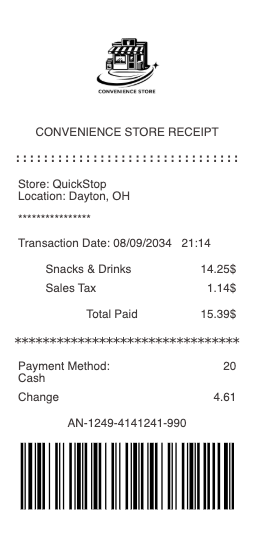
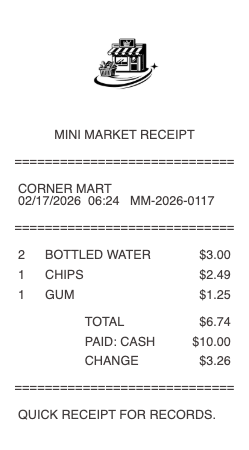
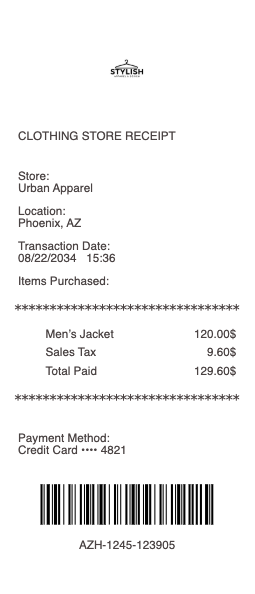
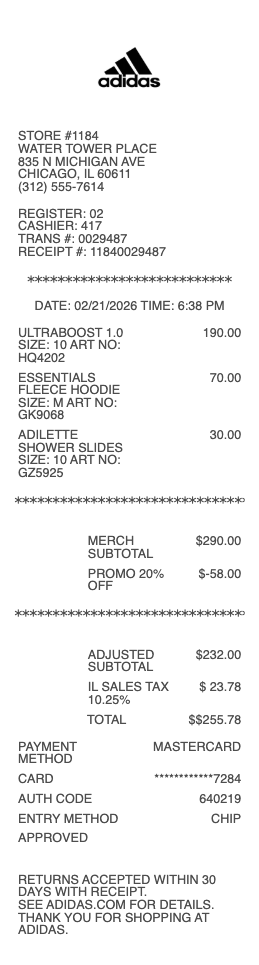
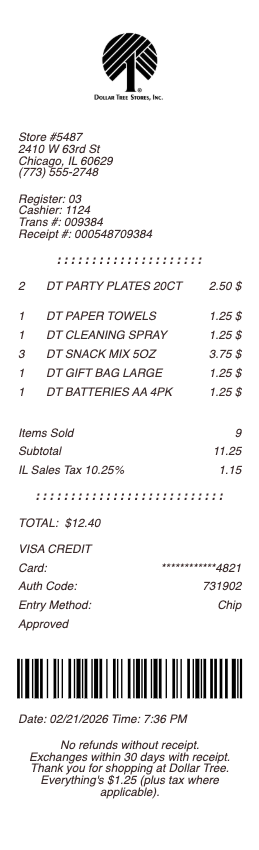
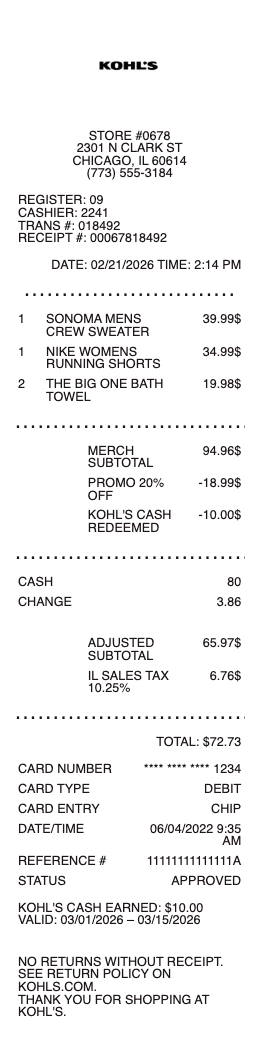
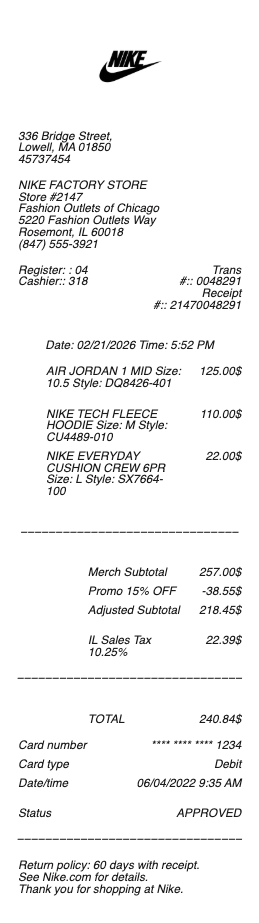
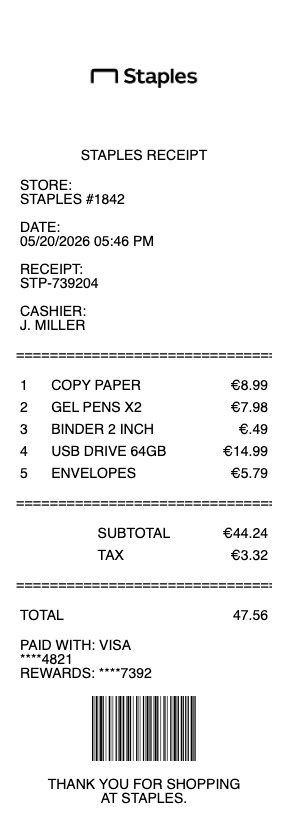
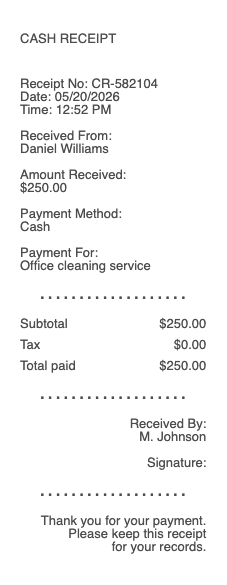
A retail store receipt is the document a customer receives at the point of sale at any major retailer — Walmart, Target, Costco, Best Buy, Home Depot, Lowe’s, Macy’s, Sephora, Nordstrom, Kroger, Whole Foods, Trader Joe’s, Apple, and the dozens of other store chains and grocery operators. Any Receipt Generator gives small store owners and shoppers a free template to issue or reconstruct a retail receipt and download as a PNG or JPG image.
A note on legitimate use. This template is for independent and small store operators issuing receipts to their own customers, and for shoppers reconstructing a record of an in-store purchase they actually made and paid for. Producing a receipt for goods that were not purchased, inflating the amount, or fabricating documentation to support a return, refund, store credit, warranty claim, expense report, business deduction, or insurance claim against a major retailer is fraud and is not what this tool is for. The only valid receipt for any return at a Walmart, Target, Costco, Home Depot, Best Buy, Macy’s, or other chain retailer is the original receipt issued by that retailer’s own POS system.
Who needs a retail store receipt
• Independent retail shop owners, boutiques, gift shops, and small specialty stores issuing receipts to walk-in customers
• Pop-up and weekend market vendors documenting sales for sales-tax filings and customer records
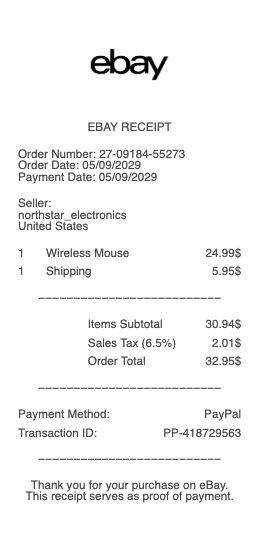
• Online sellers (Etsy, Shopify, eBay) issuing custom receipts for direct-to-customer or in-person events
• Resellers and consignment shops documenting purchase from a customer or sale to a customer
• Shoppers reconstructing the date, store, and amount of a purchase already on a credit-card statement, for personal expense tracking
• Business owners reconstructing a record of small business supplies bought at a major retailer when the original receipt is lost
• Self-employed professionals tracking deductible business purchases (office supplies, electronics, furniture, software) for Schedule C
• Small landlords and real-estate owners documenting deductible repairs and improvements purchased at a hardware retailer for Schedule E
What to include in a retail receipt
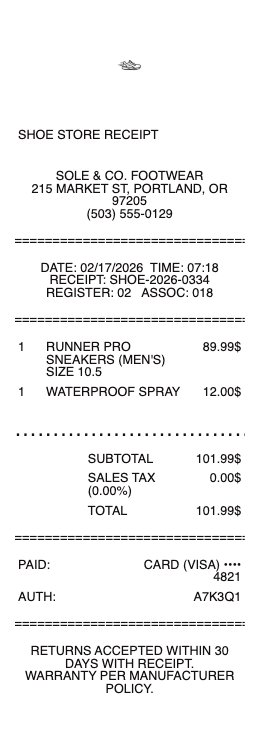
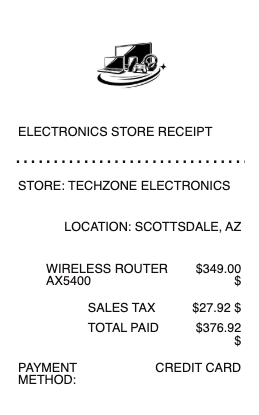
A retail store receipt has fields that distinguish it from a service or restaurant receipt — multiple SKUs, a register number, an associate ID, and store-specific tax handling.
• Store name, full street address, and phone number
• Store number (and store group, for chain operators)
• Register number and associate or cashier ID
• Date and time of transaction
• Receipt or transaction number
• Itemized line items — description, SKU or UPC, quantity, unit price
• Subtotal
• Sales tax, broken out separately by rate (some states tax clothing differently from general merchandise)
• Total
• Payment method — cash, card type and last 4 digits, store gift card, EBT/SNAP, store credit
• Discounts, promotions, or coupons applied with reference codes
• Return policy summary at the bottom (chain-specific)
How to fill out a retail receipt
1. Open the retail receipt generator and pick the layout (general retail, grocery, electronics, or apparel)
2. Enter the store name, address, phone, and store/register/associate IDs
3. Add the date and time of the transaction
4. List each item with description, SKU/UPC, quantity, and unit price
5. Apply discounts and promotion codes
6. Enter the local sales tax rate (or fixed amount) — most receipt formats break out sales tax separately
7. Confirm subtotal, tax, and total
8. Add payment method
9. Click Download to export as PNG or JPG
Sales tax on retail receipts
Sales tax handling on retail receipts varies sharply by state and by product category:
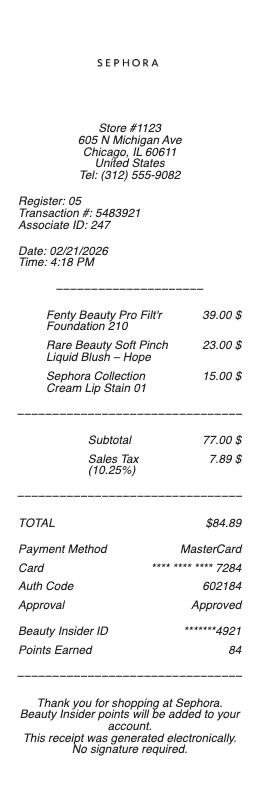
• State sales tax rates (2026) range from 0% (Alaska, Delaware, Montana, New Hampshire, Oregon) up to 7.25% (California base; many California cities reach 10.25% with local additions)
• Clothing exemption states — Pennsylvania, New Jersey, Massachusetts, Minnesota, Vermont, Rhode Island all exempt most clothing from sales tax
• Grocery food exemption — most states exempt unprepared grocery food from sales tax; prepared foods are typically taxed at the regular rate
• Local additions — many cities and counties add local sales tax on top of state. NYC adds 4.5% on top of 4% state for 8.875% combined
• Tax holidays — many states have annual back-to-school and emergency-preparedness tax holidays during which retail purchases are temporarily exempt
• Online vs in-store — after South Dakota v. Wayfair (2018), online retailers must collect sales tax in any state where they have economic nexus, regardless of physical presence
Returns, refunds, and receipt requirements
Major retailers have very specific receipt rules for returns. The original receipt — issued by that retailer’s own POS — is always the gold standard. Common variations:
• Walmart — most items: 90 days with receipt; 14 days for electronics; 30 days for cell phones; some items (firearms, prescriptions) non-returnable. No-receipt returns are limited and tracked
• Target — most items: 90 days with receipt; 365 days for Target-owned brands; 30 days for electronics. Returns without receipt are tracked via card-lookup or ID
• Costco — generous return policy on most items; 90 days for electronics; original receipt or membership card lookup
• Best Buy — 15 days for most products with My Best Buy account; 60 days for Elite, 30 for Plus. Mobile devices restricted to 14 days
• Home Depot, Lowe’s — 90 days for most items with receipt; some categories (special-order, perishables) non-returnable
Producing a fabricated receipt to a major retailer for a return, refund, or warranty claim is felony fraud — most chain retailers run loss-prevention programs that compare receipts against POS records and will identify mismatches. Always use the original.
Retail receipts and your taxes
For business and personal tax purposes, retail receipts feed several deduction and credit categories:
• Schedule C — self-employed business expenses: supplies, equipment, software bought at retail. Itemized receipt is preferred over a card statement for amounts above the IRS $75 substantiation rule
• Schedule E — rental property repairs and improvements bought at a home-improvement retailer. Receipts distinguish deductible repairs from depreciable improvements
• Form 5695 — energy-efficient home improvement credit (heat pumps, insulation, doors and windows). Retail receipts substantiate the qualifying purchase
• Schedule A — itemized deductions for state sales tax (in lieu of state income tax) where retail receipts substantiate paid sales tax
• Casualty-loss deduction — receipts for property destroyed in a federally declared disaster substantiate the loss
Recovering a lost retail receipt
• Walmart, Target, Costco, Home Depot, Lowe’s, Best Buy all offer credit-card or membership lookup at the customer service desk for transactions usually within 60–90 days
• Online purchases at the same retailer’s website always have a digital receipt in your account history
• Card statements show the date, amount, and store name — useful for tax purposes if the original is lost, but generally not accepted by the retailer for returns
• Apple, Microsoft, Adobe, Best Buy purchases often have warranty registration linked to your account that re-creates the original receipt
• For business/tax records, photograph or scan every retail receipt the day of purchase — thermal-paper receipts fade unreadable within 6–12 months
Download formats
Every retail receipt exports as PNG or JPG. Both work for personal records, attaching to small-business expense reports, uploading to bookkeeping software, and emailing to your accountant.
Generate your retail receipt now →
See also: Walmart Receipt · Target Receipt · Best Buy Receipt · Walgreens Receipt · Starbucks Receipt · Home Depot Receipt · Lowe’s Receipt · Amazon Receipt · Apple Receipt · Sephora Receipt · CVS Receipt · Whole Foods Receipt · Kroger Receipt
Legal disclaimer
Any Receipt Generator does not validate, certify, or verify the authenticity of any generated document. This tool is provided strictly for legitimate purposes — independent and small store operators issuing receipts to their own customers, and shoppers reconstructing a record of in-store purchases they actually made and paid for at any retailer.
The following uses are strictly prohibited: producing a receipt for goods that were not purchased; inflating the amount, quantity, or items on a receipt; submitting a fabricated receipt to a major retailer (Walmart, Target, Costco, Home Depot, Lowe’s, Best Buy, Macy’s, Apple, or any other chain) for a return, refund, exchange, store credit, price-match, or warranty claim; submitting a fabricated receipt to support a Schedule C business expense, a Schedule E rental-property deduction, an energy-efficient home improvement credit (Form 5695), a casualty-loss deduction, or any other tax filing; submitting a fabricated receipt to a corporate expense system (Concur, Expensify, Ramp, Brex), an insurance carrier, a court, or any third party; or any use intended to deceive, defraud, or mislead any retailer, retailer’s loss-prevention program, employer, accountant, tax authority, insurer, or other third party.
Federal & state law. Use of this tool to fabricate documentation or otherwise commit fraud may constitute violations of US federal law, including wire fraud (18 U.S.C.
1343), mail fraud (18 U.S.C.
1341), bank fraud (18 U.S.C.
1344), false statements (18 U.S.C.
1001), tax fraud (26 U.S.C.
7206), trademark counterfeiting (Lanham Act, 15 U.S.C.
1114), and parallel state criminal statutes (including state retail-theft, return-fraud, and organized-retail-crime laws). Penalties include fines up to $250,000 per offense, imprisonment, restitution, and civil liability. Major retailers actively prosecute return fraud through dedicated loss-prevention units and information-sharing networks (TRAC, the Retail Equation), and a single fabricated-receipt return can result in criminal charges and a multi-retailer ban.
No professional advice. Information provided through this tool is for general informational purposes only and does not constitute legal, tax, accounting, financial, or other professional advice. Consult a qualified professional before relying on any generated document for tax filing, claim submission, or any third-party transaction.
"AS IS" service; no warranty. Any Receipt Generator is provided "AS IS" and "AS AVAILABLE" without warranties of any kind, express or implied, including merchantability, fitness for a particular purpose, accuracy, completeness, or non-infringement. We make no representation that any generated document will satisfy the legal, regulatory, or evidentiary requirements of any specific jurisdiction, retailer, recipient, or use case.
Indemnification. By using this tool, the user agrees to defend, indemnify, and hold harmless Any Receipt Generator and its operators, employees, contractors, and affiliates from and against any and all claims, damages, fines, penalties, losses, costs, and expenses (including reasonable attorneys' fees) arising from or related to the user’s use or misuse of the tool, including violation of these terms, retailer return policies, trademark or counterfeiting law, or any other applicable law. The user assumes full legal responsibility for the accuracy and intended use of any files they generate.
Acceptance & Terms. By accessing or using this tool, the user acknowledges having read and agreed to these terms and to our Terms of Service and Privacy Policy. Continued use after any update to these terms constitutes acceptance of the revised terms.
Any Receipt Generator is not affiliated with, endorsed by, or authorized by Walmart, Target, Costco, Best Buy, Home Depot, Lowe’s, Macy’s, Sephora, Nordstrom, Kroger, Whole Foods, Trader Joe’s, Amazon, Apple, or any other retailer, retail trade association, or loss-prevention network. All trademarks, service marks, trade names, and brand references mentioned remain the property of their respective owners and are used only for descriptive reference purposes under the doctrine of nominative fair use.